
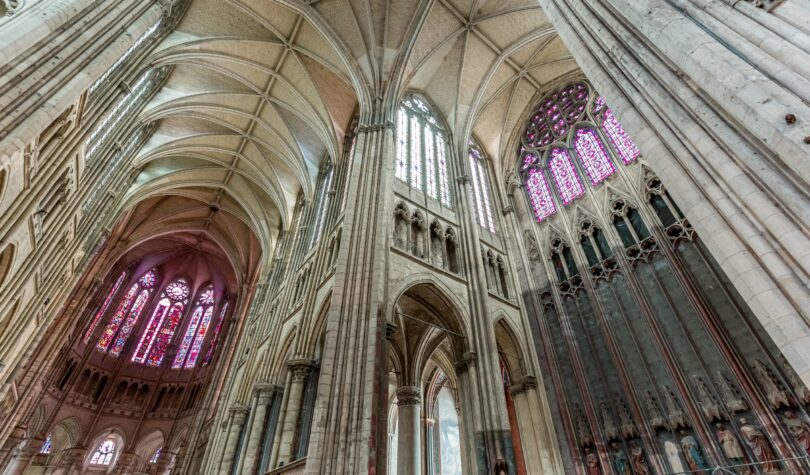
French Catholics in Saint-Quentin are pushing back hard against a planned round of “escape box” games inside the Basilica of Saint-Quentin, warning that a church built for worship is being turned into a playground. Their objection is not just about taste, but about the deeper question of whether a sacred place can be treated like a venue for secular entertainment without losing something essential.
The basilica itself carries serious weight. Dating to the 12th century and housing relics of Saint Quentin, the site is not some generic old building with nice stonework. For believers, it stands as a living witness to history, prayer, and sacrifice, which is exactly why the planned events struck such a nerve.
A letter from faithful Catholics asked Father Matthieu Saur, the basilica’s pastor, to stop the events before they went ahead. The same appeal was also sent to Father Bernard Proffit, who serves as diocesan administrator for the Diocese of Soissons, Laon, and Saint-Quentin. The tone of the letter was blunt, with the writers making clear they saw the plan as a serious offense, not a harmless bit of fun.
The “escape box” setup is aimed at children ages 12 and up and gives participants an hour to solve puzzles and unlock a mysterious box in the Saint-Fursy Chapel. Organizers describe it as a way to “uncover the secret of the Basilica,” and several sessions had already taken place in July. More dates were lined up for August, and the fact that some were sold out only sharpened the frustration of those opposed to it.
What angered the Catholic signatories most was the setting itself. They argued that the event would bring “indiscreet exploration of the sacred precincts, disorderly wandering, loud verbal outbursts, laughter, shouting.” That kind of language makes the concern plain: the issue is not merely noise, but the collapse of reverence into spectacle.
“During these four days, the sacred character of the place will be seriously compromised, which is the very definition of the word ‘desecration,’” the letter warned. That line captures the heart of the backlash, since the faithful are saying the basilica is being used in a way that cuts against its purpose. For them, the problem is not whether the activity is popular, but whether it belongs there at all.
The Church’s own teaching gives the complaint extra force. In the letter, the faithful point to a 1987 Vatican document that says churches exist first as places for the people of God and for the sacraments, not as public entertainment spaces. They also cite Canon 1210, which says only things that support worship, piety, and religion are allowed in a sacred place.
French law also enters the picture. The signatories refer to Article 13 of the 1905 law separating Church and state, arguing that a place of worship should not be diverted from its religious purpose. In other words, the complaint is grounded not just in emotion, but in a mix of canon law and civil law that both point in the same direction.
The controversy fits a wider pattern that many Catholics across Europe have noticed for years. Churches are increasingly being treated as multipurpose venues, with sacred spaces used for events that have little to do with prayer or worship. That trend may grab attention in the moment, but it also leaves a lot of believers wondering why consecrated places are expected to absorb every cultural experiment that comes along.
For many Catholics, the Saint-Quentin dispute is about more than one event or one basilica. It speaks to a larger struggle over whether faith still sets limits, or whether those limits get brushed aside whenever organizers call something creative, family-friendly, or modern. In a place built around reverence, that question is landing with real force.
