
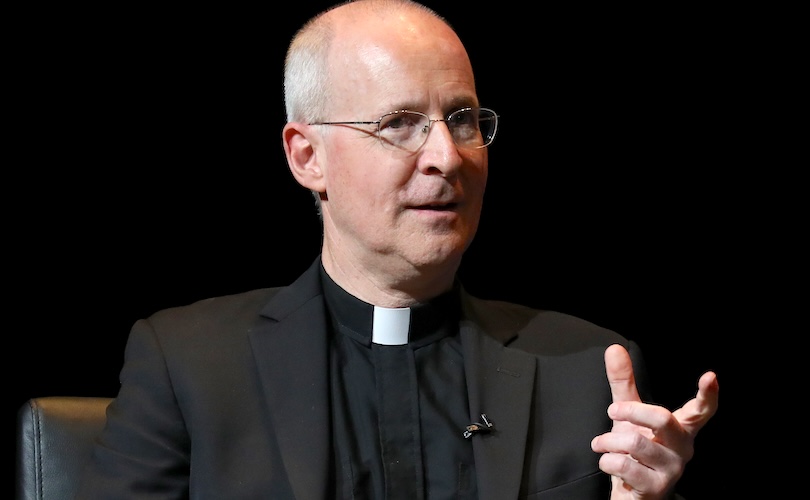
Fr. James Martin is once again at the center of a fight over Catholic identity, this time after arguing that homosexual men should be admitted to seminaries and ordained to the priesthood. His case runs straight into long-standing Church teaching, which says men with deep-seated homosexual tendencies are not to be admitted to holy orders. That clash is the heart of the dispute, and it is what makes his latest commentary so hard to ignore.
In his essay for Outreach, a site that presents itself as an LGBTQ Catholic ministry, Martin said that keeping gay men out of the priesthood can push them away from vocations or force them to hide in seminary life. He went so far as to say that, for “gay men who feel called to priesthood,” his answer is “yes.” For supporters, that is framed as inclusion. For critics, it reads like a direct challenge to Catholic teaching and a push to blur a line the Church has long kept clear.
The Vatican’s 2005 instruction is blunt about the issue. It says the homosexual inclination is “objectively disordered” and “incompatible with the priesthood,” and it says the Church “cannot admit to the seminary or to holy orders” men with “deep-seated homosexual tendencies.” That language is not vague, and it is not new. It reflects a view that the priesthood is meant to be ordered around discipline, celibacy, and fidelity to doctrine, not social pressure or cultural trends.
Martin tried to soften the picture by pointing to the many priests he has known over the years whom he describes as celibate gay men living faithful lives. He wrote that they have served as spiritual directors, pastors, professors, and mentors, and he said they embodied “good, holy and celibate” lives. That argument leans heavily on personal experience, but it does not change the fact that the Church’s rule is about admission and formation, not just individual stories.
He also objected to the idea that homosexual priests would remain private about their sexuality. In his view, the Church keeps the subject hidden through embarrassment, bad data, confusion, and fear of stigma. He argued that there is a kind of “unspoken reality” inside chanceries, seminaries, and rectories, and he suggested that silence around the topic is part of the problem rather than a sign of prudence.
To drive that point home, Martin recounted a conversation with a seminarian in Rome who allegedly told him that half of his classmates were gay but none would say so publicly because it could lead to expulsion. The anecdote is meant to show that the issue is more common than Church officials admit. Still, anecdote is not proof, and it does little to erase the Church’s concern about the spiritual and moral formation of candidates for ordination.
The discussion also drew on a 2024 study tied to Notre Dame and Georgetown that looked at how dioceses and seminaries evaluate men for ordination. Martin highlighted the finding that 22 percent of bishops surveyed said they were comfortable ordaining a man with deep-seated same-sex attraction if he were firmly committed to celibacy. That number is notable, but it also shows a divide between some bishops and the stricter Vatican standard that remains on the books.
Martin was especially critical of language used by the study’s authors, Rev. Thomas V. Berg and Professor Timothy G. Lock, who wrote that many priests know firsthand how painful it can be to try to live celibately while dealing with same-sex attraction. Martin objected to what he saw as a troubling idea of “overcoming” homosexuality itself rather than simply resisting temptation. In his telling, the bigger issue is not attraction but the way the Church talks about it.
That is where the argument gets sharper. If homosexuality is treated as an identity to be affirmed, then ordination starts to look like a debate about inclusion and representation. If the Church’s teaching is treated as binding, then the conversation shifts back to discipline, discernment, and the demands of priestly life, which is exactly where many Catholics insist it belongs.
Martin’s essay has stirred fresh debate because it touches one of the most sensitive fault lines in the Church right now, especially around the priesthood, celibacy, and moral authority. The tension is not going away any time soon, and neither is the pressure from voices trying to redefine what the Church can say, and who it can call to serve at the altar.

6 Comments
This so called Catholic Father is about as holy as Judas Iscariot at the Last Supper. He kissed Jesus in betrayal. This priest is doing the same to Jesus today. As Judas never received forgiveness for his sins, I suspect this priest will not be forgiven for his betrayal of what the Bible says pertaining to homosexuality and perversions as outlined by Paul the Apostle.
This man’s teachings is an apostasy and those who support his efforts will be sharing in the Lake of Fire. There is no Purgatory after death, only judgement.
Gee, I thought most of them were gay. He must want some fresh meat.
Warped, Twisted and Stupid! What is this moronic suggestion by Fr. Martin, his version of DEI in the Catholic Church! Go away already you Globalist Shill for the New World Order Diabolical Plan to Deceive and bring on the False Church!
Leviticus 18:21-22…”21You must not give any of your children to be sacrificed to Molech, for you must not profane the name of your God. I am the LORD. 22You must not lie with a man as with a woman; that is an abomination.”
Between this sacrilege and the industrial scale abortion industry with now 68 Million human babies destroyed since 1973 in the United States alone and closing in now on 2 Billion globally!
Judgment and the conclusion of this material world is right at the doorstep knocking very hard to give a final wake-up call!
How this Martin can consider himself a man of the cloth is insane and I say quite evil!
Matthew 7:14-16 “14But small is the gate and narrow the way that leads to life, and only a few find it. 15Beware of false prophets. They come to you in sheep’s clothing, but inwardly they are ravenous wolves. 16By their fruit you will recognize them. Are grapes gathered from thornbushes, or figs from thistles?…”
Such men are morally inept and not qualified according to God’s own words to be leaders or shepherds of the Church and flock!
He’s trying to set up ANOTHER ROUND of Altar Boys under demonic attack from Catholic priests.
When you don’t learn from history…….or you are Alphabet yourself…… or you belong to Satan……..
So many human beings now belong to Satan in this sick twisted world these End Times!
How is this “priest” even still in the priesthood? Pope Leo recently excommunicated members of St. Pious X Society for wanting to use the Latin rite for Ma;ss. This fellow, who should already be gone, should certainly be next with all the folks who “thinks” as he does.