
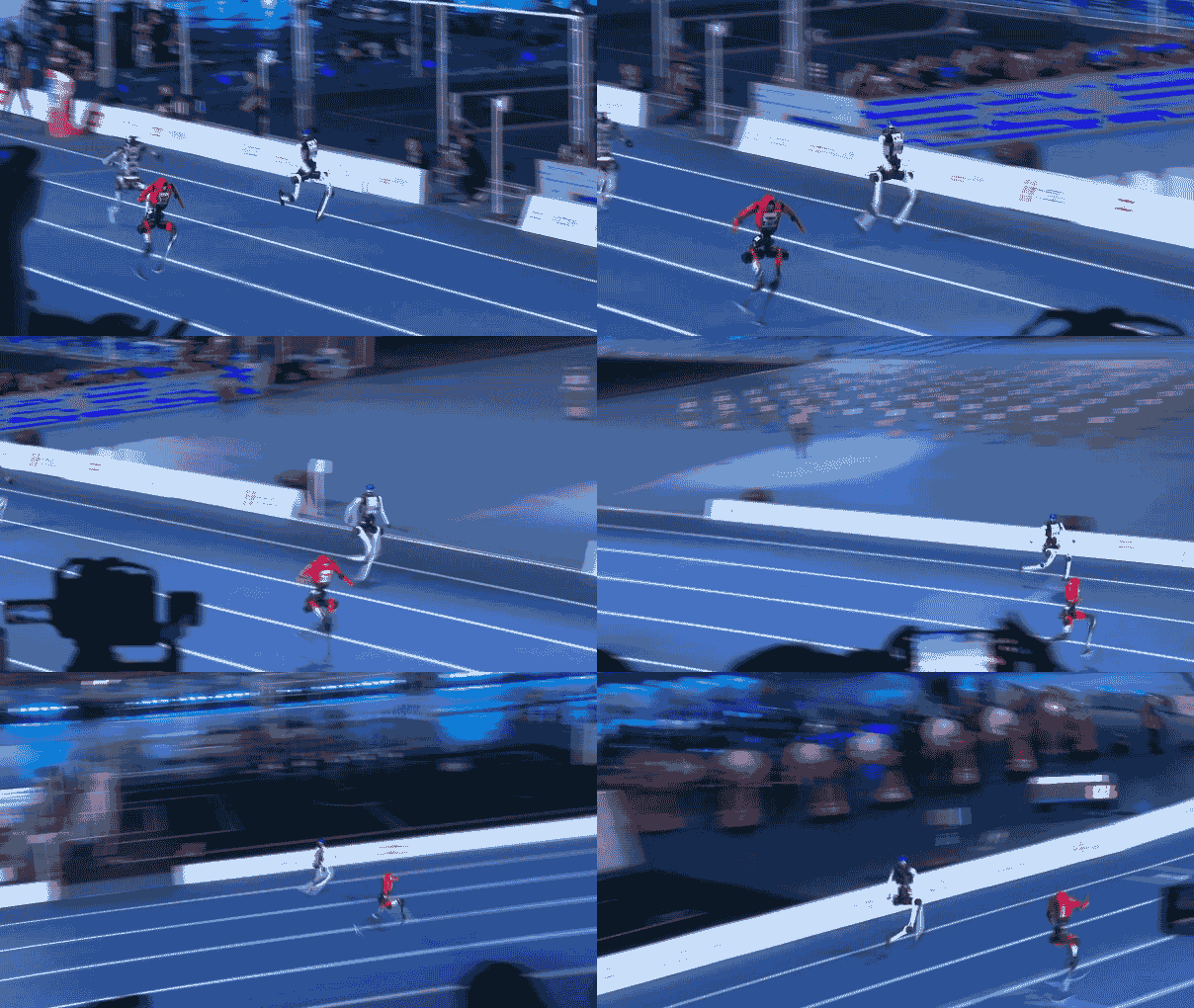
The World Humanoid Robot Games delivered a strange, thrilling mix of speed, chaos, and proof-of-progress, with robots sprinting, crashing, sparking, and sometimes looking more like props in a slapstick sketch than polished machines. Behind the viral clips, though, was a real milestone: humanoid robots are getting dramatically faster, and the people building them are now racing to make them smart enough to handle the world they are entering.
Christian Hubicki, a Florida State University robotics professor and former Survivor contestant, said the point of the event was never subtle. It was built to push robot speed to the edge and see what happened next, which, as the footage showed, often meant dramatic wipeouts and hard stops into padded walls. The spectacle made for great clips, but it also showed how far mobility has come in a very short time.
That speed was impossible to ignore. One humanoid, Tiangong Ultra, clocked 8.64 seconds in the 100-meter final, a mark that left Usain Bolt’s long-standing human record in the dust. The number turned heads worldwide, but Hubicki said the achievement came with a giant asterisk, because getting a robot to sprint is one thing and getting it to finish the job gracefully is another.
That gap is exactly where the funny part of the games turned into the serious part. Robots were shown flying down tracks, then slamming into barriers, losing limbs, or getting hauled away after spectacular failures. Hubicki said the machines were being pushed hard enough that the event felt less like a polished competition and more like a stress test for a technology still learning basic coordination.
His view was simple: the motors, gears, and joints are already strong enough to outclass people in raw movement. The real challenge is the brain, or at least the version of one that can keep a humanoid upright, aware, and useful in real life. That is why the games mattered so much, because they showed what happens when performance gets ahead of judgment.
The event featured more than 2,000 robots from 666 teams and stretched across 51 different disciplines. Along with races, there were task-based events meant to mimic factories, restaurants, offices, and emergency settings, which gave the whole thing a practical edge beneath the neon chaos. It was not just about winning medals, but about proving these machines can be trained for useful work.
Hubicki said that artificial intelligence is helping, but only up to a point. Robots still rely heavily on human direction, external sensors, and tightly controlled instructions, especially in events like tennis or racing where every motion has to be carefully choreographed. The systems can move with astonishing precision, but they are still not thinking in the flexible, common-sense way people do.
That limitation was easy to see in the most chaotic moments. A robot that cannot understand its surroundings, react to unexpected obstacles, or stop when a situation changes is impressive in a lab and awkward in the wild. Hubicki described that as the difference between a machine that can sprint and a machine that can truly live in the real world.
The whole thing also exposed a bigger truth about robotics right now: the race is no longer about whether humanoids can move fast enough. They can. The bigger question is whether they can become reliable enough to do work safely, consistently, and without turning every interaction into a near-miss.
Even the viral disaster moments helped make that point. From robots stumbling during athletic events to machines struggling in more complex challenges, the games showed a technology that is advancing fast but still feels brittle at the edges. That tension, between dazzling progress and obvious weakness, is what made the Beijing competition impossible to look away from.
For all the slapstick, the future on display was serious. The next leap will not just be about making humanoids quicker or stronger, but about teaching them to handle surprise without falling apart. That is where the real race is headed, and the machines are already out of the starting blocks.
