
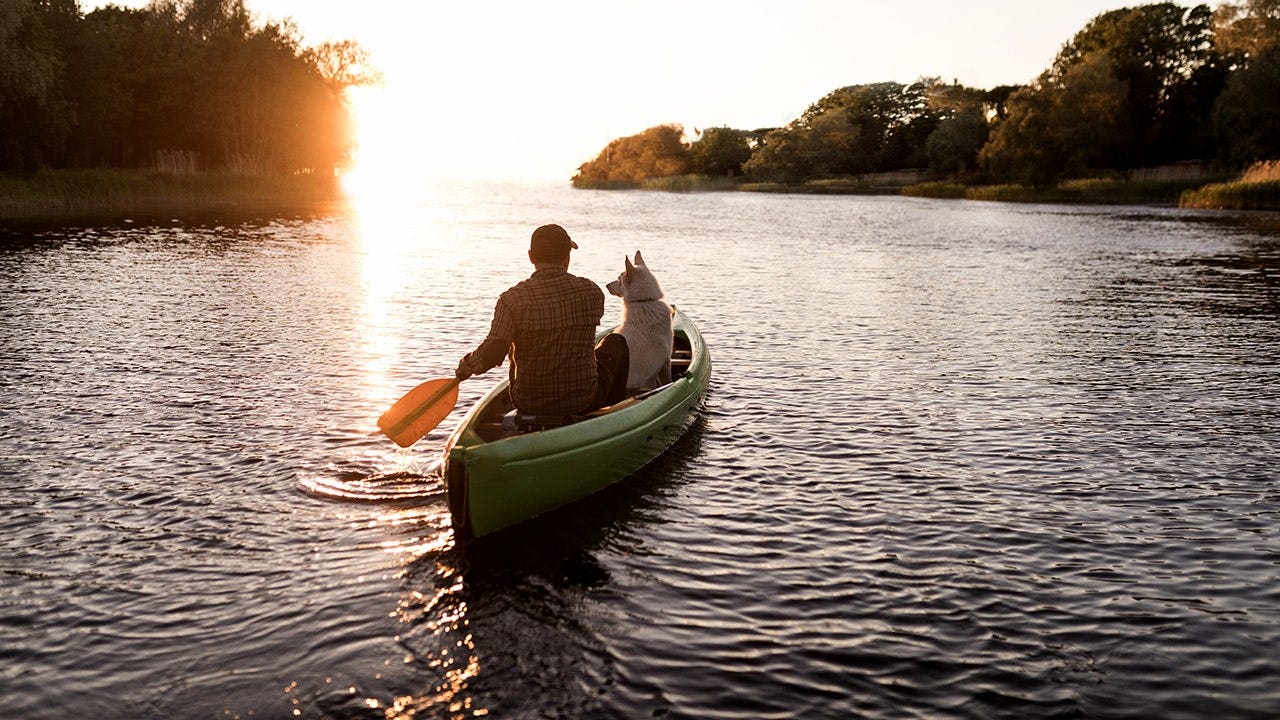
A 67-year-old cancer survivor turned a hard-won second chance into a bold river adventure, paddling more than 2,000 miles down the Missouri River with his dog, Amos, after beating a rare blood cancer. Frank Carter’s story mixes grit, treatment, and recovery with the kind of raw determination that makes an ordinary trip feel almost cinematic.
Carter, who lives in Orange County, Florida, spent 64 days traveling in a cedar-strip canoe he built himself. The route stretched from Montana to the St. Louis area, and the pair camped along the riverbank while pushing through rough weather, including storms, strong winds, and hail.
Before cancer entered the picture, Carter was already used to big physical challenges. He had spent months hiking the Appalachian Trail and later rode a bicycle across the country, so endurance was never the issue. Then, after a routine 5K race in 2021, he noticed something was wrong and kept feeling drained instead of bouncing back.
He described the moment with plain honesty: “I was wiped out. I just wasn’t recovering,” Carter told FOX 13 News. “I went to my doctor, had blood tests. Long story short, in two weeks I was getting chemo.”
That led to a diagnosis of mantle cell lymphoma, a rare cancer that affects white blood cells. Carter underwent 15 rounds of chemotherapy in Orlando, and while the treatment made a big dent in the disease, doctors later found signs that it was still hanging on.
He then headed to Moffitt Cancer Center in Tampa for CAR T-cell therapy, a newer immunotherapy approach that works by taking a patient’s own immune cells, training them to recognize cancer, and putting them back into the body. Dr. Michael Jain explained the idea simply: “We take those T-cells and genetically engineer them by putting something called a CAR into them,” Jain told FOX 13 News. “Now these T-cells can see the tumor and get rid of it, where before the tumor was able to hide from it.”
That single infusion changed the trajectory of Carter’s life. He has now been cancer-free for four years, and that milestone helped fuel the decision to take on the Missouri River trip with Amos riding along for the whole journey.
The bond between the two runs through every part of Carter’s recovery. He brought Amos home just before beginning chemotherapy, and he has said the dog gave him something steady to hold onto during a period that could have easily swallowed him up.
“After my cancer diagnosis, I told myself I was going to beat this, and I really wanted a dog during the process,” Carter told Moffitt’s Endeavor publication. “I got Amos right before my first treatment.”
That choice turned out to mean more than comfort. Amos became part of the rhythm of treatment, recovery, and eventually the river journey, a calm presence beside him as he proved to himself that life after cancer could still be active, demanding, and full of motion.
Carter’s path also reflects how much cancer care has changed for some patients. Chemotherapy remains tough, but therapies like CAR T are giving certain people new options when the disease does not fully back down the first time.
His river crossing was more than a personal challenge. It was a long, windblown reminder that recovery does not always look quiet or careful, and sometimes it shows up in a canoe, with a dog nearby, one river bend at a time.
