
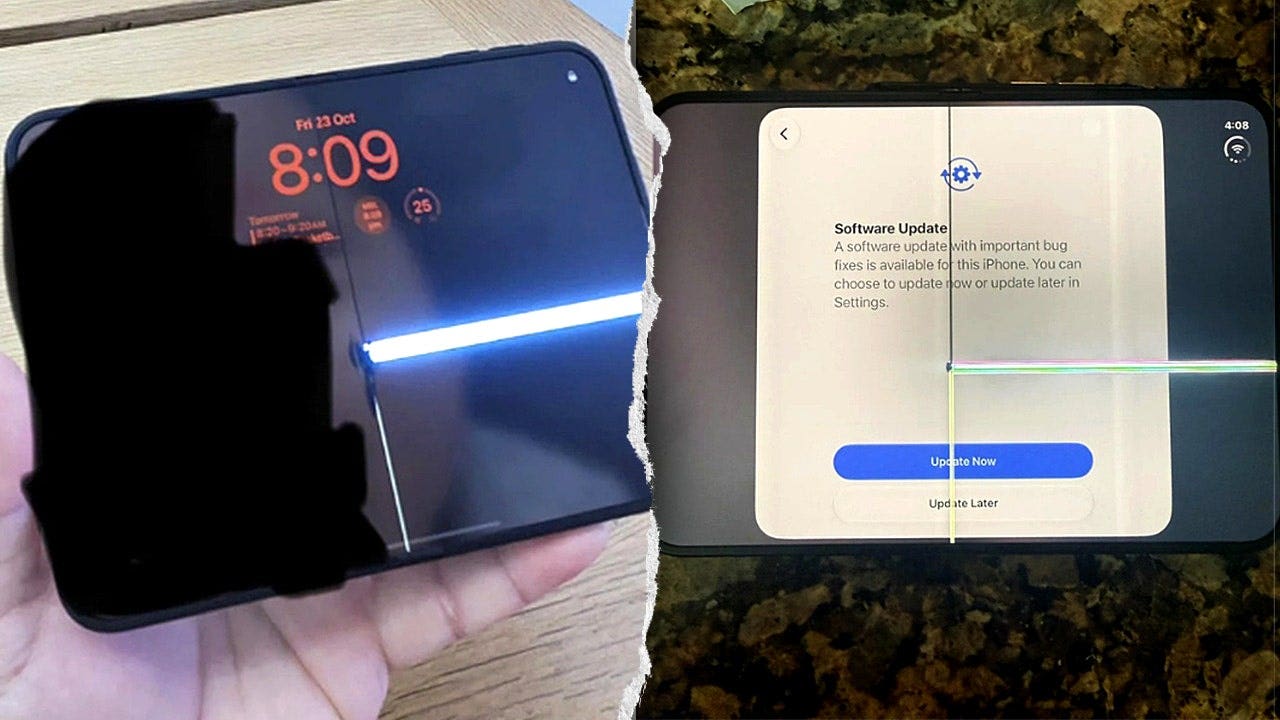
Apple’s first foldable iPhone landed with plenty of hype, but some early buyers are already reporting cracked inner screens near the hinge. The pricey new device, called the iPhone Duo, has drawn fast attention for all the wrong reasons, with complaints piling up within days of launch and Apple now acknowledging that a small number of units are affected.
The phone officially hit the market on Oct. 23 with a starting price of $1,999, and the timing of the reports has been hard to ignore. Owners say the damage showed up after very light use, sometimes after only a few folds, with some describing odd noises before the display gave out and bright white lines cutting across the panel.
That kind of failure is especially rough on a device pitched as a premium leap forward. The iPhone Duo opens into a 7.6-inch screen, giving buyers tablet-like space in a phone-sized package, while the closed form factor uses a 5.4-inch outer display for everyday use. Apple had spent years building anticipation, so the early wave of screen trouble has landed like a gut punch.
Reports shared online have pointed to damage in nearly the same spot, right around the fold. Several owners posted photos showing a crack or a line of dead pixels running from the center fold toward the edge, which makes the pattern feel more than random bad luck. For customers who paid top dollar, the idea that the same weak point could keep showing up is a seriously ugly look.
Apple has now said it is aware of the problem and is offering replacements for affected customers. The company has not said how many phones are involved or explained what is actually triggering the failures, which leaves a lot of questions hanging in the air. There is still no clear word on whether this is a design flaw, a manufacturing issue, or something tied to a specific batch.
One of the biggest questions is why the damage seems to happen in the same area. Repair analysts who looked inside the device used CT scans and teardown work to inspect the hinge, and they found a small support bar that may not clear the screen as cleanly as it should when the phone folds. If pressure builds in that spot, it could help explain why the cracks are appearing where they are.
That idea is still just a theory, but it is the kind of theory that makes foldable fans uneasy. A flexible screen is supposed to bend without drama, not buckle after a few casual openings and closings. When a device is this expensive, even a hint of a hinge problem feels like a major red flag.
Repair costs add another layer of pain. The inner display is not an easy or cheap fix, and the out-of-warranty repair price has been pegged at $999, which is a huge chunk of the phone’s value. AppleCare is the first stop for people affected by the acknowledged defect, though that does not mean every screen issue will be covered the same way.
Anyone who bought one of these phones and notices resistance in the hinge, a pop, or an unusual sound should treat that as a warning sign. Forcing a foldable open and closed just to test it is a bad move, especially if the display already looks stressed. If the screen starts showing cracks or bright lines, documenting the damage and backing up data right away becomes the smartest play.
The situation has also sparked a broader debate about whether the iPhone Duo is actually ready for prime time. Some early users liked the concept but still found the experience clunky, missing features they expected and feeling underwhelmed by the overall polish. That matters because a $1,999 phone has to do more than just look futuristic, it has to feel rock solid in hand and hold up under normal use.
For Apple, the challenge now is bigger than swapping out a few broken displays. Buyers who were excited to jump into a foldable iPhone are watching closely to see whether replacement units fare better and whether the company can explain what went wrong without brushing off the concerns. At this price, confidence is everything, and right now the Duo still has some proving to do.
