
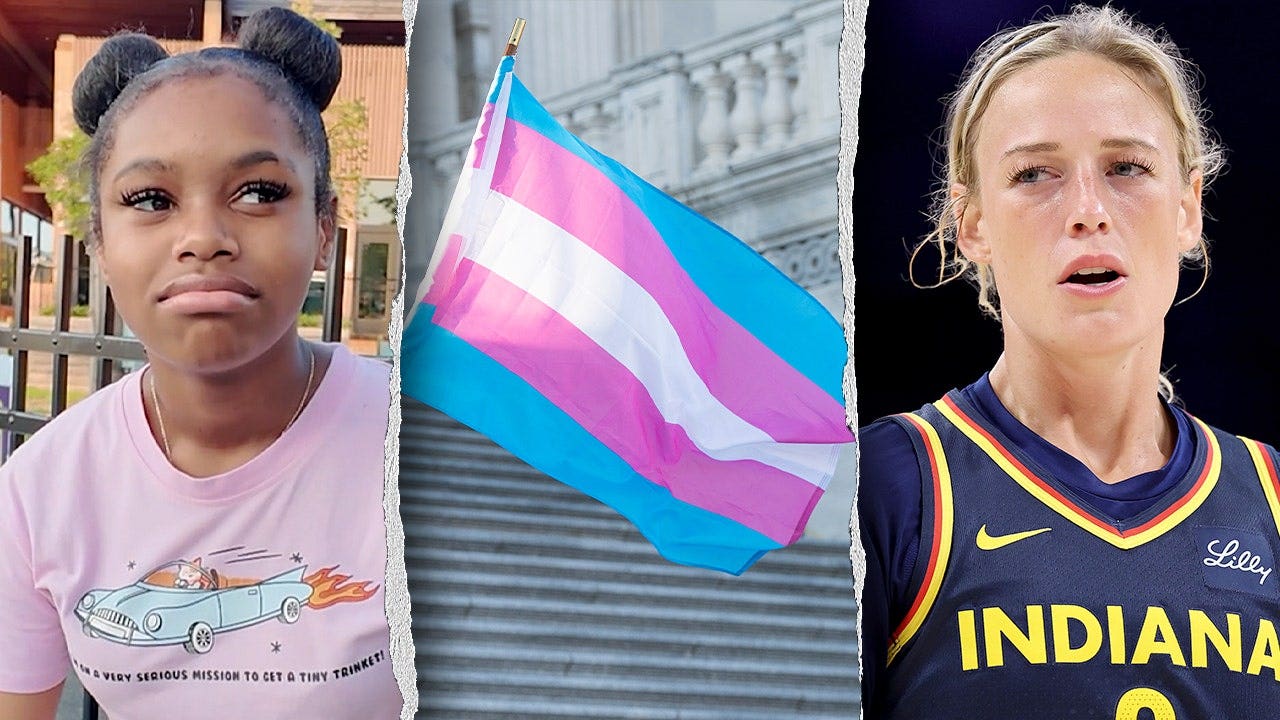
• Transgender athletes in women’s sports remain deeply divisive
• Fairness, physical advantage, and inclusion sit at the center of the fight
• Public reaction splits sharply between support and backlash
• Sophie Cunningham’s comments pushed the debate into the sports spotlight
• The issue has spread from politics into professional basketball
Americans are still split down the middle on transgender athletes competing in women’s sports, and the tension around the issue keeps rising. What sounds like a simple question about inclusion quickly turns into a fight over fairness, safety, and whether women’s competition still means what it used to mean.
Some people see the answer as obvious. A Washington, D.C. resident put it bluntly: “It’s all right if you wanna be what you wanna be, but you shouldn’t be competing against a woman and you’re a man,” while adding, “Biologically, it’s an advantage.”
That concern shows up again and again in conversations about the subject. Critics argue that no amount of identity language can erase the reality of size, strength, speed, and other physical differences that can shape competition at every level.
Others see the matter very differently. They argue that transgender women should be allowed to compete in the sport that matches who they are, and they reject the idea that fairness can only be protected by drawing a hard line at birth sex.
“I feel like a transgender woman should be able to play in women’s sports,” another person said. “They might have been a man before, but they’re trans. They’re changing into a woman, so why not play a woman’s sport? Like they’re not gonna let her play men’s sports.”
The argument has also become a bigger cultural flashpoint because it is no longer stuck in policy talk and school board meetings. It now lives in the mainstream, where every new comment from an athlete, coach, or public figure gets blown up instantly.
That is exactly what happened after Indiana Fever guard Sophie Cunningham weighed in and sparked another round of controversy. Her remarks, which focused on protecting young girls in locker rooms and in sports, drew quick backlash from people who saw her comments as exclusionary.
Cunningham pushed back on the criticism and said she was not attacking anyone’s identity. “I got a lot of negative feedback about me hating trans,” Cunningham said to ESPN. “And I’m like, ‘I never once said that.’ I think that I am here to extend love.”
She continued, “But I also think with that love is truth, being honest. And I want to protect young girls in a locker room, or young girls in sport who shouldn’t have to go against biological men.”
That kind of language lands hard because it taps into a broader fear among many parents and athletes. For them, the issue is not abstract at all, but something tied to scholarships, roster spots, safety, and whether girls are being asked to compete on uneven ground.
Supporters of inclusion argue that the backlash itself is the problem. From their view, banning transgender athletes is less about competition and more about targeting a small and already vulnerable group that is trying to live openly.
The conversation also keeps circling back to the Women’s National Basketball Player’s Association, which tried to balance diversity with a warning against being used as a political tool. Its message praised the backgrounds of players in the league while saying the league would not be dragged into partisan games.
Still, the noise does not fade. The debate has become one of those rare issues that can flip from a locker-room argument to a national shouting match in a matter of hours, with each side convinced the other is refusing to face reality.
Even the wildest comments keep feeding the fire, including claims that someone could simply identify into the WNBA and test the league’s rules. That kind of talk may sound exaggerated, but it reflects how far the issue has pushed past sports and into the culture war lane.
For plenty of Americans, the frustration is less about politics and more about trust. They want rules that feel clear, consistent, and honest, especially when the stakes involve girls’ sports and the future of competition.

2 Comments
Can not change biology or make XY into YY. muscle mass, bone structure, lung capacity all make males physically heavier, faster, taller, leading to an unfair advantage. A number of females have already been injured when having to compete with trans in NON-contact sports. Solution: let trans only compete with other trans
These broke dicks are in it for the money. They are mediocre at best as a male athletes, cut from the teams and without pay they are looking for a life line, pay check.