
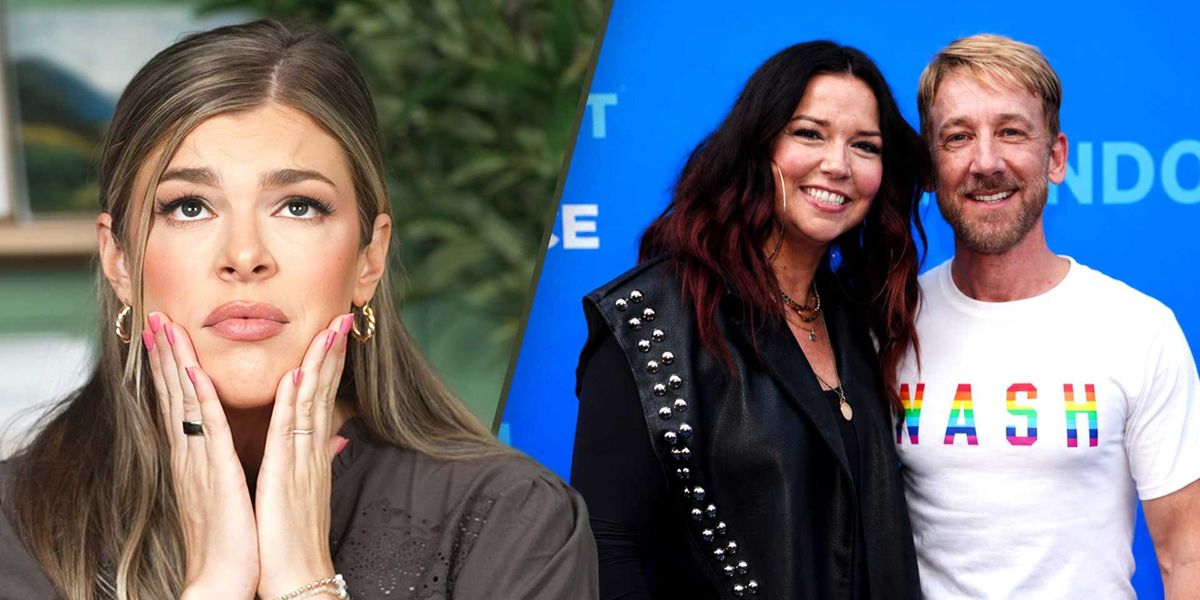
Allie Beth Stuckey reacts to a recent reworking of the Christian song “Testify to Love” after one of Avalon’s former members joined a new version and described the project as a message that “LOVE is for everyone.” The story touches on band history, a personal dispute over membership, and a broader debate about how religious songs and their meanings are being interpreted today.
BlazeTV host Allie Beth Stuckey recalls growing up with Avalon and the way “Testify to Love” became a familiar Christian anthem. Her reaction is sharp when she says artists and audiences now assign fresh meanings to songs that felt straightforward for a generation. That cultural shift troubles her because it changes how people see long-standing religious work.
Stuckey pointed to a post by former Avalon member Melissa Greene describing a re-recording: “‘Testify to Love’ drops today, originally recorded by Avalon, re-recorded by Michael Passons, Ty Herndon, and me. On Wednesday, we shot the music video. At the end of it, the three of us looked at each other, proud, and ultimately saying LOVE is for everyone.” Greene’s framing is plain and unapologetic, and it prompted a public response.
Stuckey frames the new version as retroactively assigning a queer meaning to the song. “Here’s some bad news. Now, we are being told retroactively that ‘Testify to Love’ by the CCM band Avalon is actually an anthem of queer love,” she explains. “I am not joking that this is now an LGBTQ-affirming anthem,” she adds, arguing the reinterpretation redraws boundaries people assumed were fixed.
The backstory includes Michael Passons, a one-time Avalon member. Stuckey recounts that Passons was removed from the group after he identified as gay, and she references his account: “In 2020, Passons appeared on an episode of a podcast and said that his bandmates visited his home and told him he was no longer allowed to be in the group because he was homosexual.” Those old wounds factor into why the re-recording landed with such force.
Greene’s comment that Passons “never needed to be redeemed” caused Stuckey to react. “Uh-oh,” she says, noting that this kind of language suggests moral certainty on one side and moral revision on the other. The exchange highlights how reunion projects and public statements can reopen debates about faith, forgiveness, and community standards.
At the heart of Stuckey’s response is a theological point about moral truth. “This phenomenon of believing that we are actually nicer than God, that we’re wiser than God, that we’re more compassionate than Him, that Romans 1 is too mean, that Genesis 1:27 is too cruel, that 1 Corinthians 6 is just too harsh, that passages that positively affirm the holiness of marriage between one man and one woman and the exclusive holiness of sexual activity within that marriage between one man and one woman,” she says, “it’s just too much to bear.” She argues the problem lies in human reinterpretation rather than in scripture itself.
Stuckey also tackles the idea that some forms of love should be judged differently. “If you are talking about a grown-up loving a child in a way that is inappropriate, that kind of love is unacceptable. I’m not even making the comparison of pedophilia to LGBTQ right now. That’s not the point. I’m just saying that in principle, like you understand, the logic that some love isn’t acceptable actually does hold water,” she says. Her point is meant to draw a line between consent, protection, and moral categories.
She closes by insisting on humility before religious texts. “The truth is that we are not nicer than God. We don’t know better than Him. We’re not more compassionate than Him. And if something to us seems wrong or seems cruel or seems confusing when we go to the word of God, the problem is not with God,” she continues. “It’s not with His word. It’s with us,” she adds, urging readers to consider whether cultural shifts should override long-held religious teachings.
