
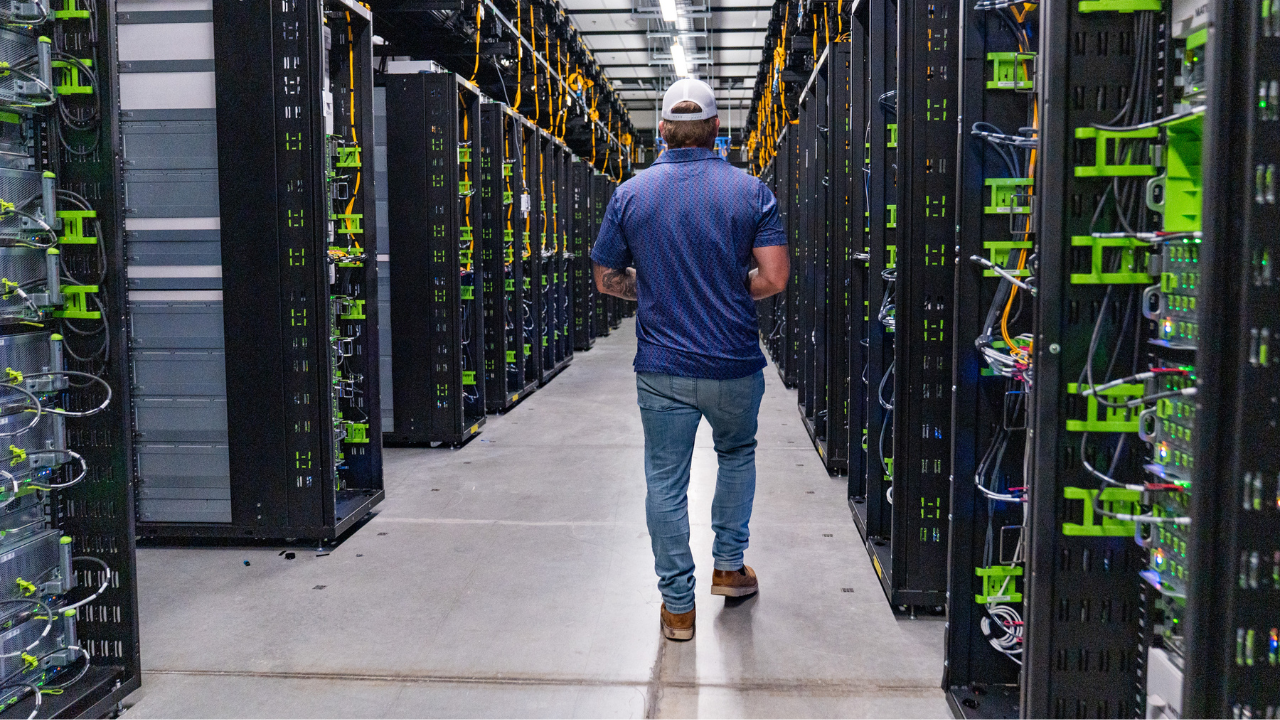
America’s AI boom is barreling forward, but the pressure it puts on power grids, water supplies, land, and local communities is getting impossible to ignore. The country needs the technology to stay competitive, yet working families also need a fair shot at sharing in the gains instead of carrying all the strain. That tension now sits at the center of the debate over how AI infrastructure grows, who benefits, and what kind of deal communities are willing to accept.
Every few weeks brings another massive announcement about a new data center, and the scale keeps jumping higher. The hype usually lands on the innovation, the capital, and the race for speed, while the places hosting these projects are left staring at higher utility demands and a changed landscape. For a lot of Americans, that is where the excitement starts to look a lot more like a gamble.
The U.S. cannot afford to sit out the AI race. China is treating artificial intelligence like a national priority, pouring resources into a technology that will shape military power, scientific progress, and economic strength for decades. If America drifts behind, the consequences will reach far beyond Silicon Valley and into every corner of national security and commerce.
But winning in AI is not just about chips, capital, and flashy model releases. It also depends on whether the public believes the whole system is fair enough to support. If people feel they are being asked to shoulder the cost while a few wealthy zip codes capture most of the reward, the backlash will not be subtle.
That problem gets sharper because AI does not feel like earlier waves of innovation. Railroads, factories, and the internet each disrupted life, but they also opened up new work and new wealth in ways that were visible to regular families. AI threatens a lot of middle-class jobs, including roles in software, design, accounting, marketing, and legal work, which makes the anxiety personal instead of abstract.
This is why the usual arguments fall flat so quickly. Some people want to tax everything and redistribute the winnings, while others promise that breakthroughs will magically lift everyone at the end of the road. Neither answer gets at the real issue, which is that workers do not hate progress, they hate being told progress no longer has a place for them.
The communities hosting AI infrastructure are starting to ask harder questions, and they should. A data center that runs for decades should leave behind more than a few temporary construction jobs and a pile of headlines. If a town is giving up land, water, electricity, and political goodwill, it deserves something durable in return.
That means thinking bigger than a ribbon-cutting event. Better local power systems, job pipelines through community colleges, apprenticeships that lead to real careers, and opportunities for local students and startups all matter more than polished public relations. When the project is over, the benefit should still be there, living in the town instead of disappearing into quarterly earnings calls.
There is also a bigger lesson here for every industry that asks communities to make room. Extractive businesses learned long ago that taking resources without giving back eventually creates resistance that no amount of branding can fix. AI companies are heading straight toward the same wall if they ignore the people and places making their expansion possible.
That is where the idea of social license becomes more than a buzzword. It is the real permission slip that lets transformation continue, and it can vanish fast when trust breaks down. Once that happens, local governments tighten up, zoning fights erupt, and projects that looked unstoppable begin to stall.
The future of AI in America will probably be built, and built fast. The harder part is making sure the country still feels like it has a stake in that future. If the technology keeps advancing while ordinary people feel pushed aside, the backlash will not wait politely at the end of the line.
