
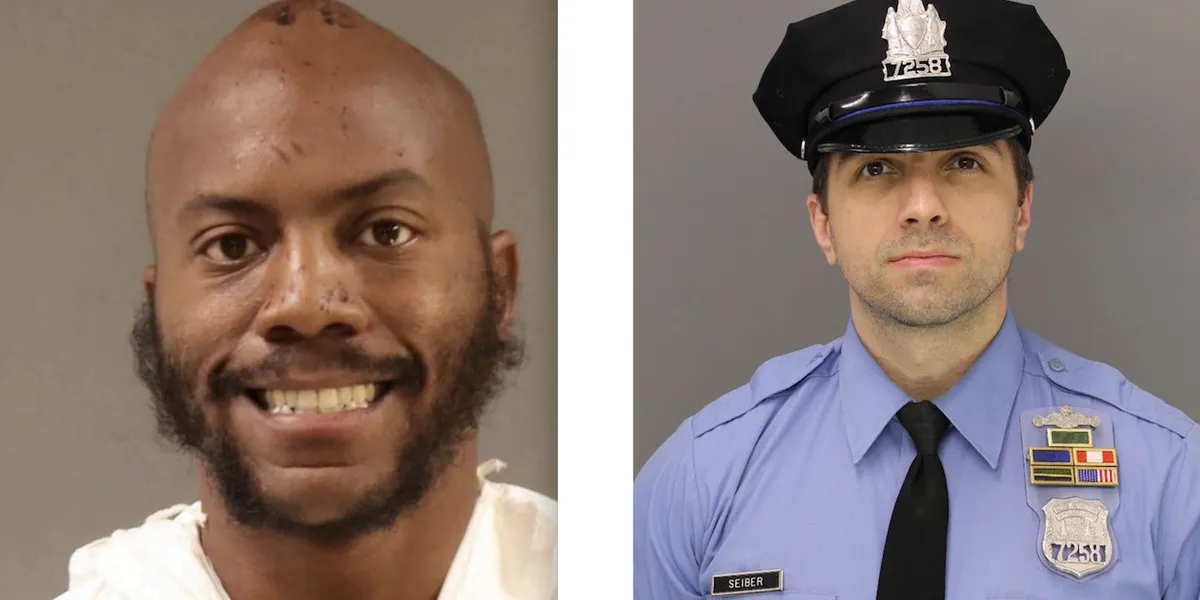
The killing of Philadelphia Police Officer Shane Seiber has shaken the city and put a harsh spotlight on the danger officers face in an instant. A suspect identified as Eric Lewis is at the center of the case, and the details have left a lot of people angry, stunned, and looking for answers.
The reported ambush took place in a setting where officers are supposed to be able to do their jobs and make it home alive. Instead, the violence ended with a police officer dead and a family left carrying a loss that is impossible to measure. Seiber was not just a badge, but a husband and a father of two young children.
That part of the story hits hard because it strips away the headlines and shows the real cost of a crime like this. A wife is suddenly left without her partner, and two children are left to grow up with a hole that can never be filled. It is the kind of tragedy that spreads far beyond one street corner or one police district.
The suspect’s image has also fueled outrage, especially because the case has been described in terms that suggest a cold lack of remorse. When a law enforcement officer is allegedly targeted in an ambush, the public reaction is usually immediate and unforgiving. People see more than just a crime scene, because they see an attack on the basic order that keeps communities from sliding into chaos.
Police work already comes with enough uncertainty without the added threat of being hunted. Officers answer calls, check suspicious situations, and walk into danger with only split seconds to react. When violence escalates into an ambush, it sends a message that every routine encounter can turn into a deadly trap.
Cases like this also force a larger conversation about how quickly violent crime can reshape a city’s mood. Residents want safety, families want stability, and officers want to know that the people they serve will stand behind them when the worst happens. A fatal attack on a cop is not just another crime statistic, because it lands in the middle of neighborhoods, precincts, and homes all at once.
Philadelphia has dealt with plenty of headlines involving violence, but the death of an officer always carries a different weight. It cuts through the noise and reminds everyone that public safety is not an abstract debate. It is the difference between a child seeing a parent at breakfast and a child waiting for a parent who never comes back.
The investigation now carries serious stakes, not only for the suspect but for a department and city that are demanding accountability. In a case like this, details matter, timelines matter, and so does the message that follows. Communities notice whether justice moves quickly, whether it moves fairly, and whether it treats the loss of an officer with the gravity it deserves.
For Seiber’s loved ones, none of that legal process will undo the damage already done. What remains is grief, the long aftermath of a sudden death, and the painful reality that a family’s future has been torn apart in a moment of violence. That is the part that lingers long after the sirens fade and the scene is cleared.
And for the people who wear a uniform every day, the case is another reminder that courage often comes with a brutal price. Some jobs ask for patience, some ask for skill, and police work can demand both while standing in the line of fire. When an officer is killed in an ambush, the city is left staring straight at that truth.
