
Genesis AI says its new GENE-26.5 system brings a robotic brain, a human-scale dexterous hand, and a cheaper glove-based data pipeline together to teach robots fine manipulation. The company pitches this as a full-stack approach that moves robots beyond repetitive single tasks toward multi-step, human-like handling. This piece walks through how the system works, why matching human hands matters, and where the company expects to deploy the technology first.
Genesis AI built GENE-26.5 to act as the control center for robot behavior, merging software and hardware into a unified stack. “Think of GENE-26.5 like a robotic brain that takes in information and tells the robot what to do,” Gervet said. “It is the industry’s most advanced robotic brain, with the most advanced capabilities. We’ve proven this by releasing a few videos showing GENE-26.5 powering the most complex tasks ever performed by robots.”
At the heart of the pitch is a dexterous robotic hand designed to mirror human form and function, paired with a glove that captures motion and pressure. “The glove system helps us directly transfer information about how human hands move to our robot hands,” Gervet said. When humans wear the glove and interact with objects, the system logs fine-grained movements so the robot can learn the same motions.
Data is the other half of the equation. “We’ve developed a way to feed GENE-26.5 massive amounts of data about how human hands move, so it can tell our robotic hands exactly how to move like a human’s hands,” Gervet said. “GENE-26.5 can also tell our robotic hands how to do tasks with many, many steps.”
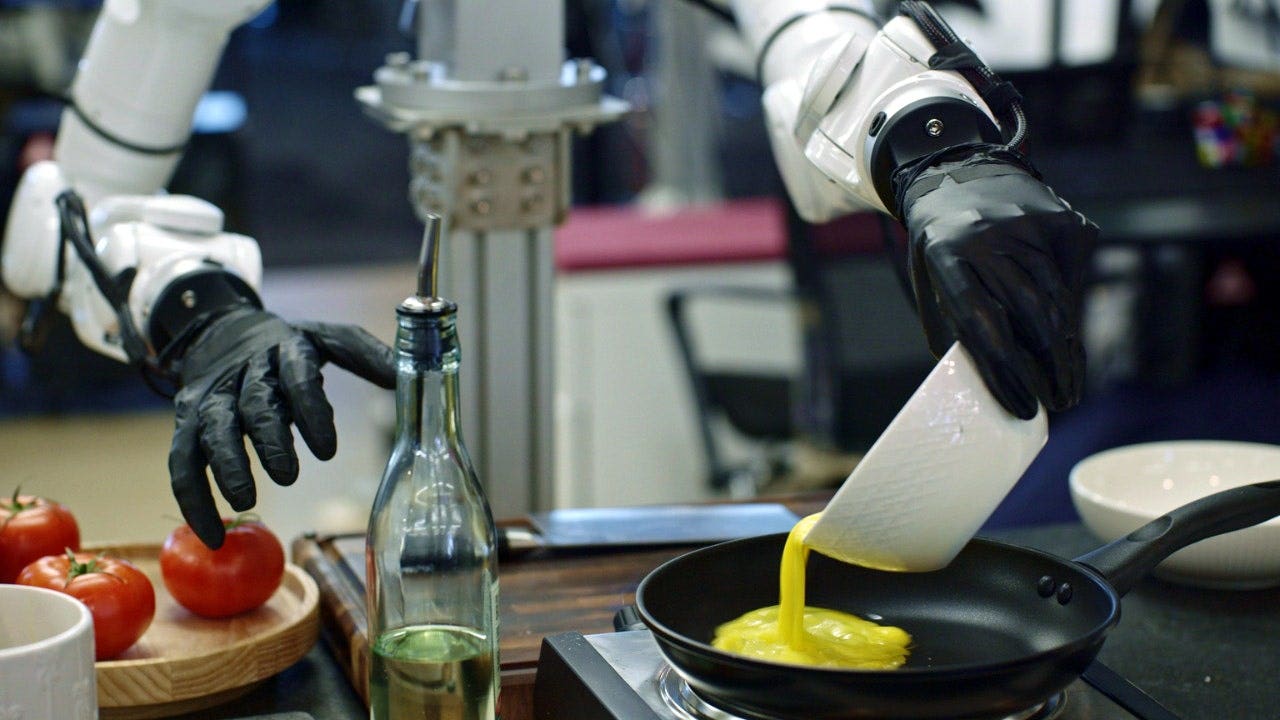
The company demonstrates complexity with everyday actions to make the case clearer. “For example, powered by GENE-26.5, our robotic hands can follow a 20-step process to make a full omelet from start to finish,” Gervet said. That example is meant to show coordinated sequences, not isolated gestures, and to signal the system can chain many delicate moves together.
Precision comes down to subtleties most people never notice during routine tasks. “Imagine you’re playing with a Rubik’s Cube. You have to hold it with the perfect grip strength. If you grip it too loosely, you’ll drop it.” The company points out that people constantly make micro adjustments while holding objects, and robots must do the same to avoid drops and slips.
“You may not even realize it, but your brain is taking notice of how the cube feels. Even if you’re just holding the cube, your hands are never perfectly still,” Gervet said. “They’re constantly making micro adjustments to make sure the cube doesn’t slip and stays balanced,” he said. “It takes a lot of complicated, intentional and coordinated movements that involve over 20 joints in your fingers, knuckles and wrists. Our robotic hands can do exactly that.”
Genesis AI also says its glove is far cheaper than typical options and more efficient at collecting training data. “When a human wears the gloves as they interact with objects or do their work, we can capture details about the exact movements their fingers and wrists make. Our robotic hands are built to exactly match a human’s hands, so that data works extremely well.” The company combines glove data, head-mounted camera video, and public footage to expand its dataset.
“Robots have always had a data problem,” Gervet said. “When you think about the AI chatbots you use on your computer, they have the entire internet to access.” He added, “The big problem comes from the fact that unless the robot’s hand exactly matches a human’s hand, any information you capture about how human hands move won’t translate well,” Gervet said. “We’ve solved this problem by creating a robotic hand that exactly matches a human hand.”
Simulation plays a major role in speeding development, letting models train on millions of scenarios before hardware trials. “Our technology goes through extensive testing and validation, first in simulation running millions of scenarios, then in controlled real-world environments,” he said. “It has to earn its way into the room.”
Initial commercial focus is industrial settings where repetitive or physically demanding work is common, with plans to move into service and home markets later. “To start, it can be deployed for industrial use in warehouses and for manufacturing logistics. We’re already having conversations with industrial customers.” Gervet envisions a phased rollout that begins on factory floors and could later include service roles and consumer products.
“The beauty of the technology is that it’s meant to fit seamlessly into the human world,” Gervet said. “Humans will still lead, but our reach won’t be limited by what we can do with our own hands.” If these robots can use ordinary tools and operate in human-designed spaces, adoption may accelerate in places that need extra hands for dull, dirty, or dangerous work.
