
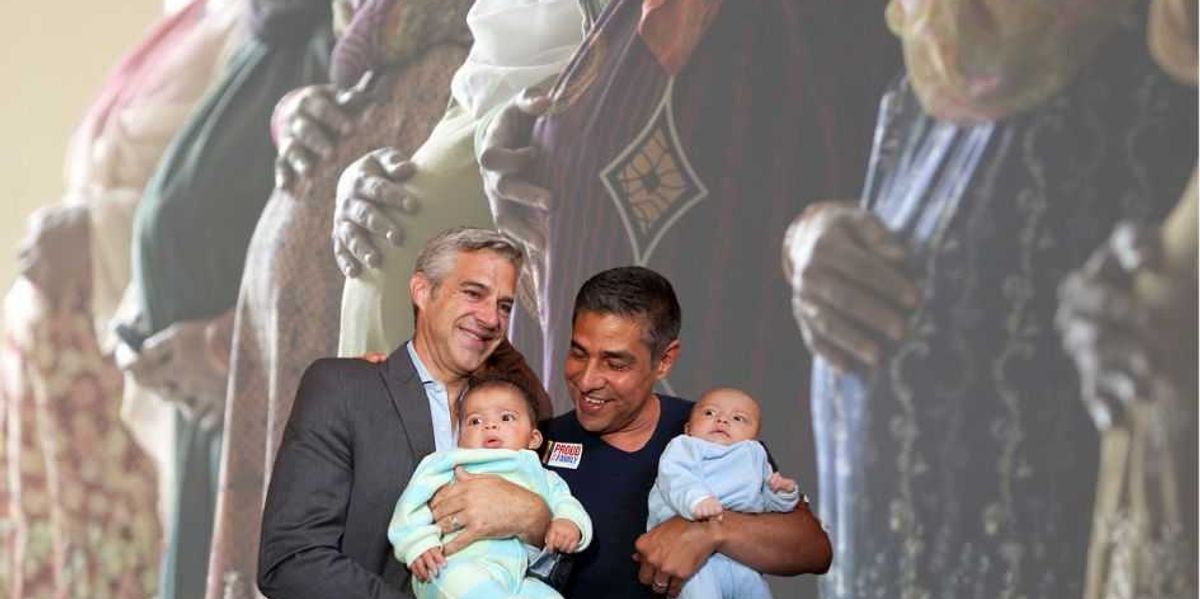
The viral clip of Shane McAnally and his husband asking their baby “Who do you want, Dada or Pop?” and the child calling out “mama” sparked a fierce reaction and reopened a hard conversation about modern family-making, surrogacy, and the legal choices that shape children’s lives. This piece looks at the moment, the deeper ethical and policy questions it exposes, and the Republican prescriptions for protecting kids by restoring traditional marriage, banning commercial surrogacy, and legally prioritizing a mother and father for each child. I will explain why this matters for children, sketch the problems with the current system, and lay out concrete legal changes to pursue. Read on for a direct Republican case that puts kids first and adults back in their proper role when creating families.
The video is simple and striking. “Baby has 2 dads… chose neither,” reads the caption, and when the boy cries out for “mama,” Michael Baum replies, “There is no mama,” as the men laugh. Many viewers did not see a quirky parenting moment but a sign of harm: a child instinctively reaching for the nurturer he will never meet. That instinct is worth taking seriously rather than dismissing as mere spectacle.
We are a decade into sweeping changes in law and culture that redefined marriage and expanded assisted reproduction, and the consequences are showing up in quiet, painful ways. When adults treat parenthood as a right to obtain a child rather than a responsibility to serve a child, the balance shifts toward adult wants. The question we must ask is simple and moral: who is the policy designed to serve, the adults or the child?
First, marriage matters because it structures parenting. For millennia societies organized childrearing around a man and a woman sharing the responsibilities of raising children, offering biological and social complements that matter for development. The Supreme Court decision in Obergefell v. Hodges changed the legal landscape overnight and left unresolved social questions about the best environment for children.
Advocates of traditional marriage argue that overturning Obergefell should be on the table if the priority is children’s well-being. This is not merely nostalgia. It is a policy position grounded in the belief that families built on complementary parental roles tend to produce better outcomes for kids. If public law makes marriage a choice that no longer privileges complementarity, then lawmakers should be candid about the trade-offs and willing to correct course.
Second, commercial surrogacy has become an industry that treats conception and birth as transactions. Paying for a pregnancy shifts the relationship between mother and child into contractual terms, and too often the surrogate and the child are left with limited legal protections. Contracts that dictate medical decisions or penalize refusal create an outsized incentive that can crush real autonomy at the moment it matters most.
Banning commercial surrogacy restores a clear moral line: the creation of human life should not be outsourced to markets where children are treated as commodities. Other countries have chosen that route, and so should the United States if the goal is to protect vulnerable people and prevent the commodification of children and the exploitation of women. This is about dignity and about refusing to let money rewrite the meaning of parenthood.
Third, the law must prioritize a child’s right to a mother and father whenever that is possible. Adoption and foster placement policies that favor adult convenience over long-term child outcomes are backwards. Courts and agencies should be required to put the child’s developmental needs first, giving clear legal preference to married mother-father homes unless there is compelling evidence to the contrary.
The moral case is also practical: children do best when they have stable, complementary parenting from both sexes. That reality should inform policy on adoption, custody, and reproductive technologies. It does not mean punishing loving adults, but it does mean shaping systems so children are not treated like accessories acquired to satisfy adult desires.
Watching that baby reach for a mother is painful because it exposes a preventable loss built into some modern family arrangements. As a parent myself, I see how mothers and fathers meet distinct needs that shape a child’s sense of security and identity. If public policy keeps drifting toward treating children as products and parental roles as optional, we will rack up more moments like this one—kids yearning for what law and markets have quietly taken from them.
