
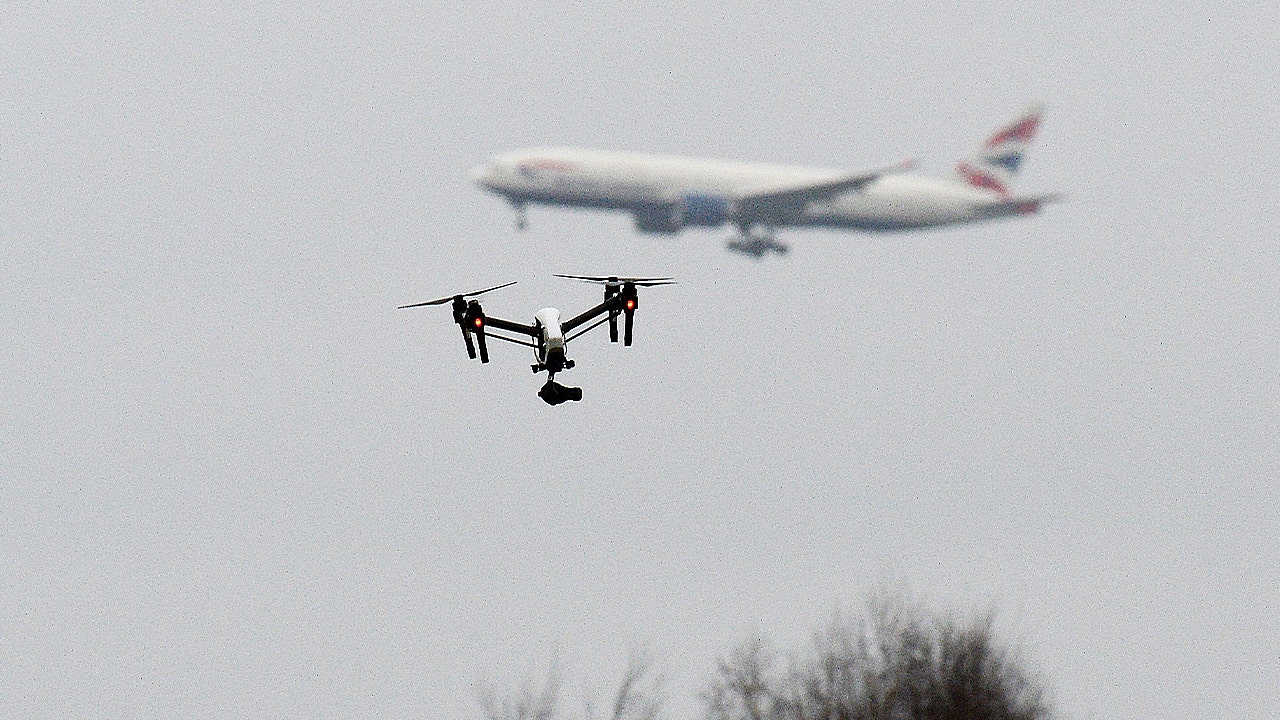
Recent drone incursions over high-value military sites prove a hard truth: if our best-defended bases can be probed, the everyday places that keep the country running are even more exposed. This piece lays out how cheap drones change the risk landscape, why current law and defenses lag, and what a Republican-minded response should prioritize. The need for layered, always-on protection for airports, power grids, ports and data centers is urgent and practical, not theoretical.
Incursions into sensitive installations show that hardened perimeters are no longer a guarantee of safety. When commercially available drones can skirt defenses, it’s a wake-up call for homeland security planners and infrastructure operators. We need to treat that wake-up as a call to act, not an academic debate.
Cheap, off-the-shelf drones are rewriting the threat playbook by lowering the cost of entry for bad actors. They can surveil, ferry contraband, and deliver explosives with surprising precision, and they scale fast. That shift turns civilian targets—airports, energy grids, ports, and data centers—into attractive, low-cost targets with high leverage.
We write from experience on both sides of the fence: one of us has spent decades in aerospace and defense building counter-drone systems, and the other helped shape security policy in Congress. That combination makes the threat feel immediate and solvable, provided policy and procurement move faster. Complacency is the real risk.
CHAD WOLF: CHINA’S AI MOCKERY SHOWS THE FIGHT FOR THE AMERICAS IS UNDERWAY This is not a theoretical trend; it is accelerating and it is pragmatic. Adversaries are experimenting openly, and we must respond with equal practicality.
Modern drones are adaptable and hard to see with legacy sensors. They operate low, slow and small—details that defeat systems designed to track missiles and manned aircraft. As the tools evolve, so do the tactics of terrorists, criminal networks and hostile states.
Our nation has invested heavily in high-end deterrence: carriers, advanced aircraft and missile shields that project power across the globe. Those capabilities remain vital, but they were designed for a different threat profile. Small, low-altitude drones expose a gap in the defensive architecture that policymakers ignored for too long.
IRAN NETWORKS SUFFER LOSSES AMID AIRSTRIKES, SHOWING DIGITAL EVOLUTION OF CONFLICTS The battlefield is changing and so is the tech that shapes it. We must recognize that digital and physical threats now intersect in ways that demand integrated responses.
Complicating defense is a legal framework that hampers timely action. Much of the airspace drones use overlaps with civilian zones where countermeasures face strict limits, and federal law often defines who can detect or neutralize a drone in ways that slow responses. Those rules didn’t anticipate the pace of commercial innovation or the realities of asymmetric threats.
DAVID MARCUS: WHY ARE WE LETTING FOREIGN FOES USE X PAYOUTS TO WAGE WAR AGAINST US? The comparison is apt: we would never let foreign interference run unchecked online, and we should not tolerate it in the skies over our infrastructure. Policy must catch up so defenders can act decisively when needed.
For many critical facilities, it is easier to buy and fly a drone than to legally stop one. Airports, ports and power plants often lack clear authority to engage a hostile unmanned aircraft without risking legal exposure. Meanwhile, the domestic supply chain for drones leans heavily on foreign-made components, which is a strategic vulnerability.
A drone doesn’t need to destroy infrastructure to cause havoc; a brief disruption is enough to cascade through supply chains, markets and public trust. A single temporary shutdown at a hub can ripple into broader economic damage and erode confidence in our ability to secure everyday life. That makes mitigation and resilience priorities, not luxuries.
Recent episodes make the stakes real: unauthorized drones penetrated the airspace over a major airbase, and Northern Command confirmed incursions over other strategic sites during critical operations. Those events underline gaps in detection, rules of engagement and rapid response. If it can happen to a base, it can happen to a city or port.
Washington has taken steps, including standing up interagency coordination and expanding counter-UAS authority in recent defense legislation, but the pace and scale are insufficient. Technology moves faster than law, and adversaries exploit that gap. A layered defense that combines detection, tracking, identification and mitigation is the only practical route forward.
Radio-frequency measures offer a cost-effective, scalable foundation, but they must be part of a broader, persistent posture that treats counter-drone like cybersecurity: always on and integrated into critical systems. The tools and talent exist in the private sector and government; what’s missing is urgency and the willingness to align policy with capability. We should not wait for a catastrophic event to motivate practical defense of the infrastructure Americans depend on.
