
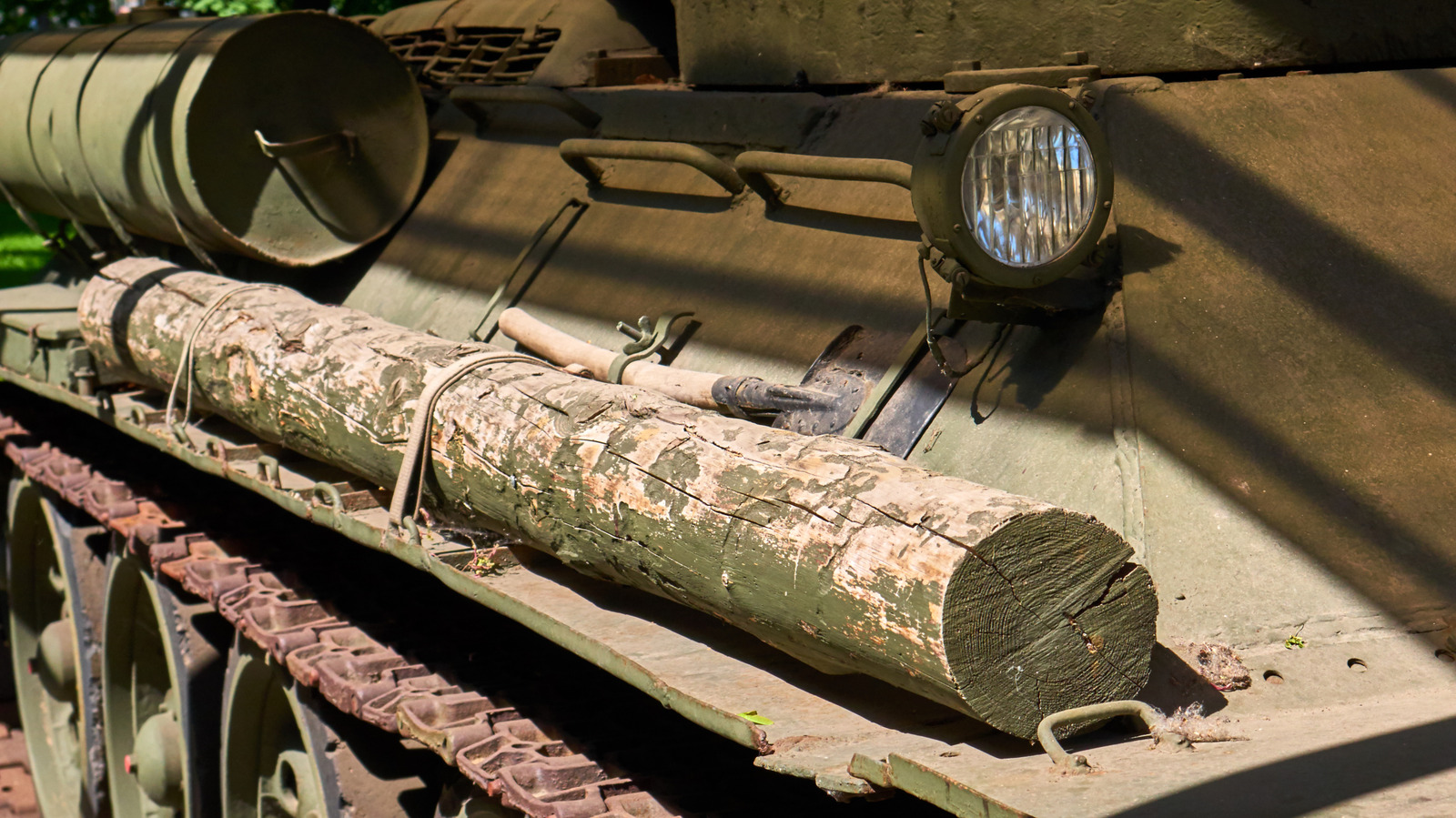
WWII tanks were often seen hauling logs, and the reason had a lot more to do with survival than looks. The wood could help vehicles claw their way out of mud, cross rough ground, and even offer a little extra spacing against certain kinds of enemy fire. That mix of practical use and improvised protection made the logs one of the war’s strangest but most recognizable field additions.
Tank crews and engineers were always hunting for ways to keep armored vehicles alive a little longer. Even the toughest machines could be knocked out by the right weapon from the right angle, so any extra layer of defense was worth a look. The result was a battlefield full of improvised fixes, including the odd sight of wooden logs strapped to steel hulls.
Protection was only part of the story, though, and not even the biggest part. Logs were also there to help tanks deal with bad terrain, especially when rain turned roads and fields into a mess of thick mud. As armored armies pushed across Europe, Asia, Africa, and beyond, crews needed every trick they could get just to keep moving forward.
Tanks were built with wide tracks for a reason, since spreading weight over a larger area helps keep them from sinking. But wet ground can still swallow a heavy machine, especially when a whole column has churned the earth into sludge. In that kind of situation, a log could be dragged under the tracks and create a firmer contact point, giving the tank the traction it needed to crawl out.
This was sometimes called “unditching,” and it could be a lifesaver for a vehicle that had sunk so deeply it was sitting on its belly. Once a tank got high-centered, brute force alone was not always enough to free it. A log, awkward as it looked, could turn a trapped hulk back into a moving weapon.
Some tanks carried logs on the outside specifically as extra armor, often along the sides or rear where protection could be thinner. American M4 Shermans were a common example, since they were famous and widely used, but they did not have the thickest armor on the battlefield. Crews hoped the wood might buy them a little more safety, even if they knew it was hardly a magic shield.
Against ordinary armor-piercing rounds, wood was not much of an answer. Those shells were built to punch through hard steel, not stop short because of a rough-cut timber bolted to the outside. If anything, the logs were more of a confidence boost than a real barrier in that kind of fight.
There was, however, a better case for logs when shaped charges entered the picture. HEAT rounds work by forcing an explosive blast into a narrow, focused jet that can rip through armor and spray destructive fragments inside the vehicle. That means distance matters, and even a crude extra layer can sometimes help by giving the blast a little more room to burn off strength before it reaches the hull.
That said, the idea was never foolproof. Logs were uneven, messy, and often mounted in a way that made their effect inconsistent from one tank to the next. They might help in one moment and do almost nothing in another, which is a pretty good description of a lot of wartime improvisation.
In the end, the logs were most valuable when the ground was the real enemy. They gave tanks a better shot at crossing mud, escaping ruts, and keeping pace with fast-moving operations. The fact that they also looked like something stolen from a logging camp only made the whole setup more memorable.
