
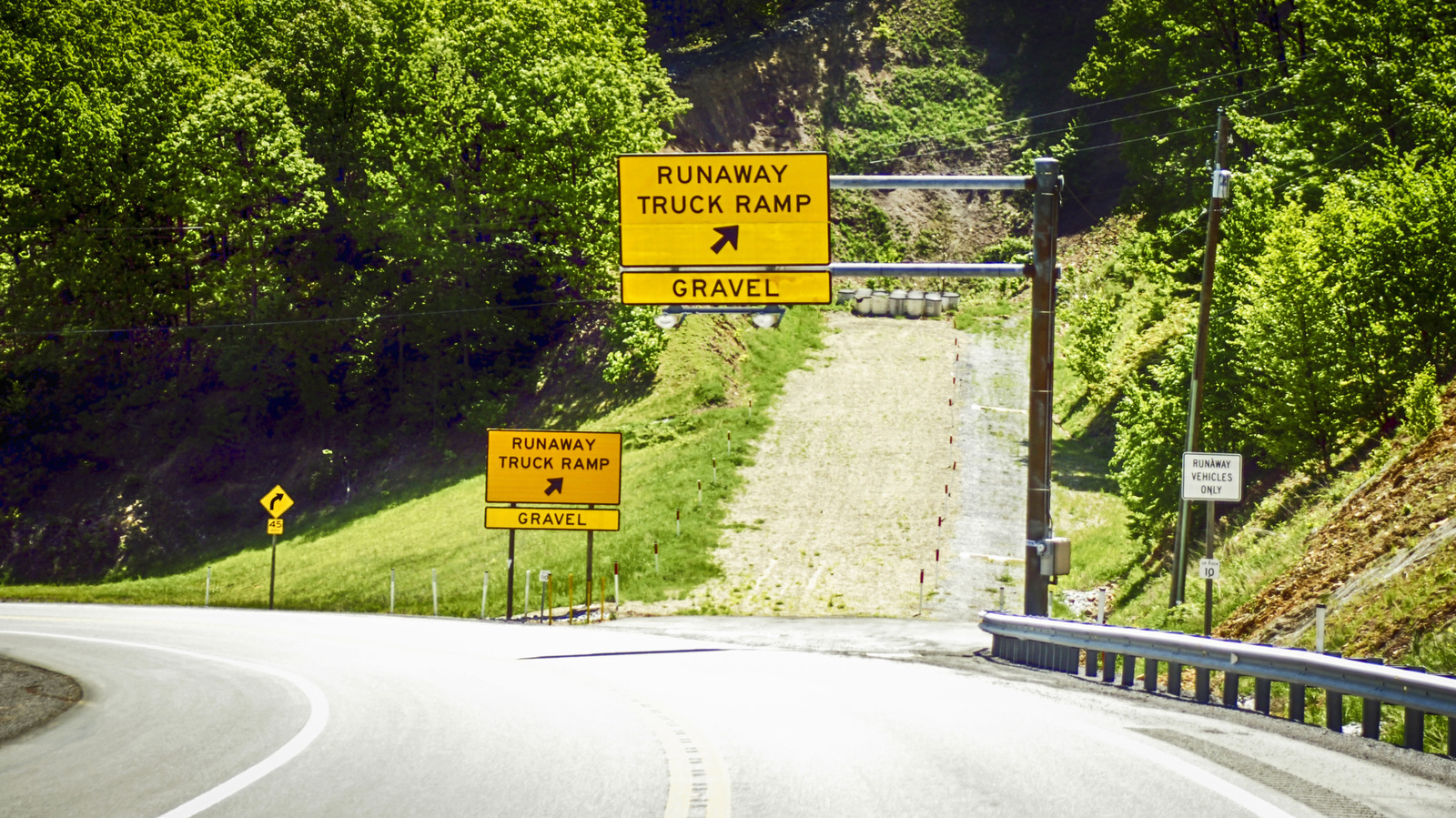
If you have ever spotted a “Runaway Vehicles Only” sign and done a double take, it is warning you about a very specific kind of emergency on steep roads. These signs point drivers toward escape ramps designed to slow and stop a vehicle whose brakes have failed, usually on long downhill mountain grades. The idea is simple, but the stakes are huge, because a heavy vehicle out of control needs a place to stop before it becomes a disaster.
They are most often built with trucks in mind, since big rigs carry serious weight and can pick up speed fast on a long descent. But passenger cars can run into brake trouble too, and when that happens on a mountain pass, there is no room for guesswork. The sign is there to make sure a driver knows that help is nearby and that the road has a built-in last resort.
These ramps are not just random shoulders or extra pavement. Most are packed with gravel or sand and angled uphill so the vehicle loses momentum while the material absorbs the force. It works a lot like trying to drive into deep, loose ground, except the whole setup is engineered to bring the vehicle to a controlled stop instead of letting it barrel ahead.
You will usually see these warnings in places where roads climb and drop through mountain terrain. Think of routes like Interstate 80 through the Sierra Nevada, Interstate 70 over the Eisenhower Pass, or the Grapevine on Interstate 5. Other well-known spots include Monteagle Mountain in Tennessee, Teton Pass in Wyoming, Mount Rose Highway in Nevada, and sections of Interstate 40 in North Carolina.
The need for these signs is not new. California opened its first runaway truck ramp back in 1956, and since then the concept has spread wherever steep grades and heavy traffic make brake failure a real concern. Engineers have kept refining the design, because the basic problem has not changed: gravity is relentless, and mountains do not care how carefully a driver started the trip.
Not every ramp looks the same. Some newer versions use energy-absorbing nets, reinforced walls, or breakaway systems instead of a deep bed of gravel. In El Paso, Texas, a modern setup along westbound Loop 375 was built to stop an extremely heavy truck at high speed, showing how far these systems have come from the older sand-and-gravel model.
That kind of design matters because not every mountain road gives engineers enough space for a long uphill escape lane. In tighter areas, the ramp may be flatter and much longer, giving a runaway vehicle more distance to bleed off speed safely. The goal stays the same no matter the layout: create friction, slow the vehicle down, and keep it from continuing into traffic or over the edge of the road.
Drivers sometimes hear terms like Jake Brakes and assume they solve everything, but steep grades can still overwhelm a truck if something goes wrong. A warning sign is not there for decoration, and it is not only for professionals who haul freight every day. It is a blunt reminder that mountain driving comes with a built-in escape plan, and if you ever need it, you will want to know exactly where to turn.
