
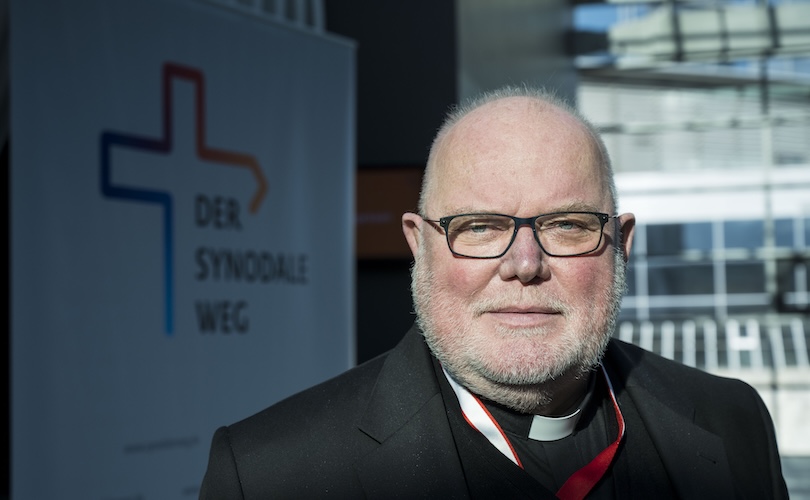
Pope Leo met with Cardinal Marx amid a public debate over how the Vatican handles pastoral care and official guidance on blessings. The meeting underscored a split: the Vatican publicly rejects Cardinal Marx’s proposed, described as radical, ‘blessings’ guidelines while at the same time allowing a form of heterodox, non-liturgical pastoral practice for homosexual ‘couples’. That tension has stirred questions about consistency, pastoral priorities, and how the Church defines theological boundaries.
The core issue is simple and sharp. On one side stands Cardinal Marx and his push for clearer rules that would regularize certain blessing practices, described by critics as a radical shift. On the other side the Vatican, represented by Pope Leo’s recent statement, says it will not adopt Marx’s guidelines as formal policy. That split creates an awkward middle ground that parish priests and bishops must now navigate.
The Vatican’s position makes a distinction between official liturgy and pastoral acts offered in particular contexts. Rome insists it will not change liturgical norms to accommodate Marx’s proposals. Yet Vatican practice or toleration of non-liturgical blessings aimed at homosexual ‘couples’ signals a softer, more pragmatic pastoral approach in some places. That practical tolerance raises questions about uniformity and who decides where the line is drawn.
For many clergy and faithful, the situation feels muddled. People expect clear guidance from the top, especially on matters touching doctrine and sacramental life. Instead they see statements that reject one set of guidelines while not categorically prohibiting other practices that achieve similar pastoral outcomes. That inconsistency can frustrate both traditionalists seeking clarity and pastors trying to respond to individual realities.
Cardinal Marx frames his proposals as a pastoral response to real human situations. He argues that the Church must accompany people where they are and find ways to recognize committed relationships pastorally without reworking sacramental theology. Critics, including Vatican spokesmen cited by Pope Leo, say Marx’s framework crosses lines that the Church cannot draw back if they become formalized. The debate exposes a wider tension between pastoral flexibility and doctrinal continuity.
The meeting between Pope Leo and Cardinal Marx did not erase those tensions. It appears to have been an attempt to manage disagreement without imposing a sudden rule that would inflame bishops and faithful across cultures. The question now is how local bishops will interpret Rome’s direction: as a prohibition, a caution, or a permission to continue certain pastoral practices quietly. How each diocese reacts will shape the lived reality of the Church far more than declarations alone.
Beyond immediate policy, the dispute touches on deeper questions of authority and identity. When a high-profile cardinal proposes a path perceived by some as radical, and Rome publicly disavows that path while tolerating similar practices in practice, people ask who sets the boundaries. The answer matters because it defines how the Church talks about marriage, sexuality, and pastoral accompaniment in the public square and within parishes.
For pastors on the ground, this may mean careful discernment and clear communication with parishioners. Some priests will double down on traditional liturgical norms, while others will emphasize accompaniment and mercy through unofficial blessings. Either approach will be judged by parishioners looking for pastoral warmth and coherence from their leaders. The balance between doctrine and pastoral care will keep shaping decisions at parish and diocesan levels.
The Pope’s stance, the Cardinal’s proposals, and the Vatican’s ongoing tolerance of non-liturgical gestures together create a live debate about how the Church manages change. Whatever follows, the Church will need practical clarity so clergy and laity alike can understand what is permitted, what is discouraged, and why those distinctions matter. The conversation is far from over, and the outcomes will ripple through parish life and episcopal practice for years to come.

2 Comments
On one side stands Cardinal Marx and his push for clearer rules that would regularize certain blessing practices, described by critics as a radical shift.
There was a radical shift many years ago when the Vatican began a terrible transition via infiltration! Sure we should see by now that there’s a terrible war going on in the world at large but also one in the Church and most poignantly the spiritual war that was prophesied in the Holy Scriptures!
Very telling to me is a clear-cut sign of how there is this Cardinal Marx in the Catholic Church Hierarchy and the Communism that is now infiltrated nations around the globe including here in America was initiated back in the 1800’s by the Satan worshiping Karl Marx who actually talked his own two daughters into committing suicide! And his big successor in Russia Vladimir Lenin followed up in the early 20th Century with this! Vladimir Lenin (in the early 1920s):
“First we will take Eastern Europe, then the masses of Asia. We will encircle the last bastion of capitalism, the United States of America. We will not need to fight. It will fall as a ripe fruit into our hands.”
And, “We must practice coexistence with other nations, until we are strong enough to take over by means of world revolution… We are not pacifists. Conflict is inevitable. Great political questio-ns can be solved only through violence…. It is inconceivable that Communism and capitalism can exist side by side. Inevitably one must perish.”
Then there was this from Nikita Khrushchev:”We cannot expect Americans to jump from capitalism to Communism, but we can assist their elected leaders in giving Americans doses of socialism until they suddenly awake to find out they have Communism.”
Those men absolutely served the “father of all lies Satan” and there can be no doubt that what’s happening right here in America presently isn’t what they were saying was coming, as they spoke for Satan!
I think this particular Scripture is speaking about this very time that we are now living in! And these historical facts I point out fully correlate with this “Biblical Truth from God Almighty!”
Matthew 24:21-23 “For at that time there will be great tribulation, unmatched from the beginning of the world until now, and never to be seen again. 22 If those days had not been cut short, nobody would be saved. But for the sake of the elect, those days will be cut short. 23At that time, if anyone says to you, ‘Look, here is the Christ!’ or ‘There He is!’ do not believe it.”
Check the stats; everywhere Communism was allowed to get a foothold and flourish hundreds of millions of the citizens in those nations were wiped-off the face of the earth either by placement in gulags or death-camps and outright slaughter! All work of Satan and his minions or cohorts!
And I recently had to post these two commentaries and thoughts of mine that spoke exactly to what I address today in this new article!!!
JUST SAW THIS on 4/26/2026 12:39PM
Elections? Selections! So you thought you had a choice In the Leadership in your land, You thought it was an Election, But Selections was and is the plan.
Nobody living today Has ever had a choice, They appoint those they choose, You have never had a voice.
The Bible mentions the Powers, And the Principalities that rule, Since Creation they’ve existed, And for all to ridicule.
They care not for God Nor any of His Creation, They only seek destruction, Of all people and each nation.
So as you watch your country, Being destroyed before your eyes, It is the work of Satan and his demons, The father of all lies!
Read and learn from the prophecies, Found throughout God’s word, Our time now was predicted, It all has been conferred.
Every word inspired through, The Holy Spirit of God, Written for each to know, The Power of God is awed!
God will see you through this, If you are a follower of Jesus, Trust Him as your Savior, Faith in Him frees us.
Freedom from the worries, When we give them all to Him, Comfort in His love for us, His Glory and Grace never dim.
So as you watch this world, Sinking towards Hell everyday, Maintain your faith in Jesus, He is coming to take us away.
Everyday we are closer, Until that Glorious Day, Soon these days will be over, While Satan and his followers, For Eternity burn away.
December 11, 2024 Anonymous Poem
Then This: Then this came out on April 29th:
*Beck Warns Democrats Complicit In Political Violence, Praises Fetterman*
“These people want to destroy the United States of America. If you want a violent destruction of your country, you just keep going down this road”
No Fooling Dick Tracy! Just the reason I’ve been calling all of them Demoncraps for years!
None of them deserve any civil consideration at this point because all they’ve done is add fuel to the Internal Fire Within America that they also ignited years ago! And look at the monstrous enemies within like Schumer, Schiff, Obama, Clinton’s, Pelosi, Garland, Mayorkas and countless others who’ve worked against the United States of America and it’s Citizenry for decades!
But things got this far out of hand because all that Congress and our Justice System have done is just “PASS THE BUCK” as the old saying goes and maintain the status-quo for the filthy rich and the Elites; some of the Corruptest, Antichrist and Evil people on the planet! These Devils own and control much of the Mass Media along with much of the System which they’ve perverted! Oh and YES, they’ve been pushing it all straight toward Marxism or Communism; and I say even something Much Worse than that if you can imagine it! “HELL ON EARTH!!!”
*A great deal of the Public have already been turned into Sheeple!*
I close with my final thoughts on our dire situation:
Mainstream Media is corrupt to it’s core and owned by many of the same evil oligarchs like Soros that have been poisoning the American Society to bring it all down into a quagmire of wickedness and antichrist agendas meant to destroy from within, while polluting minds and hearts with garbage in order to dumb down the populace to make them ready-made automatons or Slaves! Soros should have been tried several decades ago and been executed at GITMO; but corruption and evil have had the upper-hand far too long for actual righteous justice being served for the American Citizens! The mastermind corrupt characters in our government have been pillaging the social security fund which should be totally insolvent by 2035 if not sooner! They want us all to die! Hell of a government that robs us the taxpayers blind and make themselves millionaires which is absolutely 100% contrary to what the Bill of Rights and Articles of the US Constitution were instituted to avoid and protect the Citizenry from!
DEI is Evil just like the Demoncrap Party (and the Rino’s) that is pushing it to the hilt to gain public support from all the Do Nothing Want Their Free-Stuff Complainers running around all over the place in America! The Criminal Treasonous Demoncrap Party do anything that will give them more time to consolidate power and Take Over America to make the Citizens “Slaves!” All the fools are buying into the LIE that this Government Appendage wants to help the people! Bull-Shit!