
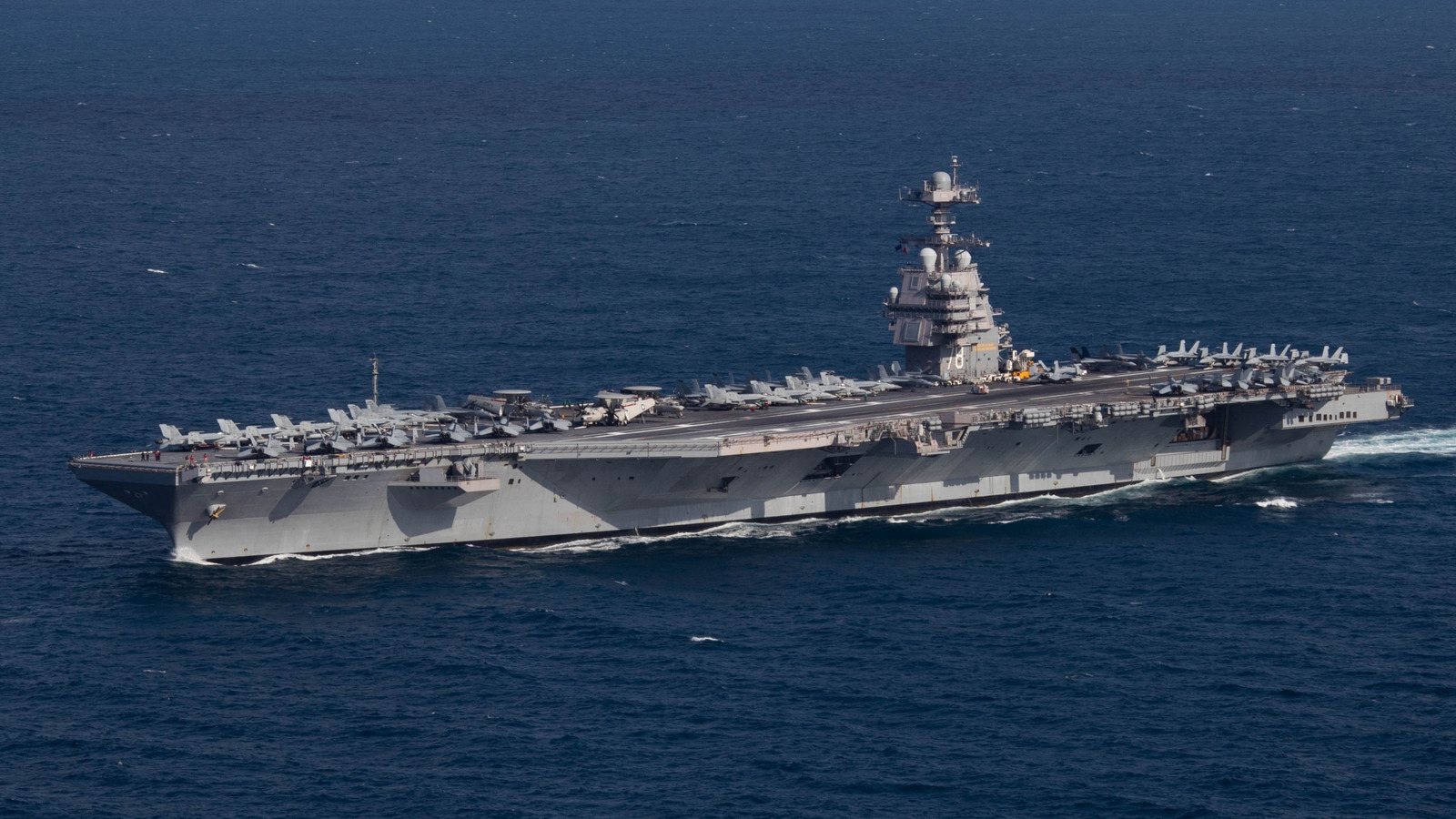
I’ll explain how a U.S. Navy supercarrier moves toward the Middle East, lay out the distances involved, run basic speed-and-time calculations, and note the logistical and political factors that affect deployment.
Start with the distance. A carrier leaving the U.S. East Coast bound for the Arabian Gulf will generally cover roughly 6,500 to 8,000 nautical miles depending on the exact origin and route through the Mediterranean and Suez Canal. If a carrier is staged forward in the Mediterranean or at bases in Europe, that distance drops dramatically to a few hundred or a couple thousand nautical miles.
Speed is the other key variable. Nuclear-powered supercarriers can sustain high speed for long periods, but the strike group usually balances speed with fuel and maintenance cycles for escort ships. Typical transit speeds for operational planning fall in the 15 to 30 knot range, with higher speeds used in emergencies and moderate speeds used for sustained transits.
Do the math. For a 7,000 nautical mile journey at 30 knots, the transit takes about 9.7 days nonstop. Slow that to 20 knots and you’re looking at roughly 14.6 days; at 15 knots, roughly 19.4 days. Stretch the route to 8,000 nautical miles and those same speeds give you about 11.1, 16.7, and 22.2 days respectively.
Those ideal numbers assume continuous steaming and an unobstructed route. Reality adds complexity: canal transits, port calls, diplomatic clearances, and tactical routing can add days. Suez transit slots and regional agreements often dictate how quickly a group can pass through chokepoints.
Logistics matter. A carrier itself is nuclear-powered and not limited by fuel in the same way as its escort ships and support vessels. Destroyers, cruisers, and supply ships need replenishment, and they coordinate underway replenishments at sea to keep the group moving. Those operations are routine, but they take time and planning and can’t be improvised without risk.
Aircraft readiness is another constraint. A carrier’s air wing can launch combat air patrols almost immediately once the ship arrives, but the planes and personnel require maintenance cycles, ordnance loadouts, and coordination with regional command. You can’t teleport an entire air wing to full combat readiness the instant a carrier hull appears on the horizon.
Forward basing and pre-positioned forces shorten response times dramatically. When the U.S. maintains assets at nearby bases or has allies in the region, you gain hours rather than days. That’s why presence matters: carriers are powerful, but their real strength often comes from being closer to trouble before crisis hits.
Political will is a hidden engine. A carrier steaming at flank speed is a policy decision as much as a naval maneuver. A clear command decision to mobilize, coordinated with diplomatic overflights and port permissions, cuts red tape. From a conservative angle, decisive policy backed by credible force sends the clearest message to adversaries.
Risk and deterrence play together. Even if it takes 10 to 20 days to arrive from the U.S., moving a carrier strike group into position signals commitment, reshapes adversary calculations, and deters escalation. The time lag is not just a vulnerability; it’s also a factor commanders use to shape options and pressure opponents politically.
Finally, keep expectations realistic. A carrier is not a magical instant fix; it’s a high-end, deliberate instrument of national power that needs planning, escorts, logistics, and political cover. The math is simple, but the decision to deploy combines strategy, diplomacy, and logistics in ways numbers alone don’t capture.
In short, if the question is how long from the U.S. to the Gulf, expect a window measured in days to a few weeks depending on origin and speed, with forward posture and political will doing more to shorten that window than technical speed alone. Deploying a carrier is about demonstrating resolve as much as it is about clocking nautical miles.
