
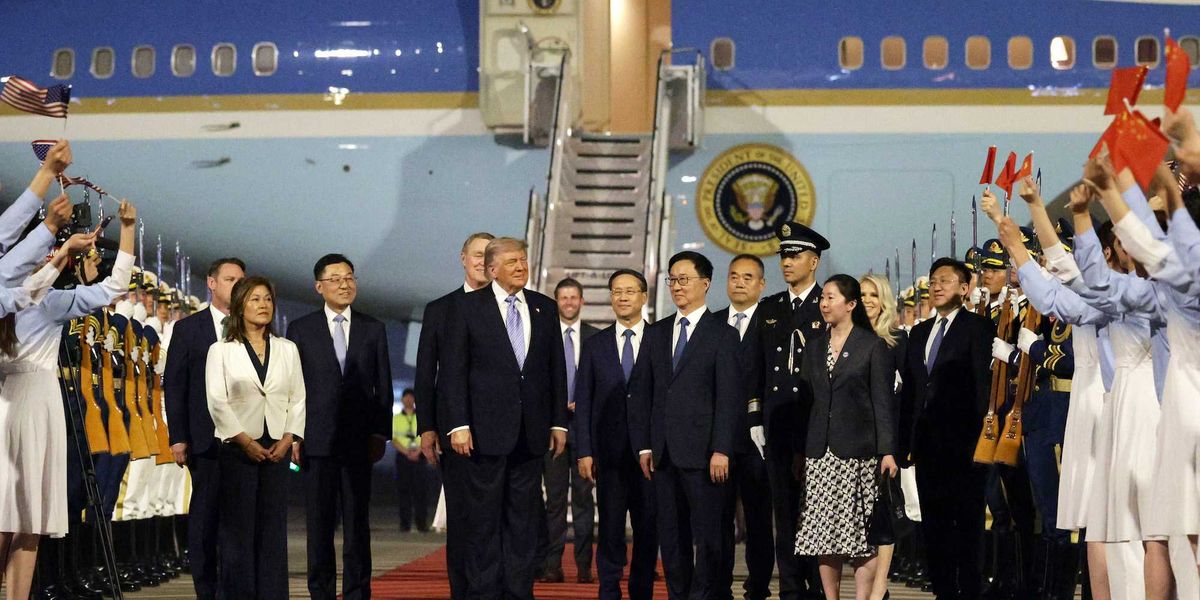
President Trump landed in Beijing for a landmark trip, greeted by cheering students and Chinese officials, and arrives with a heavyweight group of U.S. business leaders as tensions in the Middle East simmer in the background. The visit centers on a one-on-one with Xi, economic discussions, and a message that the U.S. intends to negotiate from strength while protecting American interests. Alongside top executives and tech figures, Mr. Trump is positioning trade and strategic stability as central to the trip’s goals.
Hundreds of students waved both U.S. and Chinese flags as President Trump stepped off Air Force One, a staged, high-profile welcome that underscores the diplomatic pageantry of the moment. Chinese Vice President Han Zheng and Foreign Affairs Vice Minister Ma Zhaoxu were on hand to receive him, signaling Beijing’s interest in steadying ties even as global flashpoints persist. The optics matter: both sides wanted a visible show of engagement before talks begin.
The president arrives carrying a clear message about American leverage and economic priorities, and he made that explicit to reporters at the White House before departure. “We’re the two superpowers,” he said, adding, “We’re the strongest nation on Earth in terms of military. China’s considered second.” That blunt framing sets expectations that the talks will be transactional and centered on results that favor U.S. workers and companies.
Timing is crucial: the visit comes amid the war in Iran, which delayed Mr. Trump’s travel plans. He downplayed how much Iran will figure in the agenda, telling reporters he did not expect Iran to dominate discussions because the situation is “very much under control.” Still, the backdrop of conflict gives added urgency to any diplomatic and economic commitments the two leaders might make.
The president travelled with a large that included tech billionaire Elon Musk, who had a falling out with Trump last June before restoring their relationship recently. That mix of tech, finance, and industrial leadership is meant to telegraph American economic strength and to open private channels alongside the formal talks. Bringing these executives signals that the trip is as much about deals and investment as it is about geopolitics.
https://x.com/CBSNews/status/2054552134784295356
- Nvidia;
- Apple;
- BlackRock;
- Boeing;
- Goldman Sachs;
- Meta;
- Micron;
- Qualcomm;
- Illumina;
- Mastercard;
- Visa;
- Cargill;
- Citi;
- Cisco;
- Coherent;
- GE Aerospace.
Mr. Trump made a point of contrasting his approach with past administrations, using language meant to resonate with voters who want stronger trade outcomes. “I have a great relationship with President Xi,” he told reporters, and he added, “We’re doing a lot of business, but it’s smart business. We used to be taken advantage of for years with our previous presidents. And now we’re doing great with China. We make a lot of money with China.” That quote captures the sales pitch: friendship plus firm bargaining equals wins for American workers.
Officials expect an official welcome ceremony on Thursday with Jinping, followed by substantive meetings that aim to lock in practical steps on trade, technology, and supply chains. The administration is focused on extracting concrete concessions while also exploring ways to reduce friction in critical sectors without ceding strategic advantage. For a Republican-led agenda, the priority is clear: protect national security, boost U.S. industry, and make deals that reward American labor and capital.
The president also dismissed a recent Iranian peace initiative offered on Monday, labeling the proposal “garbage” and “unacceptable,” and saying the ceasefire was “on life support.” His stance signals a tougher posture toward Tehran even as he seeks to reassure allies and competitors alike that the U.S. can manage multiple challenges. That combination of hardline rhetoric and active diplomacy is meant to sharpen America’s bargaining position everywhere from Beijing to the Middle East.
The trip will run through Friday, packing a short window with high-stakes meetings and private discussions between delegations. Expect both public ceremony and closed-door negotiations aimed at practical wins, from semiconductor rules to aerospace cooperation, framed by an unmistakable Republican priority: secure American advantage without sacrificing profitable engagement. The outcome will be measured not in press conferences but in the deals and defenses that come out of the week.
