
✔ South Korea alliance tensions under Trump’s second-term approach
✔ The shift from praise to reduced military drills
✔ Trade, investment, and burden-sharing disputes
✔ Trump’s continued interest in renewed Kim Jong Un diplomacy
✔ North Korea’s growing military threat and shifting regional ties
✔ Capitol Hill backlash over alliance uncertainty
President Donald Trump’s move to scale back major joint exercises with South Korea landed like a thunderclap, especially because it followed a burst of public praise for the alliance. The timing made the reversal sting even more, turning talk of a “historic new era” into a blunt reminder that the relationship is still built on friction, leverage, and hard-nosed politics.
At the center of the shift is Trump’s familiar belief that alliances should pay off in concrete terms. South Korea has been slow to move on a massive trade and investment framework, and that delay appears to have fed Trump’s frustration just as his team was touting deeper cooperation with Seoul.
Victor Cha said the decision looks like a two-way pressure tactic, with Trump using the drill cut to push South Korea on money and defense costs while also opening the door for new talks with North Korea. That logic fits Trump’s style, which has always mixed a transactional mindset with a taste for bold diplomacy.
The White House had recently been talking up Seoul as an “indispensable partner,” but the mood changed fast after South Korea declined to back U.S. operations against Iran. That kind of sharp turn is exactly what makes this alliance feel so uneasy right now, because the public message and the private pressure seem to be moving in opposite directions.
Trump’s impatience is not just about one deal or one exercise. He has also been irritated by slow progress on investments, disputes involving American companies, and his view that wealthy allies should shoulder more of the cost of their own defense.
That complaint has been part of Trump’s foreign policy for years, and it is back with force. He sees South Korea as a strong economy that should do more, while Seoul sees the drills as a critical part of deterrence in a dangerous region.
The North Korea angle is just as important. Trump has never fully let go of the idea that he can revive direct diplomacy with Kim Jong Un, and reducing exercises may be meant to create some opening for that approach.
The two leaders have already written a wild chapter together, moving from fiery threats to landmark summits in Singapore, Hanoi, and the demilitarized zone. Those meetings made Trump the first sitting U.S. president to sit down with a North Korean leader, but they ended without a denuclearization deal, leaving the core problem untouched.
North Korea, for its part, has only grown more dangerous since then. Its missile and nuclear programs have advanced, and its ties with Russia and China have tightened, which gives Pyongyang more room to maneuver and more confidence to keep talking tough.
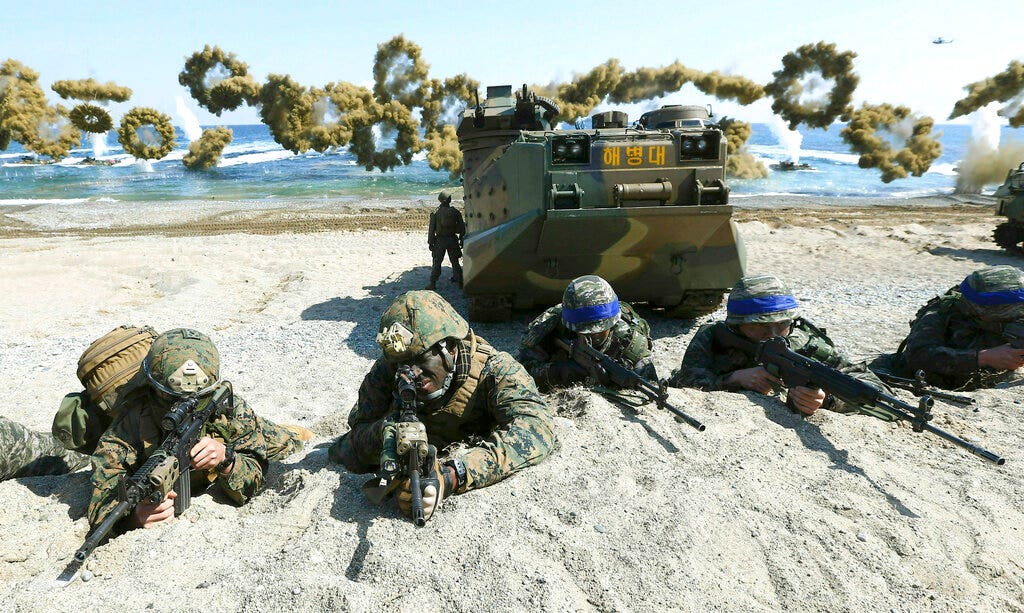
That makes the joint exercises even more important, not less. They are where American and South Korean troops practice the ugly details of real war, from moving equipment and sharing intelligence to operating under pressure if deterrence fails.
This year’s drills were set to include lessons from Ukraine, including drone warfare, GPS disruption, and the risk of losing communications in a crisis. That kind of training matters because the battlefield has changed fast, and North Korean troops fighting alongside Russian forces means the threat is no longer theoretical.
Critics on Capitol Hill wasted no time blasting the move. Some argued the cut weakens deterrence at exactly the wrong moment, while others said it hands Kim Jong Un a propaganda win and creates fresh anxiety inside the alliance.
Trump defended the decision by saying the drills send a message that is “totally inappropriate and hostile” to North Korea, which he said “has been unthreatening and respectful” during his second term. That language fits his broader bet that a softer military posture might coax Kim back to the table, even if it rattles allies along the way.
But the uncertainty is the real story hanging over all of this. South Korea wants reassurance, Washington wants leverage, and North Korea keeps testing the limits in the background, which leaves the alliance stuck in a tense, uneasy middle where every move sends a signal and every signal gets read as a warning.
