
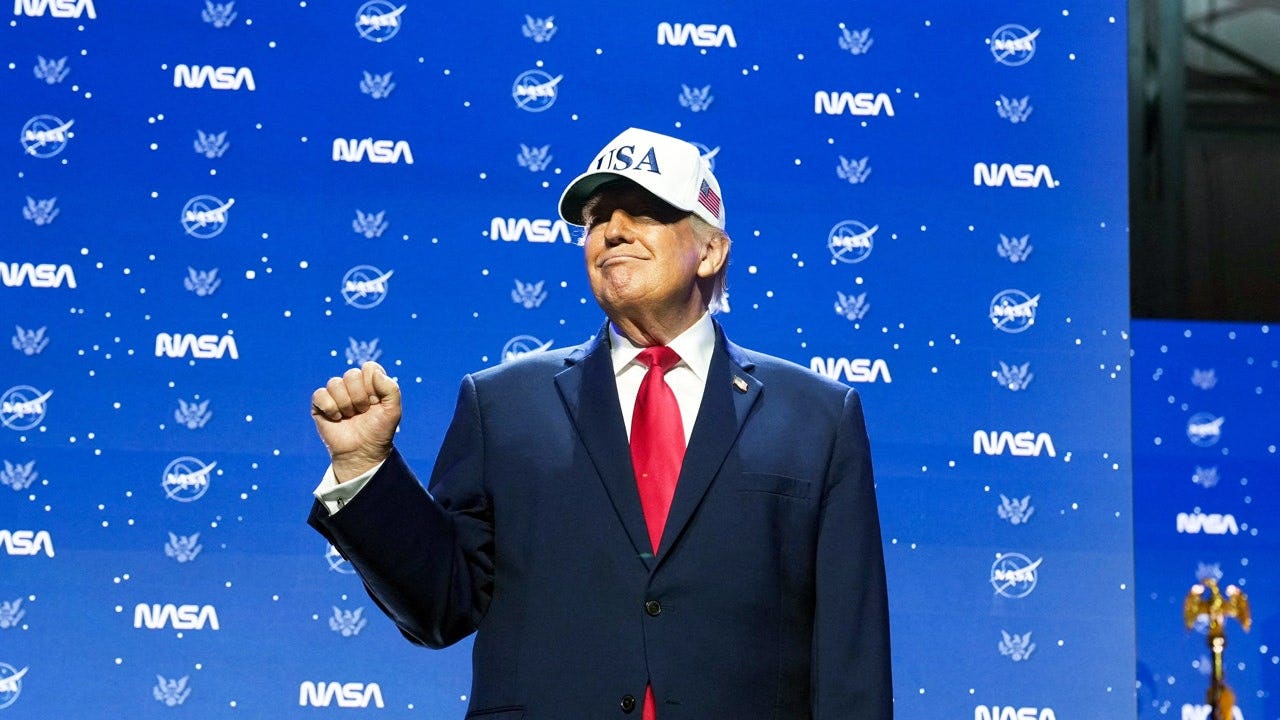
President Donald Trump used a high-profile appearance at Kennedy Space Center to push a bigger, bolder vision for American spaceflight. The message was simple and unmistakable: Mars is back in the spotlight, the moon remains a key stop along the way, and NASA is being urged to move fast.
At the center of the remarks was a plan for NASA to launch its first nuclear-powered spacecraft toward Mars within the next two years. Trump cast the effort as part of a larger national mission, one that stretches beyond one launch and into a long-term American presence in deep space.
He framed the push as more than a technical milestone. In his telling, the mission is a bridge to something far bigger, eventually putting American astronauts on the red planet and making the United States the country that leads the next giant leap in space exploration.
“Within the next two years, NASA will launch the first-ever nuclear-powered spacecraft to Mars,” Trump said.
The setting mattered too. Trump spoke at the UP Summit in Cape Canaveral, where space ambitions can feel less like rhetoric and more like a live-wire project under construction. The backdrop gave his words extra weight, especially as NASA’s Artemis program keeps grinding toward a future built around the moon and Mars.
That Artemis effort remains the backbone of the broader strategy. NASA is working to establish a lasting human presence on the moon first, then use those lessons, systems, and missions as a runway toward Mars.
Artemis II already completed a lunar flyby earlier this year, a major step that kept the program moving forward. Artemis III is slated to test spacecraft and landing systems in Earth orbit in 2027, while Artemis IV is expected to target a lunar landing in early 2028.
Trump also leaned into the symbolism of what comes next, saying the mission is about planting the Stars and Stripes on new ground. The language was classic space race optimism, but it also underscored how seriously the administration is treating the race to stay ahead in space.
“We’re going to be paving the way for astronauts to plant the Stars and Stripes on the red planet,” he said.
NASA Administrator Jared Isaacman added his own sharp focus to the event, describing Mars as part of a longer arc of discovery. Before introducing Trump, he spoke about extending America’s reach deeper into the solar system and keeping the country at the front of the pack.
“We are going to venture farther into the solar system and move closer to that next giant leap,” Isaacman said.
He also pointed to the day when “American astronauts plant the Stars and Stripes on Mars.” That kind of language may sound lofty, but it matched the tone of an administration that has been laying out bigger space plans and trying to give them more staying power.
One of those ideas is the American Declaration of Freedom in Space, which Trump said he issued to reinforce the right of Americans to explore and settle beyond Earth under U.S. law. He tied that idea directly to the future, saying space should be open for American settlement, American civilization, and American freedom.
“Just this week, I issued the American Declaration of Freedom in Space, proclaiming all of space opened for American settlement, American civilization and American freedom,” Trump said.
The broader vision also includes building institutional muscle for the next generation. Trump previously announced plans for a U.S. Space Academy, an idea aimed at training students for careers in the Space Force, NASA, and the civilian spaceflight industry.
That matters because space races are not won on speeches alone. They are won by talent pipelines, hard engineering, and a culture that rewards risk instead of shrinking from it.
Trump closed on a familiar note, turning exploration into a statement of national identity. “Our calling is to explore. Our purpose is to build, and our aim is always to win,” he said.

1 Comment
Needed rally point like Apollo was during Vietnam War