
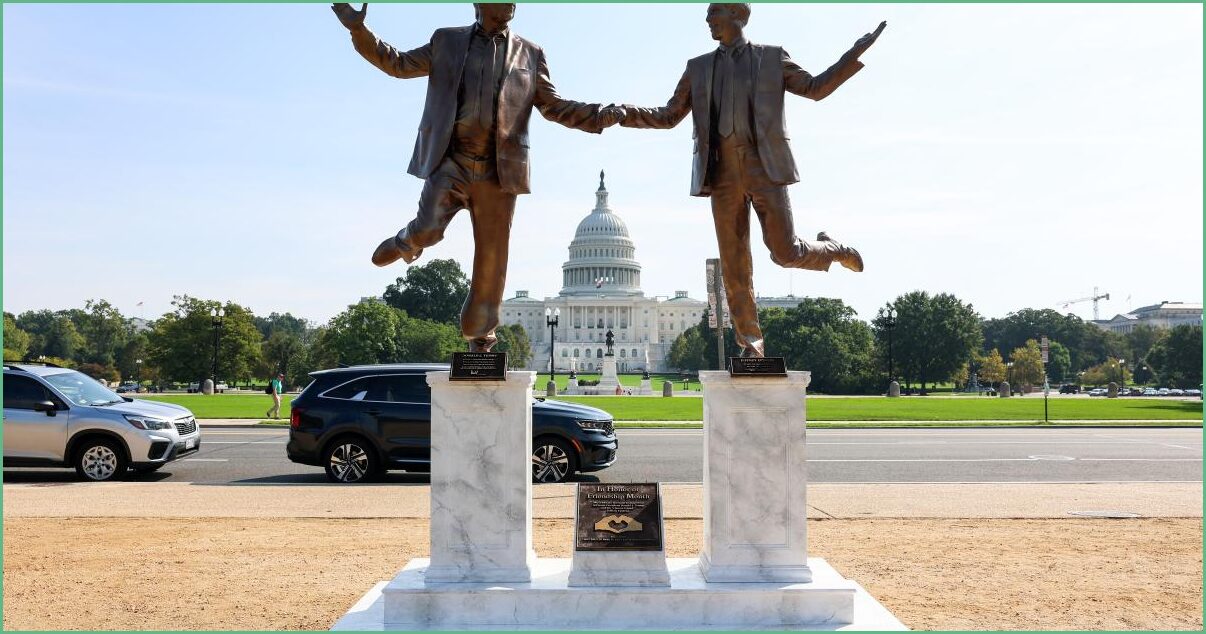
Statue of “Friendship” and the Politics of Provocation
A new statue showing two men holding hands landed in public view with a plaque that reads, “In Honor of Friendship Month,” followed by, “We celebrate the long-lasting bond between President Donald J. Trump and his ‘closest friend,’ Jeffrey Epstein”. The image is meant to shock and to startle, and it has done exactly that. Whether you see satire or slander, it is political theater dressed up as art.
Art has always been a weapon in political fights, and this piece aims squarely at one man while dragging another name into the mud beside him. For Republicans the immediate reaction is one of disbelief that such a crude provocation would be treated as legitimate commentary. The intent is obvious: to reduce a complicated public life to a single scandalous image.
Context matters, yet context is often the first casualty in modern outrage cycles. The plaque’s wording is a deliberate tag line meant to leave no room for nuance, and that bluntness is designed to win headlines rather than understanding. When public displays trade depth for provocation the whole civic conversation cheapens.
Many conservative readers will see this through the lens of unfair attack politics, where satire becomes a blunt instrument against political enemies. The work reads less like art and more like an accusation in neon, the kind of thing built to circulate on social feeds and to inflame tribal instincts. That is not accidental; it is the strategy of attention-first culture.
Still, Republicans should resist the easy, reflexive swing into victimhood that lets opponents set the terms of debate. Pointing out hypocrisy and mischaracterization matters, but it is more effective when mixed with a clear, affirmative message about values and leadership. Turning every provocation into a counter-protest only prolongs the cycle of outrage.
There is also a strategic question about how to respond to art that traffics in scandal without evidence. If the goal is to defend a public figure fairly, Republicans should highlight the difference between political satire and unmoored insinuation. That distinction keeps the conversation anchored in facts and legal outcomes rather than in rumor and spectacle.
At the same time, conservatives can call out the double standard in cultural institutions that elevate such displays while ignoring other examples of political or moral failure. Consistent standards for what gets public space and what is considered acceptable commentary would serve the public interest. The selective outrage from cultural gatekeepers undermines their moral authority.
Another angle is to reclaim humor and satire without stooping to the level of smear. Republicans can use wit effectively to defuse attacks and redirect the story toward substantive issues voters care about. A well-placed joke can undercut the power of a crude image and remind people why they voted in the first place.
The discussion also touches on free expression and its limits. Conservatives value the First Amendment while also insisting speech should be responsible, not vindictive. Calling for civility and for accountability in public discourse is not censorship; it is asking for a higher bar from those who claim the mantle of culture-makers.
Public trust in institutions is at stake when art is used primarily as a tool for political hit jobs. That erosion of trust is dangerous for everyone, not just the targets. If the cultural conversation becomes nothing but a series of character assaults, voters will tune out and democracy suffers.
Republicans should push back by insisting on fairness, context, and standards for public displays that carry political weight. They should also offer a positive alternative: focus on policy, results, and the principles of limited government that actually affect people’s lives. Shouting about hypocrisy matters less when you have nothing constructive to say instead.
The statue and its plaque succeed at starting a fight, but that is not the same as winning a debate. Conservative responders have an opening to change the subject from scandal theater to substance, from spectacle to practical matters like the economy and security. That pivot is where durable political advantage lives.
Art will always provoke, and sometimes that provocation is useful. When it becomes a smear in public space, however, it invites a broader conversation about what we accept in civic life. Republicans can lead that conversation by demanding consistency, defending dignity, and offering a clear vision beyond the outrage of the moment.
In the end, a plaque can say whatever its makers want, and the image will travel fast. What matters more is how leaders respond and whether they use the moment to elevate the debate or simply to retaliate. For conservatives who hope to win persuadable voters, choosing the higher ground is often the smarter play.
n
h/t: Just The News
n
