
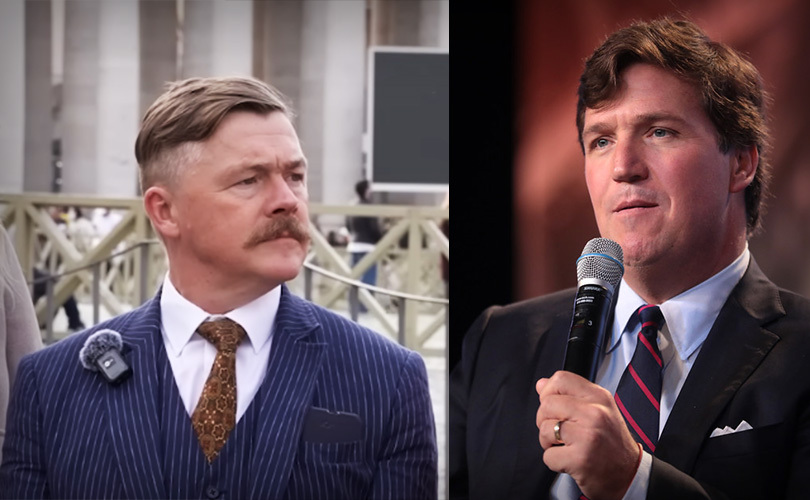
Frank Wright has been cutting through the noise with a clear, traditional Catholic critique of modern Western political life, arguing that liberal democracy, mass migration, and reckless regime change are symptoms of a deeper spiritual decline. He pins the West’s unraveling on a loss of moral roots and a refusal to acknowledge the role of faith and family in sustaining a free society. This piece follows his line of thought and why it matters for anyone worried about national identity, social cohesion, and the fate of Western civilization.
Wright begins by questioning the unquestioned faith in liberal democracy as an absolute good. From a conservative Catholic perspective, he says, political systems are means to an end not an end in themselves, and when a culture loses sight of the moral end, the system rots from within. That critique lands hard because it forces a choice between procedural mechanics and the moral goods those mechanics are supposed to protect.
Mass migration gets the blunt treatment in Wright’s analysis, portrayed not as merely an economic or logistical challenge but as a cultural and spiritual rupture. He argues that uncontrolled migration overwhelms community bonds, dilutes civic traditions, and accelerates the disintegration of shared values. For those on the right, that is not alarmist rhetoric but a sober look at long-term consequences.
When it comes to regime change abroad, Wright is equally skeptical, insisting that the arrogance of exporting systems by force has backfired. Military adventures and top-down democratization efforts often leave power vacuums that breed instability rather than liberty. He makes the case that humility and restraint are wiser tools for preserving national interests and moral clarity.
The spiritual roots of the crisis are where Wright’s traditional Catholic lens becomes most compelling, because he frames political decay as an outgrowth of religious neglect. Without a shared moral grammar shaped by religion and community, laws and institutions become fragile and hollow. That perspective pushes against the modern tendency to reduce politics to administration and policy to technocratic problem solving.
Wright also challenges the professional class that runs modern institutions and media, accusing elites of promoting policies that undermine the social fabric. According to him, these elites champion open borders and global interventions while living separated from the communities they reshape. From a Republican viewpoint, that critique connects to long-standing concerns about accountability, national sovereignty, and cultural stewardship.
Family and local church life come up repeatedly as solutions Wright favors, not as nostalgic gestures but as practical bulwarks against social fragmentation. He insists that strong families and active parishes cultivate the virtues necessary for sustaining free institutions over generations. Restoring those institutions is treated less as a recipe for legislation and more as a civic revival that can’t be engineered from the top down.
Wright’s tone is unapologetic and rooted in conviction, which makes his message both invigorating and unsettling for readers who have grown comfortable with the status quo. He refuses easy compromise when he sees compromise as surrender, and that clarity appeals to voters and thinkers who feel betrayed by incremental fixes. This clarity, however, also forces a reckoning with uncomfortable trade-offs that politics rarely spells out.
Critics will say Wright oversimplifies or romanticizes the past, but his point is not to offer perfect nostalgia; it’s to insist that a people without a soul cannot long remain a people in practice. The remedy he offers centers on a return to moral formation, a tightening of communal bonds, and a foreign policy rooted in prudence. Those prescriptions speak directly to anyone who wants durable order rather than perpetual reform.
Whether one agrees with every conclusion, engaging with Wright’s argument is useful because it reframes familiar debates around migration, intervention, and governance as moral and spiritual questions. That reframing forces political movements to decide whether they will treat culture as an afterthought or as the foundation of policy. For conservatives and traditional Catholics, Wright offers a coherent voice calling for a restoration of moral seriousness in public life.
