
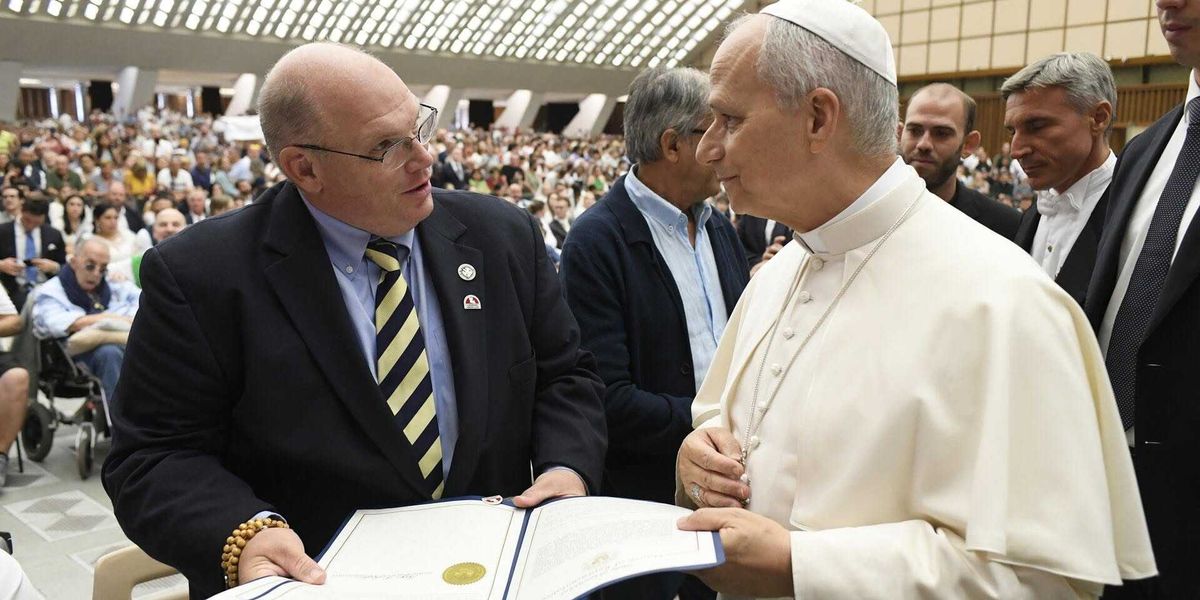
From Baton Rouge to Rome, one Louisiana Republican found himself standing in a moment that blended faith, school pride, and a very public show of respect for the new pope. The scene tied together a Catholic tradition, a campus political spirit, and a Louisiana flavor that made the whole thing feel bigger than a simple presentation. At its core, it was about honoring Pope Leo XIV with a proclamation that carried more weight than paper alone.
The image of Michael Bayham presenting the proclamation quickly stood out because it hit several cultural nerves at once. Louisiana State University, the Catholic Church, and the energy of young Republicans all surfaced in one snapshot, giving the moment a kind of local-to-global punch. Even the timing around Thanksgiving added another layer, since the holiday always invites a little more reflection on gratitude, identity, and tradition.
Pope Leo XIV has become a focal point for Catholics who see leadership in the Church as more than a ceremonial role. For many believers, the pope represents continuity, order, and a reminder that old institutions still matter in a noisy world. That is part of why a gesture like this lands so well, especially when it comes from someone connected to a state where faith and civic life still overlap in visible ways.
The proclamation itself was not about spectacle for its own sake. It was about recognition, and the kind of respect that often gets overlooked in a political culture that moves too fast to pause for shared values. In that sense, the moment fit neatly into a broader public mood where people still want leaders to acknowledge faith openly instead of treating it like something to tuck away.
There is also a distinctly Louisiana angle here that cannot be ignored. The state has long had a strong Catholic presence, and that heritage runs through families, neighborhoods, and public life in ways that are hard to miss. When someone from that world steps forward to honor the pope, it does not feel manufactured. It feels rooted.
The connection to college Republicans and young Republicans gives the story a fresh edge. Too often, younger conservatives get painted as if they are only interested in online fights and campaign slogans, but moments like this show something broader. There is still room in politics for symbolism, respect, and public expressions of belief that are not embarrassed by tradition.
That matters because political culture has become so flattened and cynical that sincerity sometimes looks unusual. A proclamation handed over in a faith-centered context cuts through that cynicism fast. It reminds people that not every public gesture has to be a battle, and not every conservative instinct is about confrontation.
Thanksgiving is a fitting backdrop for that attitude. The holiday carries its own mix of gratitude, family, memory, and sometimes even a little civic reflection about what kind of country people want to live in. When faith, school loyalty, and a papal honor all land in the same season, the result feels especially resonant.
Bayham’s presentation also taps into something bigger about how Catholic identity still shows up in American public life. In some places it gets treated as background noise, but in moments like this it steps forward with real presence. The Blessed Virgin Mary, church tradition, and public ceremony may sound like separate lanes, yet they often meet in the same communities and shape the same sense of belonging.
The New Orleans Saints comparison practically writes itself because Louisiana culture has a way of making sports, religion, and local pride feel part of the same conversation. That is the kind of environment where a gesture toward Pope Leo XIV can feel normal rather than ceremonial. It is a reminder that the state still has a pulse of its own, and that pulse is deeply connected to faith and place.
For Republicans, especially younger ones, these kinds of moments can carry real significance. They show that politics does not have to be sterile to be serious, and that public respect for religious authority still has a place in American life. In a season built around gratitude, that kind of posture can stand out in a good way.
