
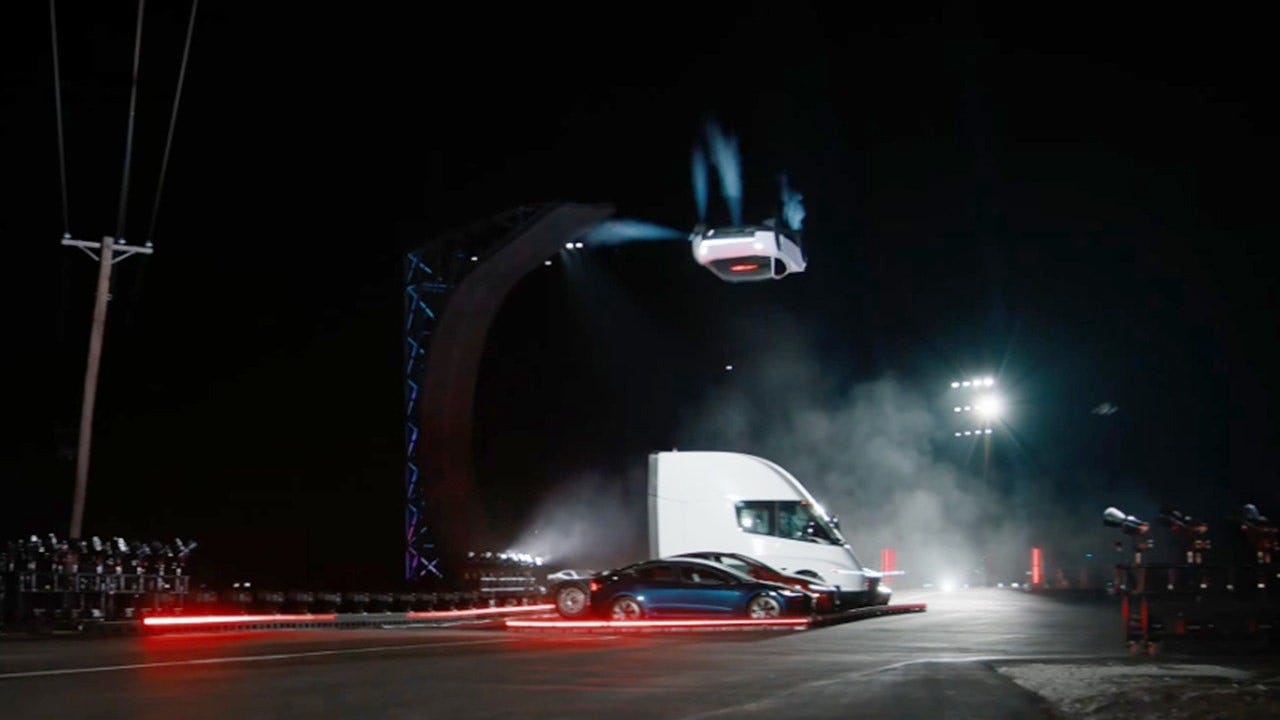
The old dream of flying cars keeps inching closer, and Tesla’s Roadster stunt has given that fantasy fresh life. A short, dramatic demonstration of a car lifting, flipping, and settling back to earth has become bigger than a flashy promo. It is now a conversation about ambition, risk, and whether America still makes room for people who try wild ideas instead of playing it safe.
Growing up on visions of the future, it was hard not to think of the Jetsons and their smooth, effortless world above the clouds. The most unforgettable piece of that cartoon future was the flying car, the symbol that technology had finally outrun ordinary limits. Tesla’s latest display taps directly into that same feeling, the kind that makes people sit up because something once reserved for sci-fi suddenly looks a little more real.
The Roadster’s demonstration was built for spectacle, and it delivered. The vehicle launched up a ramp, turned over in the air, and seemed to hover as thrusters guided it back down with surprising control. For a few seconds, it was not just a car on a set or a concept drawing. It was a machine doing something that would have sounded ridiculous not long ago.
That kind of moment splits people fast. Supporters see momentum, imagination, and a reminder that serious engineering still exists in a country obsessed with complaints. Critics shrug it off or try to shrink it into a gimmick, which says more about them than about the technology on display.
Elon Musk has become the clearest example of that divide. Love him or hate him, the list of things attached to his name is hard to dismiss, from payments to electric vehicles to AI to spaceflight. What matters most is that the work has largely been rooted in America, where the companies, the talent, and the capital have been able to build at scale.
That is why the response matters so much. Musk’s companies have repeatedly pushed into places other businesses would avoid, whether that means building cars differently, landing rockets with precision, or chasing new manufacturing ideas that sound unrealistic until they start happening. The broader point is not just that one person is bold. It is that boldness can still produce results when the environment does not crush it first.
There is also a reason so many people are drawn to him beyond the headlines. He represents a style of leadership that expects hard things to be attempted, not merely talked about. Teams around him seem to operate with the sense that failure is part of the process, but surrender is not.
That mindset is exactly what too many policies and politicians seem determined to smother. Instead of creating more room for experimentation, they pile on rules, suspicion, and endless second-guessing. The result is a culture that praises innovation in speeches while making it far harder in practice.
That tension shows up clearly in the way some public figures respond to business success. Rather than celebrate companies that create jobs, move technology forward, or stretch what is possible, they treat achievement like a threat to be managed. The instinct is to regulate first and ask questions later, which is a great way to end up with fewer breakthroughs and more excuses.
America has always worked best when ambition is rewarded instead of punished. The country does not need a careful little committee version of the future. It needs thousands of people willing to build, risk, fail, adapt, and build again until the impossible starts looking normal.
That is what makes the flying-car moment matter beyond the spectacle. It is a reminder that progress still comes from people who refuse to shrink their ideas to fit the mood of the moment. And as the next round of breakthroughs takes shape, the real test will be whether the country keeps clearing space for the builders or lets the roadblocks win.
