
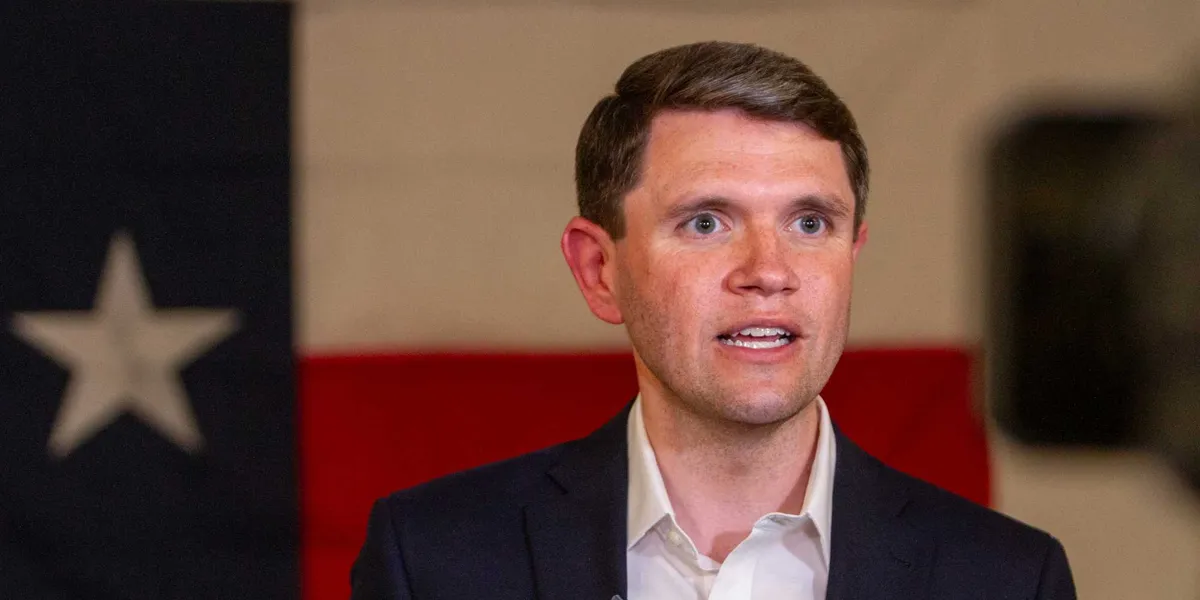
James Talarico’s resurfaced remarks about Christianity and his church have stirred alarm in a high‑stakes Texas Senate race, raising questions about whether Democrats can sell their pick to voters who value faith and tradition.
Voters in Texas are watching a contest that went from quiet to explosive after a clip of State Rep. James Talarico surfaced. The footage has Republicans pointing to a candidate whose public comments clash with mainstream faith communities, and who now stands in the center of national attention as the November contest approaches.
The video was an interview with Roberto Che Henderson-Espinoza, who identifies as Latinx, nonbinary and transgender, and a post of that material was shared by Republican operatives along with the embedded clip . The exchange is being used to argue that Talarico’s personal theology is out of step with many Texans, and that his words aren’t just private musings but a campaign liability in a state that values religious freedom.
Talarico says of himself, “I always think of myself as a Christian who hates Christianity, right?” he laughs. “And I always get drawn back into it.” Those lines are now replayed as evidence that his relationship with faith is complex and, to critics, unsettling for someone asking for statewide trust.
He also declared in that conversation, ‘No other political philosophy, in no other economic theory, do I find anything as truly radical or revolutionary as the teachings of that barefoot Rabbi.’ That particular phrase has been highlighted by opponents who argue it frames Jesus in purely political terms and downplays traditional beliefs that shaped America’s moral foundations.
https://x.com/RNCResearch/status/2069421193812148502
The clip includes other contentious remarks, including a characterization of his pastor as a “true white traitor,” which has inflamed cultural and racial tensions around the campaign. For many conservative voters, the comments about race and religion together suggest the candidate is courting a radical redefinition of faith that voters in Texas may reject.
Beyond the sound bites, critics point to a pattern: past statements about God being “nonbinary,” reported support for progressive church practices such as a lesbian chaplain, and allegations that the congregation provides sexually explicit materials for children. Those claims have been circulated widely by conservative media and used to argue that Talarico’s church departs from orthodox Christian teaching.
On the campaign trail, context matters, but optics matter more. Talarico won his Democratic primary over Rep. Jasmine Crockett and now faces Republican Ken Paxton, who beat incumbent Sen. John Cornyn in the GOP primary. Polls show the race tight, with figures clustering in the low forties for both candidates as the parties pour in money and messaging.
Republicans are using this episode to frame the choice simply: a candidate who publicly struggles with traditional Christianity versus a conservative who positions himself as a defender of faith and law. That framing is aimed at persuading undecided voters and mobilizing the base in a state where cultural issues often decide elections.
November 3, 2026, will be the moment of truth for both parties, but in the near term this resurfaced footage has already altered dynamics. For Democrats, Talarico’s comments are a headache — a candidate meant to flip a seat now required to explain theology to an entire electorate — and for Republicans it’s a clear talking point about cultural fit and values in leadership.
