
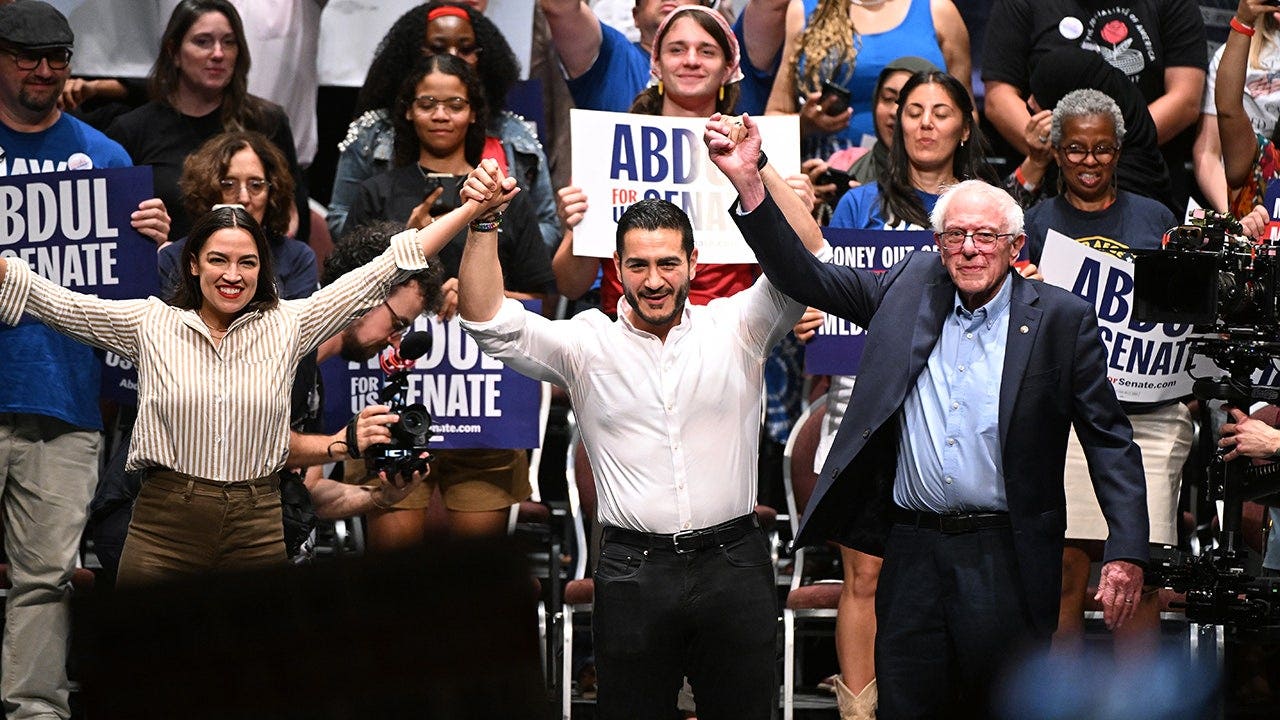
Alexandria Ocasio-Cortez, Ilhan Omar, Ayanna Pressley, Rashida Tlaib, Summer Lee, Delia Ramirez, and Greg Casar have all lined up behind Abdul El-Sayed as Michigan’s Democratic Senate primary tightens, giving the race a loud progressive stamp. That backing lands at a tense moment, because El-Sayed is also trying to talk like a practical Democrat who is not boxed in by the socialist label. The result is a primary fight that is as much about branding and ideology as it is about who can win in a battleground state.
The support comes from the informal group known as the Squad, a bloc that has become shorthand for the party’s most aggressive left flank. Several of its members have had current or past ties to the Democratic Socialists of America, which only makes El-Sayed’s balancing act more awkward. He is trying to keep one foot in the progressive lane while waving off the kind of baggage that can sink a candidate once the contest moves beyond the Democratic base.
That tension is exactly what makes the endorsement pile-on so useful for Republicans. It gives them a ready-made message that El-Sayed is being carried by the same crowd that many Michigan swing voters already distrust. In a state where elections are often decided by suburban moderates and working-class voters, the optics of a candidate embraced by the far left can matter almost as much as the policy details.
National Republicans wasted no time turning that into ammunition. The argument is simple enough: if the most visible progressive members of Congress are all-in on El-Sayed, then his campaign is not some soft-edged, middle-of-the-road operation. It is a left-wing project dressed up for a broader audience, and that kind of disguise tends to crack once voters start paying attention.
Casar was the latest Squad member to step forward, praising El-Sayed as a “bold, pro-working class campaign” and saying strong Senate partners are needed to push ideas like Medicare for All. That kind of language is catnip for the activist left, but it also pulls the candidate deeper into the progressive lane he says he is trying to leave behind. Every endorsement like that makes the contrast sharper between what El-Sayed says he is and what his allies clearly want him to be.
El-Sayed’s history with Democratic Socialists of America only adds fuel to the fire. He has spoken at multiple DSA events over the years, including one fundraiser tied to Detroit’s chapter, and organizers have described him as a longtime friend of the local group. Even if he now insists he is not a socialist, that past keeps following him around like a shadow that never quite leaves.
The candidate has tried to draw a cleaner line in public. He has said, “I’m not technically or practically DSA,” and in another interview added, “I am not somebody who is a socialist. I believe in capitalism, I just believe that capitalism has to be regulated.” Those are the kinds of words a candidate uses when trying to reassure voters who like a little market medicine with their politics, not a full-blown ideological sermon.
The problem is that endorsements tell their own story, and they often drown out the carefully chosen quotes. When Ocasio-Cortez, Tlaib, and the rest of the Squad stand shoulder to shoulder with a candidate, voters notice who is really in the room. That matters even more in a general election environment, where opponents are already sharpening their pitch for the fall campaign.
El-Sayed faces Rep. Haley Stevens in the Democratic primary, and Stevens is seen as the more centrist option in the field. Polls have generally shown El-Sayed ahead, which means the progressive surge may be doing real work inside the party. But a lead in a primary can turn into a liability fast when the campaign has to answer for every socialist-adjacent photo, event, and quote that comes back around.
That is why this endorsement wave hits so hard. It is not just a show of support, it is a signal about the kind of politics El-Sayed is surrounded by, even if he is trying to talk it down. And with Michigan always close enough to keep everyone on edge, the clash between his messaging and his allies is likely to stay front and center.

1 Comment
All Blue States go Commie Red