
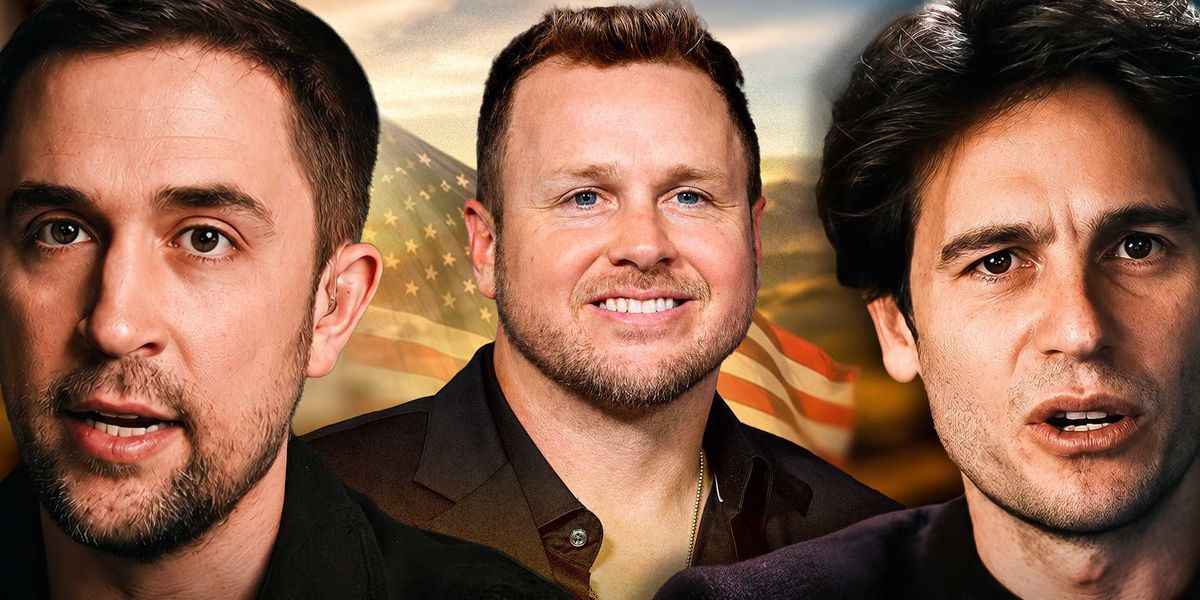
Spencer Pratt shocked a lot of people in the Los Angeles mayoral debate, earning praise for a sharp, media-ready performance, while conservative commentators warned the real fight is structural. The hosts Christopher Rufo and Jonathan Keeperman laid out why charisma and fundraising may not be enough against entrenched city institutions, and why a specific local crisis might be Pratt’s narrow pathway. This piece follows that debate, those critiques, and the one political opening that could make the race interesting.
On debate night many viewers said Pratt delivered crisp answers and brought contagious energy, and even had critics calling his debut “10/10 no notes.” His surprise showing has lit up social feeds and conservative talk, because he managed to break the mold of the usual career politician. That visibility has also translated into fundraising that, at least on paper, looks competitive with both Karen Bass and Nithya Raman.
Still, two seasoned commentators from BlazeTV pushed back hard on the idea that media fame is a ticket to City Hall. They warned that Los Angeles politics runs on deep institutional money and voter networks that don’t respond to viral moments alone. For anyone who believes Hollywood-level recognition automatically converts to votes, those networks are a sobering reminder.
Rufo leaned into the deeper structural argument with a pointed question: “A reality television career, a media savvy campaign, an outsider political movement — can you actually bridge that gap and become … the mayor of Los Angeles?” His tone was skeptical, not because Pratt lacks showmanship, but because the city’s power flows through organized institutions that candidates either control or do not.
He named the other players bluntly: “You have Karen Bass, the sitting mayor of L.A., who was a member of the Venceremos Brigade communist Cuban front group. … And then the third character is Nithya Raman … a hard-left democratic socialist in the vein of a Mamdani or a Saikat Chakrabarti, who ran the AOC campaign early on.” Those are heavy labels and they matter because they signal who’s talking to which donor and which activist base.
Rufo kept going: Bass and Raman, he explained, “are fighting over the actual power system in L.A. — who gets the union money, who gets the activist money, who gets the nonprofit money, who gets the public money, meaning who can dominate those institutions and ride them to power.” That competition is less about slogans and more about control of the levers that get people to the polls.
Pratt’s campaign, he suggested, is intentionally “media-centric” and even “savvy,” but that might not be sufficient to dislodge established machines. Those machines deliver votes through payrolls, programs, and long-standing relationships that a late-breaking celebrity candidacy struggles to match. In short, showbiz charisma can open a door, but it rarely replaces institutional reach.
Keeperman framed the problem in stark numbers: “It’s not even whether or not he runs a good campaign or whether this media strategy is effective or not. … It’s just a numbers game.” He argued that the voters most likely to turn out in an L.A. mayoral race are often those tied to city employment, unions, and nonprofits that depend on municipal budgets.
He elaborated: “They are working for the state probably and/or working for some kind of NGO that is itself working for the state, and so most of the voters here — and it’s largely going to be driven by union turnout — are dependent on precisely the institutions that someone like Karen Bass is promising to sort of keep intact and keep funding.” That dynamic, he said, skews turnout toward candidates who protect those payrolls and programs.
Keeperman warned Pratt’s “only hope,” he says, is that enough “sideline” voters recognize that the horrific wildfires that destroyed thousands of acres and killed 31 people in January 2025 were due to “the failure of democratic governance.” He added realism to the scenario: “I don’t mean to be a doomer here or sound too pessimistic, but no matter what Pratt does in terms of raising his profile at the national level and getting on social media … you’re just talking about a very narrow set of voters in the city of L.A., and they’re dependent on the city of L.A. government structure for their livelihood.”
