
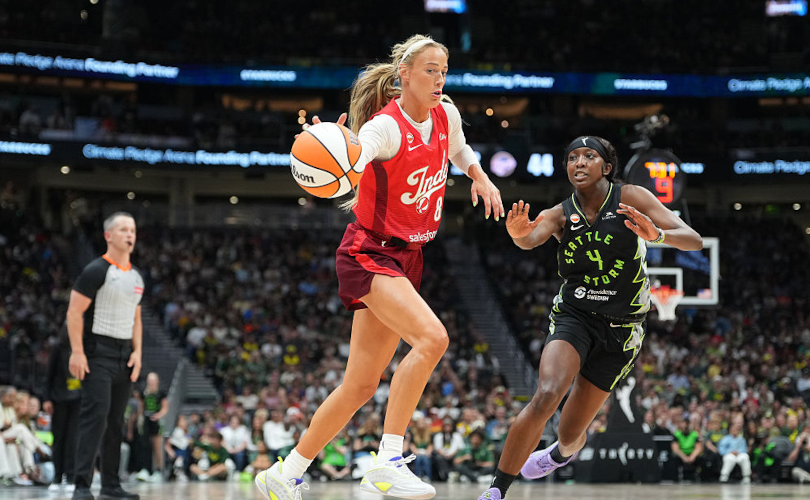
- Focus on Sophie Cunningham and the WNBA spotlight.
- Cover her comments on women’s sports and locker rooms.
- Connect her backlash to the Riley Gaines story.
- Show the reaction from activists, fans, and media.
- Highlight the growing public support around the issue.
The WNBA has plenty of drama already, but Sophie Cunningham has pushed the conversation into something bigger than basketball. After speaking plainly about protecting women’s sports, she suddenly found herself in the middle of a loud cultural fight that has only made her profile grow.
Cunningham has built a reputation as a tough, physical guard who does not shy away from contact or controversy. That edge, paired with her rising fame alongside Caitlin Clark, has helped turn her into one of the league’s most watched personalities, even when the attention has little to do with box scores.
The spark came when she was asked about the heated debate over men in women’s sports. Her answer was direct, and it was not wrapped in careful PR language. She said she wanted to “protect women’s sports, and: “I got a lot of negative feedback about me hating trans. And I’m like, ‘I never once said that … I think that I am here to extend love. But I also think with that love is truth, being honest. And I want to protect young girls in a locker room, or young girls in sport who shouldn’t have to go against biological men.”
That kind of comment has a way of flipping a switch. It did it to Riley Gaines, who was pulled into the national spotlight after standing next to Lia Thomas at the NCAA championships, and it is doing the same thing to Cunningham now. Once the activists decide someone is a problem, the person usually stops being treated like an athlete and starts being treated like a symbol.
The backlash came fast and came ugly. Some media coverage framed Cunningham as offensive, while social media filled up with insults meant to shut her down rather than answer her point. At one game, an opposing player even arrived wearing a shirt that read “Trans Rights Are Human Rights,” turning the matchup into a political stage instead of a sports event.
One basketball writer :
Sophie Cunningham is like every other transphobe: a bigoted loser advocating for discriminatory policy change based on immaterial safety concerns. She is endorsing and perpetuating violence against one of the world’s most marginalized communities and it is despicable.
That kind of response says a lot. It shows how quickly a straightforward defense of female spaces can trigger a pile-on from people who preach tolerance while hurling venom at anyone who disagrees with them.
https://x.com/jackfrank_jjf/status/2081871167145783567?s=20
When Cunningham was pressed again and given a chance to walk it back, she didn’t budge. “I said what I said,” she retorted. “I think it’s kind of common sense… I think it’s really important to protect children.” That answer landed because it was simple, and because a lot of Americans are tired of watching common sense get treated like a scandal.
The story got even bigger in Seattle, where two teenage girls showed up with a sign thanking Cunningham for speaking up. A Storm co-owner exploded at them, yelling so aggressively that one of the girls was brought to tears before halftime, and the team later faced discipline. Instead of quieting things down, the reaction only made Cunningham look steadier and made the overreaction look worse.
Cunningham answered that scene on X with a message that was sharp but controlled: “Bravo to those girls for standing up for what they believe. You’ll be hearing from me soon … yay for gifts. Truly embarrassing of the co-owner. Unfortunately shows the type of leader she is.” The response made clear she wasn’t backing away, and that she saw the girls, not the critics, as the ones showing real courage.
What happened next was predictable in one sense and surprising in another. Supporters began organizing public rallies in her name, including events in cities like Portland and Minneapolis, where people want to show that women and girls should not be bullied into silence. The message behind those gatherings is pretty simple: speak up, stand firm, and stop pretending the debate is settled when millions of people disagree with the loudest voices.
For Cunningham, the whole episode has pushed her from player to lightning rod without much warning. But it has also revealed how many fans are ready to say out loud what a lot of people have been thinking for years, and that is that women’s sports should stay women’s sports, no matter how hard the activists try to rewrite the rules.
