
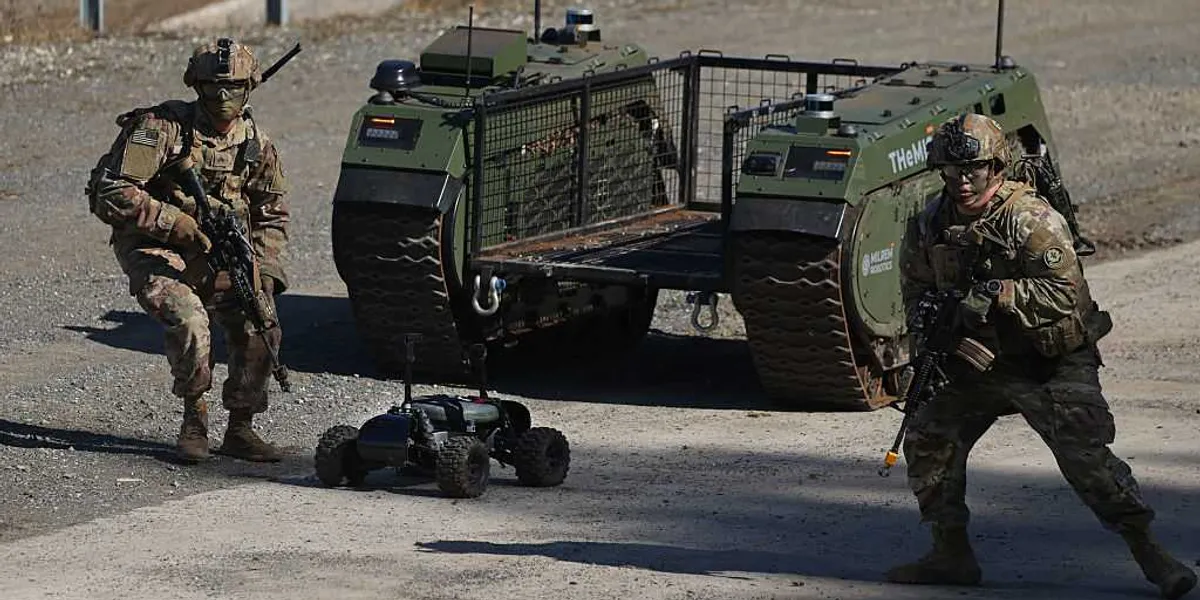
America’s defense industrial base is trapped between decade-long programs that blow budgets and a battlefield that rewards speed, agility, and cheap, autonomous systems. This article argues the obvious: faster delivery and renewed manufacturing capacity come when big, reliable defense firms team up with agile startups and private capital. I’ll show how that blend fixes weaknesses, the role venture-backed firms play, and real partnership examples already moving the needle.
For years the defense acquisition process rewarded scale and longevity over speed and iteration, and our rivals smelled opportunity. Adversaries are deploying asymmetric, robotic, and increasingly autonomous systems that erase the old advantages of mass and time. That means procurement that moves at the speed of politics loses on the battlefield.
Washington can no longer tolerate multi-year program creep while modern threats evolve overnight. The way to close that gap is not to trash established firms or worship startups, but to fuse their strengths. Big primes bring production lines, sustainment, and supply chain heft; small firms bring rapid cycles, modern software practices, and operator-driven design.
The fusion of established and startup contractors is the best strategic framework to reshore American manufacturing and reinvigorate our nation’s defense industrial base.
Venture capital has crept into defense for a reason: when you let talented engineers chase product-market fit, they build things the Pentagon actually needs. Companies like Palantir and Anduril proved you can iterate quickly, field prototypes, and refine systems with real users before bureaucratic requirements even finish circulating. That pressure to deliver drives innovation that legacy program timelines rarely produce.
At the same time, major firms are not standing still. Lockheed, Boeing, Northrop, and General Dynamics still hold the factories, quality control, and experience needed to turn prototypes into fleets. Those factories are also where the United States sustains deterrence at scale and keeps lines of supply and repair close to home. Marrying fast-moving tech to those factories gives us both speed and staying power.
Putting these pieces together requires policy that incentivizes partnership, not competition for crumbs. Contracting rules, funding windows, and accountability must favor programs that pair a startup’s prototype with an established partner’s production plan. That approach shortens the time between a capability idea and a capability everywhere our troops need it.
Industry is already moving in the right direction. General Dynamics Land Systems and Epirus built mobile counter-UAS systems that can protect forward-deployed units and critical infrastructure. Lockheed Martin’s deal with Hadrian expanded production of missile components that the country sorely needs. Northrop Grumman’s investment in Firefly Aerospace pushed launch capabilities faster toward operational use.
These are not isolated wins; they are repeatable patterns where private investment and prime-level scale create leverage. When venture-backed teams prove a design and primes commit production capacity, the government gets mature systems without funding every R and D step. That reduces cost overruns and speeds fielding — which is exactly what national security demands.
Secretary Pete Hegseth’s Warfighting Acquisition System pushes the right ideas: prioritize commercial best practices, embrace modular architectures, and bake software-upgradability into platforms. Those are the mechanics that let us update capabilities in months instead of decades. Industry must follow that playbook and Congress should make it the default rather than the exception.
This model also helps reshore manufacturing and secure supply chains, two priorities that are both patriotic and practical. Strengthening domestic production creates jobs in communities that deserve better economic options and reduces risky dependence on foreign suppliers. It also gives commanders predictable logistics when tensions spike.
No one side has a monopoly on the answer. Startups need scale to make their designs meaningful for large force structures, and primes need new ways to accelerate engineering cycles. Policymakers should reward joint proposals that combine early-stage innovation with firm production commitments rather than favoring either extreme.
Keeping deterrence credible means moving faster and smarter, not throwing out what already works. The goal is simple: build a defense industrial base that can out-innovate and out-produce rivals, then deliver capabilities to the tip of the spear on a timeline that actually matters. That balance is within reach if we insist on practical partnerships and clear, results-focused procurement rules.
