
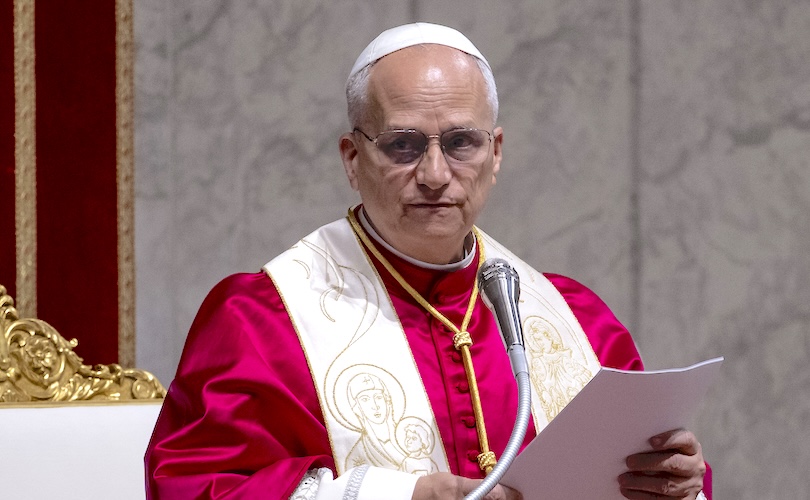
This piece takes a clear look at a clash inside the Church: a modern pope’s revision on capital punishment and a new claimant to papal authority who backs it, and what that collision means for doctrine and conscience. I lay out how that decision conflicts with long-standing teaching, why it creates practical problems for clergy and laity, and what faithful Catholics should watch for as the debate unfolds. Expect frank language, a straightforward Republican critique, and a call to defend doctrinal clarity in a time of institutional uncertainty.
By endorsing Francis’s 2018 Catechism revision on capital punishment, Leo XIV has chosen a competing rule of faith over that proposed by the ordinary and universal Catholic Magisterium. That sentence is the hinge of the issue and it cannot be softened without losing the point: when a claimed pope upholds a change that sidelines the established magisterium, the result is theological chaos. Conservatives who love the Church need to see this for what it is, not paper over it with polite words or bureaucratic niceties.
The dispute is not just abstract theology; it touches how bishops preach, how judges weigh conscience, and how ordinary Catholics understand justice and mercy. For centuries the Church navigated the moral complexity of capital punishment with prudential judgment anchored in a consistent moral framework. Rewriting that framework in a way that undercuts the ordinary and universal teaching amounts to replacing a map with someone else’s sketch, and that matters when souls and civic order are at stake.
Practically, this endorsement furthers confusion among the faithful. Priests try to teach a living tradition while parishioners hear conflicting signals from high places. When Rome sounds like it is split, local pastors face impossible choices: follow older magisterial guidance or bend toward the newest text stamped with papal approval. That tension weakens authority and hands critics of the Church ammunition to claim incoherence where there should be moral clarity.
There are also political consequences. A change that soft-pedals legitimate uses of state authority on public safety plays well in some circles, but it alienates those who believe in law, order, and the prudent use of justice to protect society. Republicans who care about the rule of law should be wary when doctrinal shifts are used to score partisan points or to reshape civic norms without due deliberation. Faithful Catholics should not let the Church be a pawn in ideological battles that ignore subsidiarity and prudence.
At the same time, this moment demands clear, courageous leadership from bishops and theologians who will defend a coherent moral vision. That means refusing to hide behind ambiguity when doctrine is under pressure, and insistently teaching the faithful what the Church has always meant about moral responsibility and statecraft. It also means calling out errors plainly when they appear and offering pastoral care to those bewildered by competing claims from the top.
The laity play a role too: informed Catholics must press for explanations, ask for consistent teaching, and hold pastors accountable without turning every disagreement into factionalism. Loyalty to the Church is not blind; it is a commitment to truth and to the integrity of a living tradition. When leaders endorse changes that contradict the ordinary magisterium, the faithful have a duty to seek clarity and to defend the Church’s teaching heritage.
What happens next will set a precedent for how doctrinal disputes are resolved or ignored inside the Church. Will bishops insist on the ordinary and universal magisterium as the anchor of teaching, or will future popes and claimants find it easy to substitute their own theological judgments for long-standing consensus? Republicans who value stable institutions should watch closely, because the integrity of religious authority affects public life and civic trust. The stakes are real, and this controversy is only getting started.
