
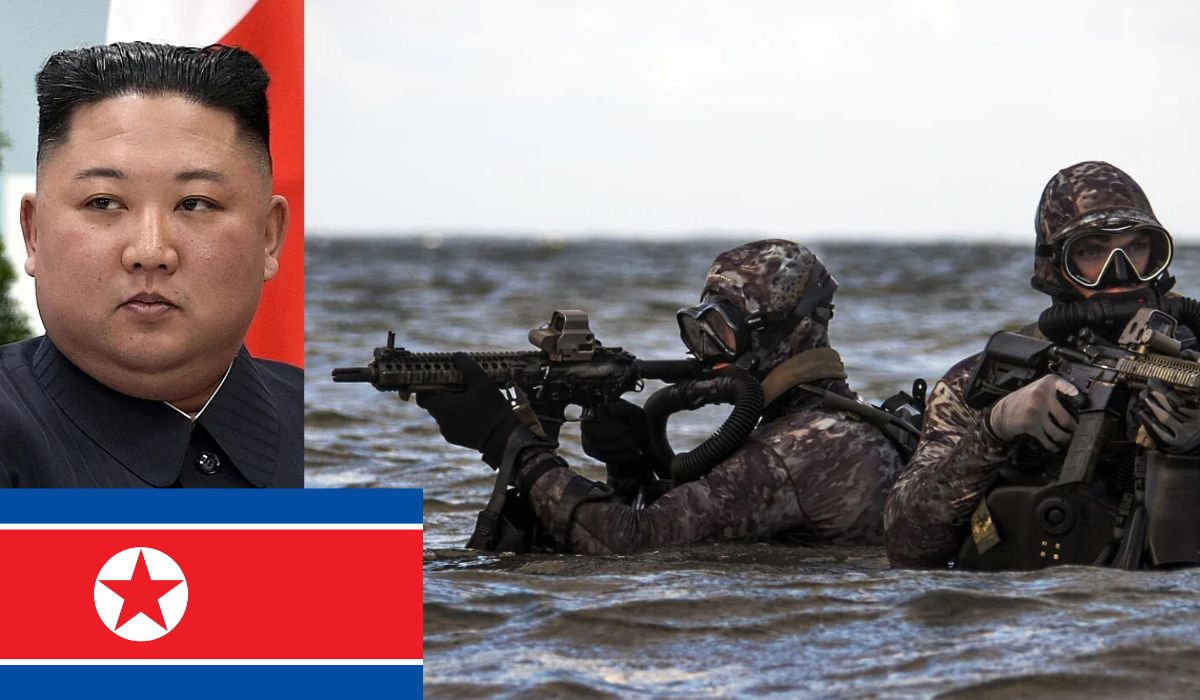
In early 2019, a covert mission involving SEAL Team 6’s Red Squadron was initiated deep within North Korean territory. Their objective was to plant a communications-interception device aimed at monitoring Kim Jong-un’s private communications. The operation, reportedly approved at the highest levels of government, supposedly had the personal blessing of then-President Donald Trump.
The mission unfolded amidst diplomatic efforts to ease tensions with North Korea. Frustrated by the lack of progress through sanctions and surveillance, U.S. intelligence circles saw this as an opportunity. They believed that deploying highly trained operatives might yield the intelligence that satellites and drones had failed to secure.
The SEALs embarked on their mission from a nuclear-powered submarine, utilizing stealthy mini-submarines to reach the North Korean coast under the cover of night. With near-freezing temperatures, the team had rigorously prepared for months in similar conditions. Every aspect of the mission was rehearsed to minimize exposure, including maintaining strict radio silence and precise timing.
However, despite meticulous planning, the operation quickly went awry. As the SEALs approached the shoreline, they encountered a North Korean fishing boat. Mistakenly believing they had been detected, the team opened fire, only to realize they had engaged unarmed civilians.
Reports indicate that two to three civilians were killed instantly. In interviews, members of SEAL Team 6 defended their actions, arguing that the use of force was inherently permitted under the mission’s nature. They believed they were taking necessary precautions to protect themselves and the mission.
The SEALs reportedly attempted to cover up the civilian deaths by sinking the bodies, then withdrew without completing their objective. The mission ended in failure, leaving many questions unanswered. Allegedly, key congressional committees were never informed about the operation.
President Trump, when asked about the mission, denied any prior knowledge of it. “I’m hearing it now for the first time,” he told reporters. This secrecy has raised significant legal and ethical questions, as such operations are typically required to be reported to congressional intelligence committees.
The incident has sparked debate about who holds the authority to authorize covert military operations that could potentially spark international conflict. On social media, opinions were divided, with some defending the SEALs and President Trump, while others questioned the accuracy of the New York Times’ report.
The White House and Pentagon have largely chosen to remain silent on the matter. Despite the mission’s catastrophic outcome, some SEALs reportedly received promotions. This has led to further scrutiny over military accountability and transparency.
The mission’s failure had broader implications for U.S.-North Korea relations, occurring just weeks before a summit between Trump and Kim Jong-un. The botched operation contributed to a breakdown in trust, and the summit ended without an agreement. This development has had lasting effects on the diplomatic landscape.
In the aftermath, North Korea accelerated its nuclear development, complicating the regional security situation. Pentagon sources cited rules of engagement to justify the SEALs’ actions, but many experts question whether such actions are justifiable when unarmed civilians are involved. The incident has reignited debates about the ethics of covert operations.
Although the exact number of Navy SEALs is not publicly known, there are an estimated 2,500 members. These elite forces are trained for high-risk missions in various environments, often operating behind enemy lines to gather intelligence and support U.S. objectives. Their actions are critical, yet they must be balanced with accountability.
Legal experts have pointed out potential violations of federal law regarding the mission’s secrecy. Covert operations risking civilian casualties should be officially approved and monitored by oversight bodies. The failure to report this mission to Congress could be a breach of these rules.
The incident is part of a broader history of U.S. operations abroad that often result in civilian casualties. These are frequently underreported, with the mainstream media glossing over the human cost. Such incidents, labeled as ‘collateral damage,’ continue to spark controversy.
The civilian impact of American foreign policy remains a contentious issue, with past wars resulting in significant loss of life. Estimates from the Afghanistan and Iraq wars reflect a wide range of civilian casualties, further fueling the debate. These figures underscore the ongoing political controversy surrounding U.S. military actions.
North Korea, with a population of around 26 million, remains technically at war with South Korea. The Korean War ended in 1953 with an armistice, not a peace treaty. This has left the Korean Peninsula in a state of tense ceasefire for over seven decades.
A similar incident involving civilian deaths was brought to light by WikiLeaks in 2010. The release of a video titled “Collateral Murder” showed a U.S. Apache helicopter engaging what was believed to be insurgents in Iraq, but were actually civilians and journalists. This footage, recorded in 2007, became one of the most controversial leaks of the 2000s.
