
Nvidia is pushing data center cooling into stranger, hotter territory, and that is exactly the point. The company’s newest AI infrastructure leans hard into closed-loop liquid cooling, aiming to cut water waste inside the facility while keeping massive racks stable under punishing heat loads. But the real story is bigger than one clever cooling system, because it ties together AI growth, power demand, water use, and the messy reality of how modern data centers actually run.
For years, a lot of data centers have depended on open-loop evaporative cooling, which sounds efficient until you look at the water bill. These systems use chillers and cooling towers to dump heat through evaporation, and that means a steady stream of makeup water is always needed. Studies have estimated that a huge share of that water, often around 70% to 80%, is lost in the process, which is why greener approaches have become less of a nice-to-have and more of a necessity.
That pressure is already changing the industry. Some operators are turning to reclaimed wastewater, while others are building water-positive programs and experimenting with different cooling methods that squeeze more performance out of every watt. Closed-loop liquid cooling has been gathering momentum because it can be far less thirsty than traditional setups, even if it has taken time for the hardware, plumbing, and operating habits to catch up.
Nvidia’s approach fits right into that shift. Its new design uses direct-to-chip liquid cooling and sits inside the company’s DSX AI platform, a reference blueprint for AI factories built around Nvidia hardware and software. Within that system, the cooling setup is part of a broader effort to maximize compute while keeping energy use under control, which is a pretty big deal when the machines in question are chewing through extraordinary amounts of power.
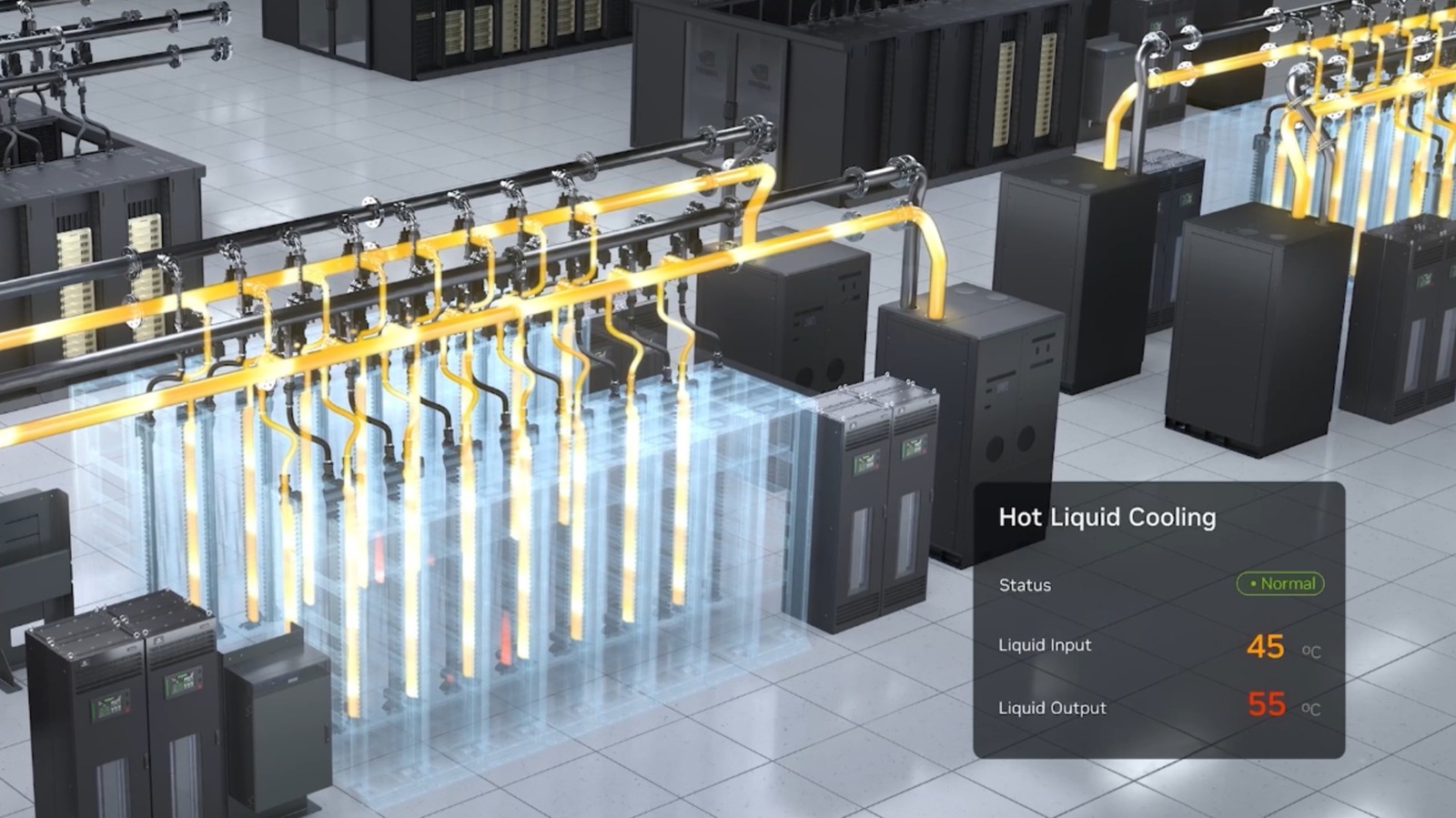
The cooling loop itself is built around a mix of 75 percent water and 25 percent propylene glycol, and Nvidia says it runs at a warm 45°C. The fluid enters at 45°C and leaves at 55°C, then carries heat to an outdoor passive radiator instead of relying on more traditional mechanical cooling in many situations. That warm-water approach is the trick, since it can reduce dependence on chillers and cooling towers, though Nvidia also acknowledges that geography matters and hotter regions, like Arizona, may still need chillers.
There is also a lot more being cooled than just the obvious chips. Nvidia’s setup uses monolithic cold plates that move liquid across GPUs, CPUs, NVLink switches, optic modules, and even power bus bars rated for a continuous current of 5,000 amps. The closed loop is designed to be filled once and, in Nvidia’s telling, to last for the life of the facility, which is a bold claim and one that naturally invites some healthy skepticism.
The reason Nvidia is going this far is simple: the newest chips are beasts. The company’s Vera Rubin architecture cranks power requirements up to a different level, with a single Rubin GPU drawing as much as 2,300 watts, a major jump over the older GB300. A full Vera Rubin NVL72 rack, with 72 Rubin GPUs and 36 Vera CPUs plus supporting hardware, pushes beyond 200 kW, which is way past what air cooling can realistically handle.
That is why the move to full liquid cooling feels less like a fancy optimization and more like a hard requirement. Earlier Grace Blackwell systems already used liquid cooling for GPUs, but other components still leaned on air. With Rubin, the heat load is simply too intense for that split approach, so the entire stack has to be treated like a single, tightly managed thermal problem.
Even then, the water conversation does not end at the data center fence line. Cooling towers can use roughly 2.6 million gallons of water per megawatt each year, but facility water is only part of the picture because the electricity powering these systems has its own water footprint. Fossil fuel plants still consume enormous amounts of water every day, and with data center demand climbing, the cooling debate is starting to look a lot like an energy debate wearing a water mask.
