
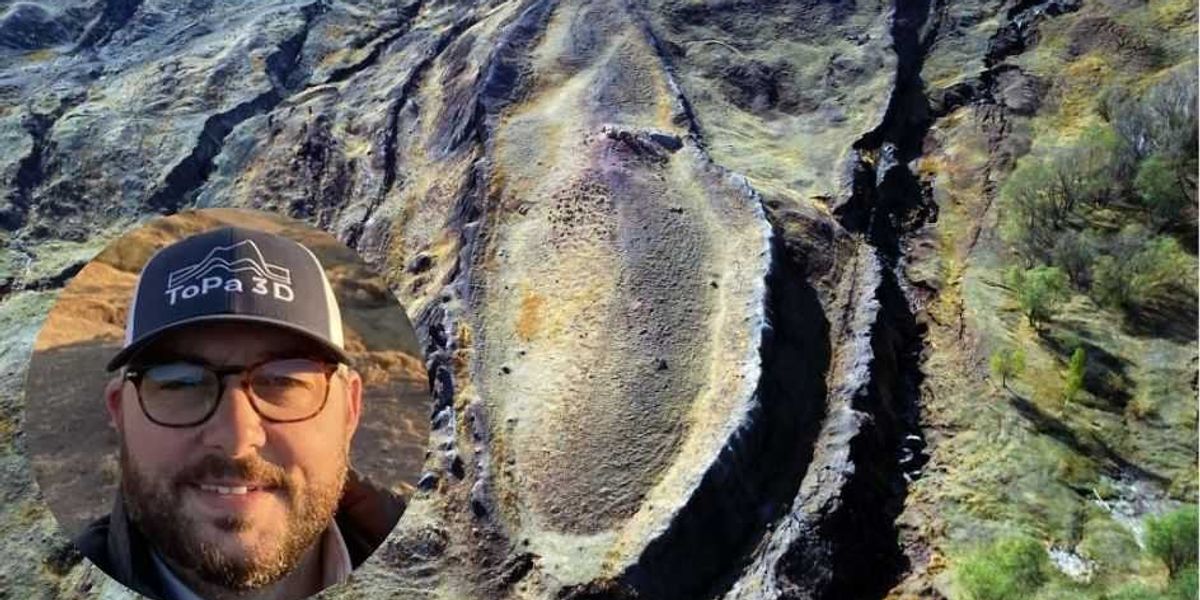
This piece follows one man’s patient, science-first push to test a boat-shaped formation in eastern Turkey and the loud skepticism that greets anyone who even suggests it might be related to Noah’s ark.
There is a strain of online dismissal that masquerades as skeptical rigor but often stops at a punchy tweet. Instead of calling, checking data, or asking for raw results, critics fire off a hot take and let ridicule do the heavy lifting. That attitude has landed squarely on Andrew Jones, who has been building a careful, multidisciplinary inquiry into a boat-shaped feature in the Armenian Highlands.
Jones will tell you he is not an archaeologist, and he says so openly. What he is is an organizer who has spent years living in Turkey, cultivating relationships with universities, navigating permits, and assembling geologists, geophysicists, soil scientists, and archaeologists to conduct systematic surveys. The team’s approach is deliberately stepwise: noninvasive scans, soil chemistry, independent review, then proposals for drilling or excavation if the data justify it.
The Durupinar formation is a boat-shaped impression in a valley south of Mount Ararat that has drawn attention for decades. It first entered the public record long before modern internet debates, yet today it is too easily dismissed by invoking a single controversial amateur from the past. That reflex ignores the fact that the feature was flagged during a 1959 aerial mission and investigated by ground teams in the early 1960s.
What complicates easy dismissal are the context clues around the formation: abandoned churches, graveyards, and other artifacts dotting the valley floor. Jones notes an on-site discovery by a Turkish archaeologist: “Maybe 50 feet away from the site, he [found] pottery just laying on the ground where the locals are plowing,” and that the fragments were identified as dating to eras relevant for biblical chronology. “This is the age you’re looking for for Noah’s Ark,” says Jones. “If you’re doing biblical chronology, they would place it during that time period.”
Some critics focus on semantics, arguing the term Ararat is too vague or that its modern association is recent. They repeat lines like “the modern site of Mount Ararat has only been called that since the 13th century” and that “the broader issue is that the precise location of Ararat remains unknown.” Those claims matter rhetorically, but they do not remove the Durupinar site from the Armenian Highlands, the region understood historically as Urartu, which the biblical text references.
Another favorite dismissal aims squarely at the science: ground-penetrating radar. One critic’s line is that “you simply don’t know what you’re looking at with GPR alone.” That is technically accurate and Jones’ team has never argued otherwise. They treat GPR as a preliminary tool, the modern equivalent of an MRI before you consider surgery, not a final verdict.
GPR surveys and other geophysical methods used at the site have returned features that are not easily waved away as random geology. The scans reportedly revealed angular, right-angled internal anomalies and a linear anomaly running down the center, which Jones describes plainly: “There’s a straight line of voids,” he says. “Now I interpret that as someone who’s thinking this is possibly Noah’s ark.” To him, that geometry hints at internal corridors rather than natural synclines.
Independent electrical resistivity tomography also identified three distinct horizontal layers in the formation, an observation some have noted aligns with the biblical description of decks. The team’s soil sampling showed organic matter levels inside the formation several times higher than the surrounding matrix, with elevated potassium consistent with decomposed wood rather than pure mountain detritus. Those are the kinds of geochemical signals geologists use to form testable hypotheses.
Critics often reduce years of coordinated work to a single talking point: “It’s just GPR.” But the project combines multiple lines of evidence, cross-checked by unaffiliated specialists, and awaits permission for sonic core drilling that would produce intact subsurface samples. If core results contradict the ship hypothesis, that result will be published and debated like any scientific finding.
Charges that the enterprise is amateurish also miss the years of groundwork required to operate in Turkey. Jones has secured formal agreements with a Turkish university, coordinated sample analysis in local labs, and involved experienced regional archaeologists in pedestrian surveys. Those steps are the slow, unglamorous parts of doing legitimate field science in a foreign jurisdiction.
There are commentators who propose quick, expensive digs on the air, but public bluster is not a substitute for permits, local collaboration, and methodical geophysics. The critics offer talk; Jones’ camp offers data streams, lab reports, and peer review opportunities. That difference between noise and measured inquiry explains why the debate often feels more cultural than scientific.
The investigation isn’t finished, and the team has repeatedly invited independent review of raw data and methods. Rather than reflexive dismissal, the practical move is to demand access to the datasets and to let future drilling and analyses decide the question. Until then, the data deserve serious engagement, not predictable mockery.
https://x.com/WesleyLHuff/status/2047497595824611486
