
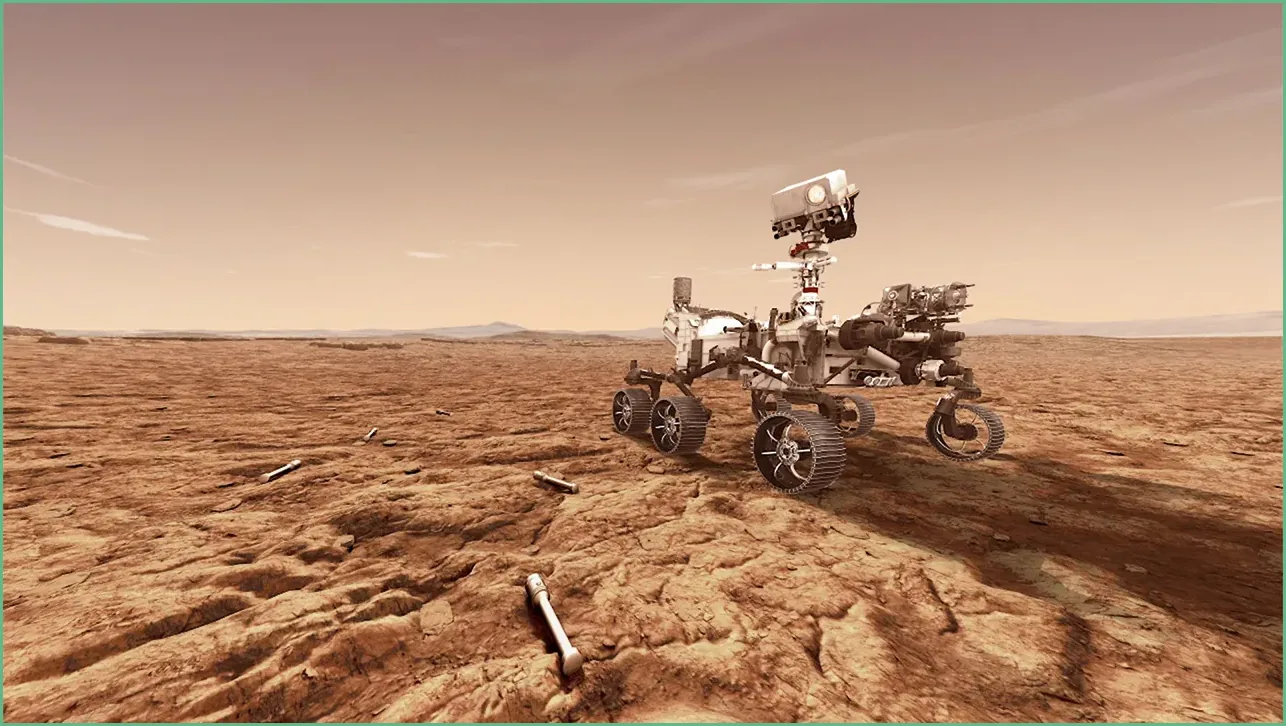
NASA’s Perseverance rover may have found a small but striking clue from space: a shiny, metallic rock nicknamed “Phippsaksla” that the team thinks might be a meteorite. Instruments on the rover detected unusually high levels of iron and nickel, elements typically linked to cosmic fragments. If confirmed, this find would add another chapter to what rovers are teaching us about how meteorites behave on Mars.
The rock caught attention because it looks out of place on the flat, broken terrain near Jezero crater. Its surface gleams compared to surrounding stones, which is exactly the sort of visual cue that makes scientists put a target on it. That odd contrast led to closer inspection with the rover’s science toolkit.
Perseverance trained its SuperCam instrument on “Phippsaksla” to get a chemical readout. SuperCam fires a focused laser that vaporizes a tiny bit of material and reads the resulting light to identify elements. The readings flagged elevated iron and nickel, a combination that often points toward a meteorite origin rather than native Martian rock.
Iron and nickel together are unusual on Mars except in objects identified as meteoritic, which is why the team is excited. Past missions have turned up similar metallic visitors, so the pattern is familiar even if each example adds new details. Those earlier finds help establish expectations about weathering and how long such pieces can remain recognizable on the surface.
Other rovers have discovered metal-rich fragments before, including Curiosity’s finds named “Lebanon” and “Cacao” as well as pieces cataloged by Opportunity and Spirit. Each time, the fragments offered lessons about how Martian winds, dust, and oxidation change meteorites over time. Adding a Perseverance example would let scientists compare a fresh data set gathered with modern instruments to those older observations.
Location matters: “Phippsaksla” sits on impact-formed bedrock just beyond the Jezero rim, which could be meaningful for its story. Being perched on ancient substrate may tell researchers whether the rock landed there long ago or was moved by later processes. Context helps separate whether a meteoritic piece is an isolated visitor or part of a broader depositional story.
SuperCam’s detections are a powerful first step but not a full identification on their own. The instrument gives clear fingerprints of elemental presence from several meters away, which is ideal for scouting targets. Follow-up measurements and close-up imaging will be needed to confirm the texture and composition that clinch a meteorite diagnosis.
Perseverance carries a suite of tools geared toward thorough geological work, including a robotic arm and a rock drill for sample collection. The rover’s payload is designed to look for signs of ancient environments that might once have supported life, but it also does fundamental planetary science like cataloging meteorites. Finding one now fits cleanly into both goals: it is a geological curiosity and a piece of solar system history.
Meteorites on Mars are more than curios; they are records of the broader solar system hitting the planet over eons. Studying their composition and how they break down under Martian conditions helps refine models of impact flux and surface alteration. Each example tightens the picture of how Mars interacts with space debris and what that tells us about planetary surfaces in general.
The Perseverance mission launched in 2020 and touched down in Jezero crater in early 2021, where it has been mapping, probing, and caching samples. The rover is powered by a plutonium generator and carries seven main scientific instruments to probe rocks, atmosphere, and ancient environments. Its work supports both immediate science goals and long-term plans for returning samples to Earth and preparing for future human exploration.
For now, the team continues to study “Phippsaksla” to confirm whether its chemistry and texture match meteorite expectations. If the verdict is yes, the rock will join a growing list of cosmic visitors that have left metal fingerprints on the Martian surface. Either way, the discovery highlights that even familiar-looking landscapes can still surprise us with new pieces of the solar system puzzle.
