
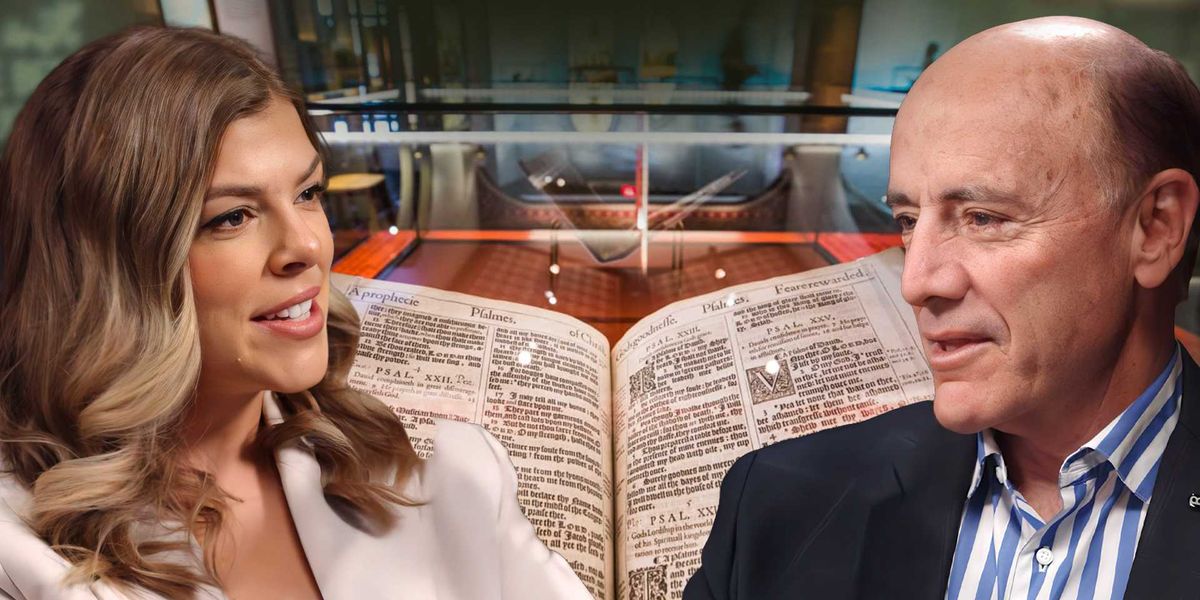
The short version: the Museum of the Bible and Allie Beth Stuckey argue that the Bible and Christian ideas were woven into America’s founding, and they push back hard against the notion that the founders were merely secular deists. Their conversation digs into how language like the capital-C “Creator” and the moral instincts of the era point to a Christian cultural backbone. They don’t claim every founder was an orthodox believer, but they insist the Bible shaped the public life and vocabulary that produced the Declaration and other founding documents.
People love the simple version that the founders were all pragmatic Enlightenment figures who left faith at the door. That’s a tidy story, but it misses how ideas travel: they soak into culture, law, and speech. Dr. Carlos Campo, who runs the Museum of the Bible, is showing an exhibit that looks for those echoes and he makes the case plainly—Christian ideas were in the air.
Allie Beth Stuckey frames the question bluntly: “Is that true what we hear — that all of the founders were just deists, that they didn’t really have any faith imbued in our founding documents?” She challenges the lazy academic line that strips faith out of public life and leaves only cold rationalism behind. Stuckey presses for nuance, not erasure, and insists we read the era on its own terms.
Campo answers with a careful refusal to oversimplify: “Can we say that every founder was an orthodox Christian? No. And we wouldn’t say that. See, we have a mandate, unlike other places, that we have to tell the story fully and faithfully.” He doesn’t sanitize the past, but he refuses to pretend faith had no public role. That’s an important distinction for anyone who wants an honest account.
Campo points out something simple and often overlooked: these men lived inside a Christian cultural grammar. “But if we could only exhume the bodies of these men and talk to them again, I don’t think we can even fully understand how the Bible was truly part of the air that they breathed,” he says, and that image is hard to shake. Once you accept that a whole culture shares assumptions, the legal and political language starts to make a lot more sense.
Consider the debate over the Declaration. The draftwork and edits reveal deliberate choices, not accidental phrasing. Campo highlights that they inserted the word “Creator” with a capital “C,” a small editorial move that carries big meaning. It signals reliance on a concept of rights rooted in a theistic view of human dignity, not in state-granted privilege.
Stuckey presses that point. “That’s such a good point that it was so ubiquitous in their culture … that they just didn’t realize how special and unique it was,” she responds, noting how ordinary those references felt to people of the time. To modern ears they can sound steeped in theology, but to contemporaries they were just part of normal civic conversation.
She links the gospel’s moral claims to the radical political idea that rights come from the person, not the crown. The principle that “your rights don’t come from a monarch” flips the old order, and Stuckey says the gospel fed that conviction. The claim is modest but powerful: faith helped shape a political imagination that rejected monarchy.
Stuckey goes further and quotes John Adams to underline the point: “The general principles on which the fathers achieved independence were the general principles of Christianity, as eternal and immutable as the existence and attributes of God.” That line is often cited for a reason; it captures a contemporary judgment about where moral authority was thought to reside.
From a modern Republican viewpoint, acknowledging faith’s role isn’t about rewriting history to evangelize; it’s about recognizing roots. If the founders drew on Christian concepts of human value, then our constitutional order grew from moral soil that included religion. That reality should inform how we defend religious liberty and the public square today.
Rejecting the caricature of a uniformly secular founding doesn’t mean ignoring complexity. People like Jefferson, Adams, and Franklin held different beliefs and tensions existed between private faith and public reason. Still, the cultural presence of Christian language and moral instincts mattered—deeply and institutionally—when they framed rights and government.
So the conversation at the Museum of the Bible and Stuckey’s take aim to correct a common mistake: treating religion as an irrelevant footnote to the founding. Instead, they want readers to see how faith shaped ideas about personhood, rights, and community. That’s a view worth wrestling with honestly, without shrinking the founders to one-dimensional caricatures.
