
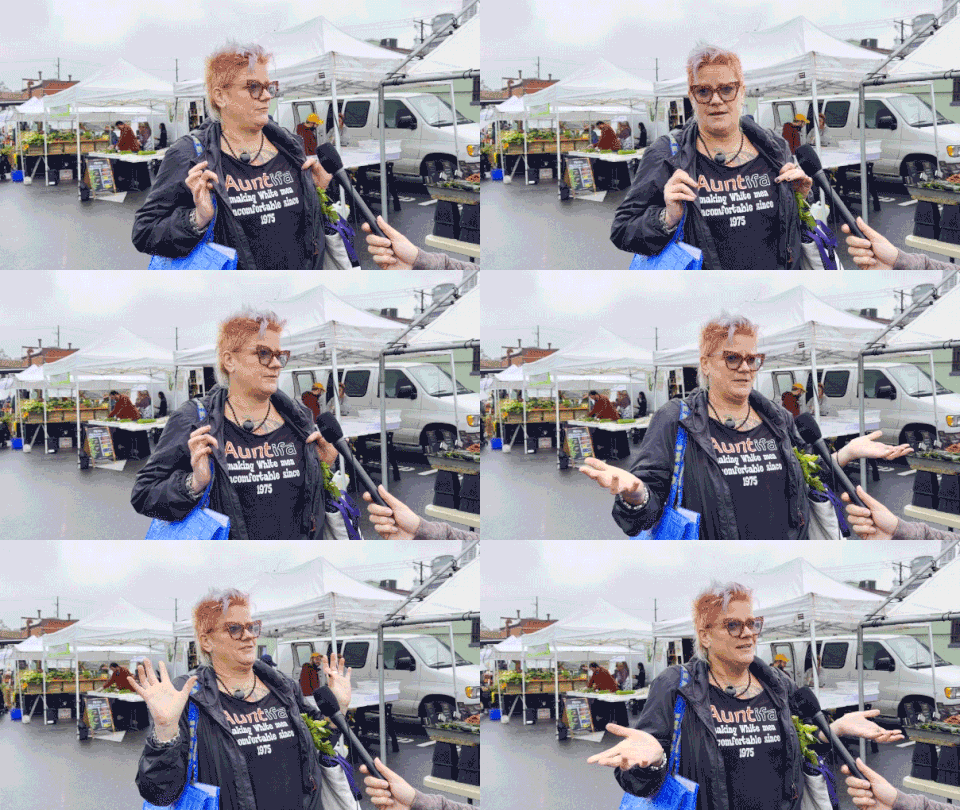
At a rainy street festival in Takoma Park, Maryland, festivalgoers gave blunt, often surprising answers when asked whether government should be able to take private homes and hand them over for public use. Some were open to the idea in principle, others said they would only consider it if there were fair compensation, and a few rejected the whole concept as a bad trade for personal freedom. The responses landed in a place already known for loud progressive politics, where questions about socialism and private property are hardly abstract.
Matt Volk said he could support the idea in broad terms, especially if land or property could be put to better use for housing and public needs. He stressed that the details would matter, but he clearly did not treat private ownership as untouchable. That kind of thinking has been showing up more often in younger, left-leaning circles, where socialism is no longer a fringe word tossed around in whispers.
The festival crowd reflected that shift in a very visual way too, with pride flags, activist shirts, and plenty of progressive messaging baked into the atmosphere. Karen Irwin, wearing a shirt that read, “Auntifa: Making White men uncomfortable since 1975,” was just as open to the idea of surrendering property if it happened through a democratic process. Her view was simple enough: if everyone voted for it, then the result would be fair.
Irwin also raised a bigger question that hangs over these debates, which is whether property rights are being discussed in the present tense or stretched across generations of ownership and confiscation. That uncertainty matters, because arguments for redistribution often sound neat until they run into the reality of who loses control and who gets to decide. Once government starts playing referee over homes and land, the line between public good and raw seizure gets thin fast.
The numbers behind the trend help explain why the subject keeps surfacing. A Fox News poll from March found that 38% of respondents said moving away from capitalism and toward socialism was a good idea, with support especially strong among very liberal voters, Democrats under 45, Black voters, and adults under 30. Even so, a narrow majority still said capitalism works well, which shows the country is far from all-in on the socialist pitch.
Not everyone at the festival was ready to hand over the keys to the state. Jaw Blake said he would not love the idea of government taking his home, but he would at least consider it if the outcome clearly helped people. Jenny Sniderman took a more guarded line, saying she would not want to give up private property unless she was compensated fairly, which is a lot closer to real-world economics than ideological slogans.
Steve Ney focused less on home seizure and more on rent stabilization, calling it a good way to keep people in their homes by limiting rent hikes. That position lines up with the kind of policy push now seen in places like New York City, where rent controls and broader socialist ideas have become a political flashpoint. Supporters sell these moves as protection, while critics say they are a fast track to less housing, more strain on property owners, and fewer incentives to build.
That tension showed up again through the words of REBNY President James Whelan, who argued that the real issue is not a lack of political slogans but a shortage of housing. He said record-high rents are tied to supply problems and stressed that many of the worst conditions are concentrated in buildings already under heavy regulation. In other words, government intervention may feel compassionate in the moment, but it can also deepen the mess it claims to solve.
Then there was Nina Gilden Seavy, a historian who dismissed the whole notion outright. She called the idea of government allocating all resources a fool’s errand and made it clear she saw no upside in turning that job over to politicians and bureaucrats. That kind of pushback still exists, even in places where progressive politics has a strong grip, and it keeps the debate from sliding into a one-sided cheerleading session.
