
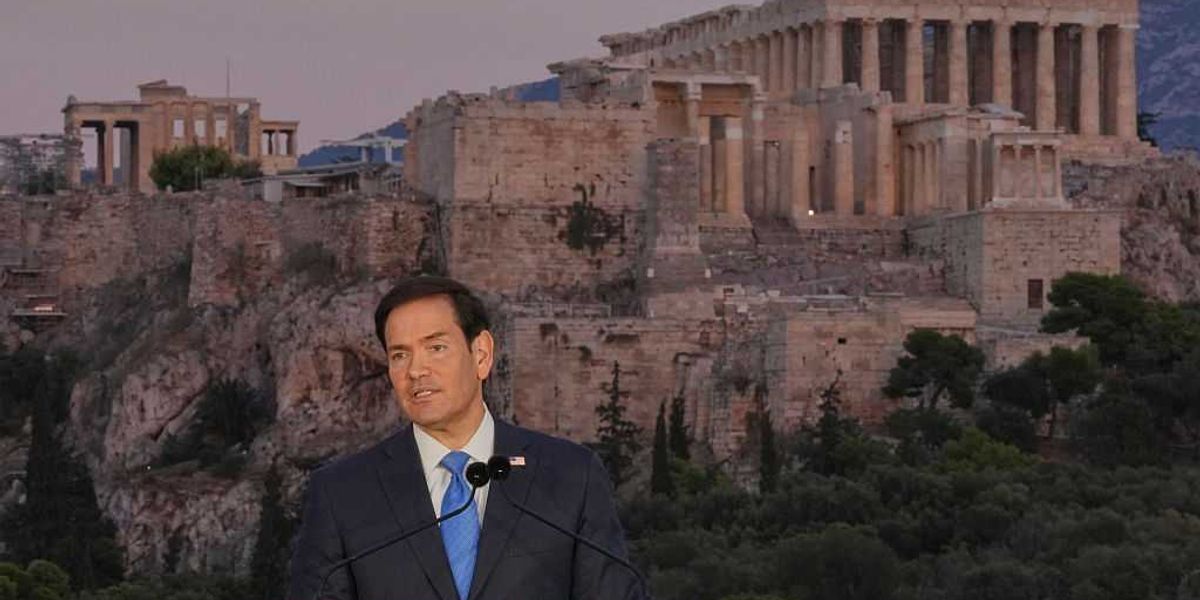
Marco Rubio’s Athens speech tapped into a big idea that still gets people fired up: the West did not happen by accident. It grew out of Greek philosophy, Roman law, and the moral weight of the Judeo-Christian tradition, and that mix still shapes the way free societies think about duty, liberty, and human dignity. What gets left out in speeches like this is often just as revealing as what gets said out loud.
That omission matters because Athens is more than a backdrop. It is the symbol of a civilization that asked hard questions about truth, virtue, citizenship, and power, and those questions never really went away. Rubio’s framing leaned on that deep inheritance, but the full picture is broader, thornier, and more unsettling than a clean tribute to the classics.
The ancient Greeks gave the West its hunger for reasoned argument and moral seriousness. Socrates forced people to examine themselves, Plato chased the meaning of justice, and Aristotle treated virtue as something to be practiced, not just praised. Homer, Plutarch, and the rest of that world offered stories of courage, pride, tragedy, and restraint that still echo because they deal with people as they really are, not as wishful thinkers imagine them.
Rome took that intellectual fire and built institutions around it. Law, citizenship, public order, and the idea that a republic could bind itself with rules all came into clearer focus there. That legacy matters now because modern freedom is not just about doing whatever feels good; it depends on habits, limits, and a sense that authority has to answer to something higher than raw power.
Then comes the Judeo-Christian layer, the part that often gets mentioned quickly and then rushed past. The Christian claim that every person has dignity before God changed the moral horizon of the West in a profound way, and it did so in ways that keep shaping debates over rights, justice, and the value of the individual. Without that influence, the Western story would be missing its strongest moral center.
Still, speeches about civilization can sound polished while skipping over the messier parts. Europe and the broader West have also carried conquest, arrogance, and ugly failures right alongside their highest ideals. Any honest account has to hold both truths at once, because the greatness of the tradition is easier to praise than to live up to.
That tension is part of why Athens remains such a powerful stage. It is a place where the past feels close enough to touch, but also demanding enough to make people think about what has been preserved, diluted, or discarded. In that sense, the speech was not just about memory, but about choosing which inheritance still deserves to guide public life.
The modern argument underneath all this is simple enough: a civilization survives when it remembers the sources of its own strength. If the West forgets the Greeks, Rome, and the moral law that came through Christianity, it risks becoming a shell that still uses old words while losing the substance behind them. That is why references to Athens continue to land with force, especially when public life feels noisy, shallow, and increasingly unsure of what should be defended.
What makes the speech land is not nostalgia alone, but the reminder that free people need more than procedures and slogans. They need a sense of excellence, discipline, and responsibility that reaches beyond the latest headline. Athens keeps offering that reminder, and it does so with a kind of old-world confidence that still unsettles anyone who prefers easy answers.
