
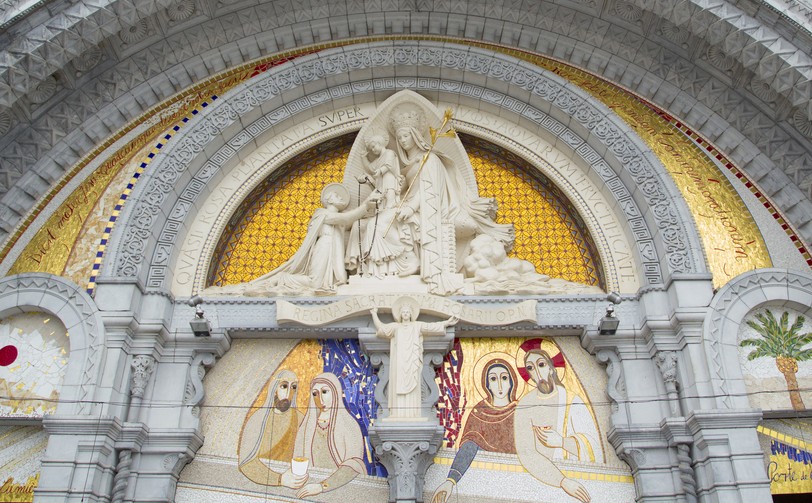
Bishop Jean-Marc Micas has decided that the Rupnik mosaics at Lourdes will stay covered for Pope Leo XIV’s September visit, a move meant to keep the focus on healing rather than the artwork of a disgraced former Jesuit. The decision lands in a place that draws pilgrims looking for peace, and it comes with the weight of abuse allegations that have shadowed the images for years.
At the center of this is the Basilica of Our Lady of the Rosary, where mosaics by Marko Ivan Rupnik have stirred anger and grief among survivors of clerical abuse. Micas said the cover-up is meant to show respect for victims, especially because Lourdes is a destination many of them already approach with caution.
The bishop has described Lourdes as a place shaped by the Immaculate Conception and by consolation for the wounded. He tied that meaning directly to survivors, saying the shrine can offer a measure of relief to people who carry deep pain from abuse and may struggle to enter spaces marked by troubling art.
That concern is not abstract. Bishop Micas said he listened to abuse survivors and heard how some of them could feel blocked from visiting the sanctuary when Rupnik’s work is visible, especially inside a place so closely associated with prayer and healing.
One recent visit sharpened that response. Micas mentioned Sister Samuelle, a French mosaicist and one of Rupnik’s alleged victims, as part of the broader reality that the images are not just decoration, but a live reminder of scandal for those who say they were harmed.
Rupnik’s case has remained one of the most disturbing in recent church memory because the allegations go far beyond a single accusation. He has been accused of sexual, spiritual, psychological, and physical abuse, and former Jesuit superiors have reportedly regarded the credibility of those claims as very high.
The controversy around his work has also grown because of what it depicts. Rupnik’s art is known for stylized figures with oversized, hollow-looking eyes, and critics have long argued that the imagery feels unsettling rather than uplifting, especially when placed in sacred settings.
For many Catholics, the problem is not only aesthetic but moral. The same man now facing serious allegations also built a reputation as a prominent church artist, which has made his mosaics difficult to separate from the scandal surrounding his name.
Coverage of the Lourdes mosaics has shifted over time. Bishop Micas ordered part of the pieces on the basilica’s doors to be covered in March 2025, yet the artwork was later seen fully visible again in May, showing how uneven the response has been.
Lourdes is not the only major Catholic site where Rupnik’s art has stood in public view. His mosaics have also appeared in prominent churches and shrines, including places tied to Saint Padre Pio and Saint John Paul II, though some works have since been hidden or removed.
The Vatican has also faced pressure over the pace and secrecy of the case. Pope Francis handed it to the Dicastery for the Doctrine of the Faith in 2023, and judges were appointed later that year, but the process has remained tight-lipped in a way that has fueled frustration.
That frustration only deepened when reports surfaced in July suggesting a five-judge panel had acquitted Rupnik of allegations of violence, while leaving other questions unresolved. The Holy See Press Office then denied that he had been cleared, leaving the case in a cloud of uncertainty that has done little to ease suspicion.
So the covered mosaics in Lourdes now sit inside a larger battle over accountability, memory, and whether sacred spaces should reflect the pain of survivors as much as the power of the art on their walls. As Pope Leo’s visit approaches, the shrine remains a place where devotion, scandal, and unfinished justice are all pressing against each other in plain sight.
