
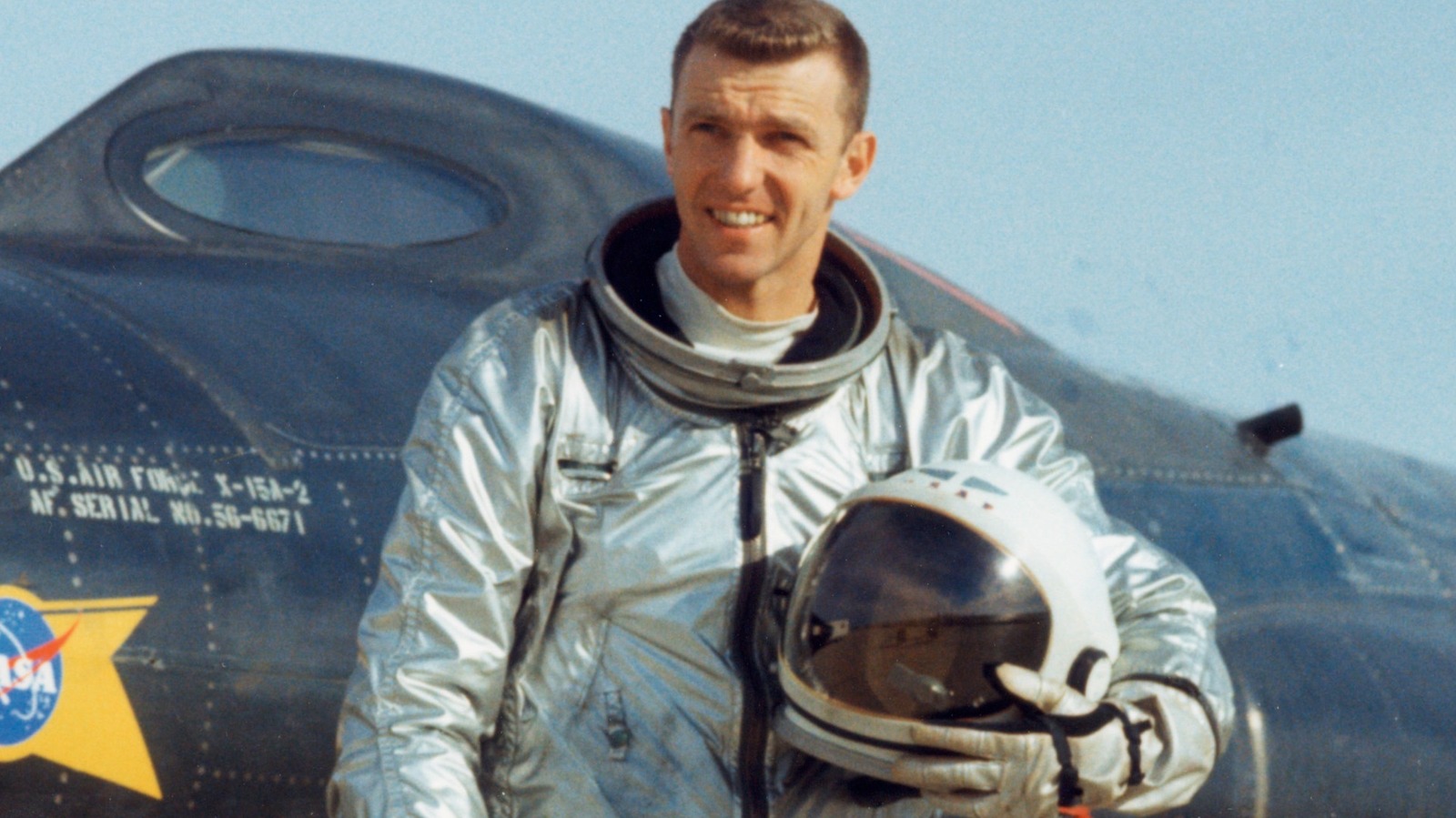
- Highlight the rare feat of flying to the edge of space in winged aircraft
- Follow Joe Engle’s path through the X-15 program and its record-setting flights
- Show how the X-15 shaped later NASA spacecraft and shuttle design
- Cover Engle’s place in NASA’s astronaut corps and the Apollo-era near misses
- Trace his Space Shuttle missions and the legacy that made him unique
Joe Engle’s story sits in a tiny, almost unbelievable corner of aviation history. He is the only person to fly both NASA’s rocket-powered X-15 and the Space Shuttle, a combo that put him in a class of his own and made his career feel bigger than one program or one era.
Back in 1965, Engle flew the X-15 high enough to cross the Kármán line, the widely used boundary between Earth’s atmosphere and space. He did it three times, which is wild enough, but the bigger picture is even better. That aircraft was built to push the limits of piloted hypersonic flight, and Engle was one of the pilots brave enough to keep taking it farther.
The X-15 program itself was a heavy-hitter. It was a joint effort involving NACA, later NASA, plus the U.S. Navy, the U.S. Air Force, and North American Aviation, and the data it produced helped shape Mercury, Gemini, Apollo, and even the Space Shuttle. In other words, the program was not just about speed and altitude, it was about figuring out how human beings could survive and operate in the harshest parts of flight.
Engle joined the X-15 program in 1963, after hoping to move directly into NASA’s astronaut corps. Instead, he was sent to Edwards Air Force Base, where he ended up logging 16 flights in the rocket plane before the program wrapped in 1965. That detour turned out to be the kind of career pivot that only looks random until history starts lining up behind it.
He also racked up some serious numbers along the way. On February 2, 1965, Engle hit Mach 5.7, which worked out to 3,866 mph, and on June 29 of that year he climbed to 280,600 feet, or 53.1 miles. On his very first flight, he even lost radio contact with the B-52 carrier aircraft and came back with an unauthorized 360-degree roll, which tells you the job was never boring.
NASA brought Engle into its astronaut program in 1966, right in the thick of the Apollo years. He was one of only 19 selected and worked as support for Apollo 10 before becoming backup Lunar Module Pilot for Apollo 14. He never got the moon landing seat, though, because Edgar D. Mitchell flew the mission, and later Harrison H. Schmitt took the Apollo 17 spot that Engle had been lined up for.
That kind of disappointment would have ended some careers, but Engle kept moving. When Apollo 18 was canceled, the door to the Moon shut for good, at least for him, and NASA shifted into the Shuttle era. Engle then commanded STS-2 in 1981, the second test flight of the Space Shuttle, which gave him a front-row seat to a brand-new kind of reusable spacecraft.
He did not stop there, either. Engle later commanded STS-51I, and over time he became a rare bridge between the experimental, high-risk rocket plane world and the orbital shuttle age. That is part of what makes his name still pop up whenever people talk about the boldest pilots NASA ever had, because his career touched the frontier on both sides of the atmosphere.
After leaving NASA and the Air Force, Engle kept collecting honors, including a string of hall of fame recognitions that matched the scale of his flying. He retired from the Air Force as a colonel in 1986, later accepted a brigadier general rank in the Kansas Air National Guard, and eventually retired from that service too as a major general. The medals and titles mattered, sure, but the real headline was simpler: he flew where almost nobody else could, and he did it in two of the most famous winged machines ever built.
