
–>
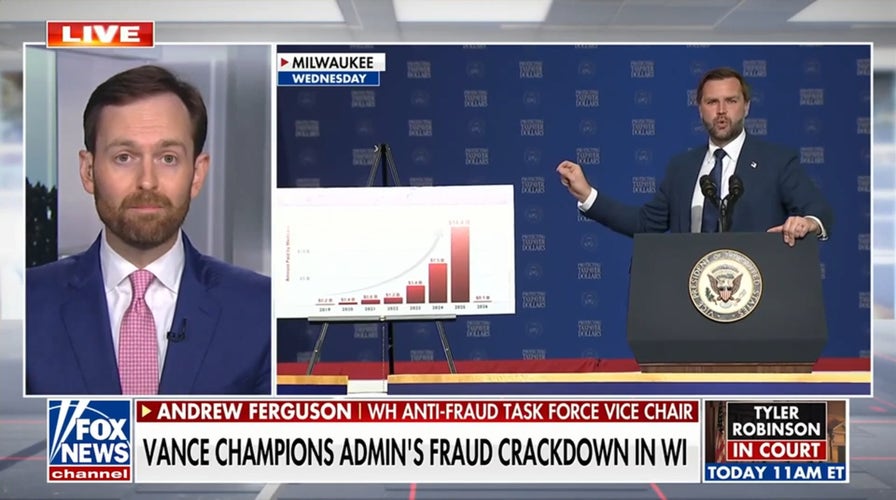
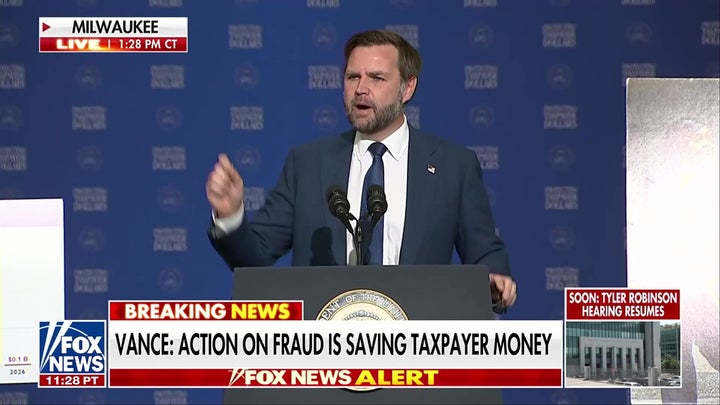
Vance champions Trump admin’s fraud crackdown
FTC Chairman Andrew Ferguson joins ‘America’s Newsroom’ to detail the Trump administration’s war on fraud.
Father Henry Stephan is one of the heroes of “Communion,” the new book from Vice President JD Vance. Father Stephan was integral to the vice president’s journey into the welcoming pews of the Catholic Church.
Even if you don’t buy “Communion,” if you pass it displayed in an airport shop or find yourself in our dwindling number of actual bookstores, turn to page 163 and read the good Father’s additional explanation to the statement that “for most of us, grace is not something that happens in a moment.”
“You don’t feel God’s presence and then change in an instant,” begins Father Stephan’s longer explanation. But to quote him further would be to rob you of some of the surprising clarity of his explanation of “the road map to God.” More of Father Stephan’s full reflection on grace might discourage you from actually reading the whole of “Communion” — which is actually four stories, artfully woven into one book.
‘THE VIEW’ CO-HOST WARNS AGAINST VANCE INTERVIEW BECOMING ‘FREE-FOR-ALL’ TO SELL BOOKS
The first story, and the one which stretches across all of its pages, is the vice president’s lifelong quest to either accept or reject the idea of God and, having accepted it, the further account of how he landed in the Roman Catholic Church. Mass-attending “cradle Catholics” are likely to know at least a few converts, and their stories are often unique and uplifting. This one is most definitely that.
The second story is simply a love story. The vice president recounts in loving detail how he fell — hard — for his wife Usha and how the beer-drinking Marine/Ohio State Buckeye-turned-Yale Law School hyper-ambitious-striver tricked the future clerk to Chief Justice John Roberts into moving to Cincinnati and marrying him.
There is also a third portion, a short but disquieting sharp meditation (at least to this Boomer because the VP may be right) on how Boomers may be overly attached to the assumptions about the West they were born into and have long believed and defended.
LISA DAFTARI: LINDSEY GRAHAM UNDERSTOOD AMERICA’S ROLE IN THE WORLD — AND WHY IT MATTERS
That vision of the West actually succeeded in its long contest with the Soviet Union. That the principles and assumptions behind that success may now be an unconscious burden a that older generation, is a disquieting thought. The Boomer generation is well represented in the Senate from which the vice president came, even after the sad passing of Sen. Lindsey Graham. The vice president suggests we ought to at least consider the cost of over-valuing the prized “the rules-based world order,” which may in fact be gone and not coming back. A reader doesn’t have to be persuaded by that mediation to at least give it some much-needed consideration.
The vice president’s succinct critique of what may be the sunk costs weighing on my generation may actually stop and oblige some “Reagan conservatives” to wonder for the first time about that possibility. That clutch of pages punches hard.
Most of my generation was indeed blind to what the global economy was doing to America’s heartland even as it super-charged China’s totalitarian quasi-empire expanded its power and unveiled its ambitions. The battle with the Soviet bloc was indeed existential, but it was also conclusively won.
VANCE CALLS SCOTUS BIRTHRIGHT CITIZENSHIP RULING A ‘MAJOR MISTAKE,’ WARNS OF MORE BIRTH TOURISM
The collective sigh of relief and joy over the liberation of tens of millions when the Berlin Wall came down in 1989 and the USSR dissolved in 1991 may have, indeed, blinded those in the front rank of the fight as well as those at the tail end that the struggle to preserve “Western Christian civilization” had not ended with the fall of the wall, and that the rules of that long twilight battle may have changed if not evaporated. The recent and ongoing battle with Iran’s fanatical theocrats is a sharp reminder of the never-ending effort to preserve that treasury of that civilization unique to the West, one anchored in the Judeo-Christian worldview, but the threats it and its senior partners, China and Russia, are at least different in degree and maybe in kind.
Then there are occasional political riffs effortlessly woven into the book, each of which is integral to the story, but could each stand alone as the proposition for an Oxford Union debate, e.g. “Resolved: Western Civilization’s embrace of unrestricted immigration may have been, if not suicidal, then at least deeply and recklessly dangerous to its foundations.” These are more reflections of a Catholic Christian than of a Republican politician, as is the brief but essential reflection on the widespread substitution of economic theory in the places where faith traditions once provided worldviews.

“One of the jobs of a Christian statesman,” the vice president writes, “is to preserve the social cohesion that makes charity and generosity possible.” That is not the rhetoric of a stump speech, but the sort of conclusion one would expect from contemporary Christian essayists Rod Dreher or Ross Douthat, who are featured in the book.
As are St. Augustine, G.K. Chesterton, Rene Girard and Pope Leo XIII. Who knew that a symposium on “Theology and Falsification” between Anthony Flew, R. M. Hare, and Basil Mitchell would challenge the reader to slow down and take a few passes over the text (and to look up and bookmark for later the transcript)?
This book is not the work of ghostwriters on a campaign timeline, but a spiritual biography that could actually spur many in the vice president’s generation to actually articulate and grapple with the problems of meaning in an achievement-driven world, one that is changing at a pace so dizzyingly fast that young parents especially can be excused the raft of genuinely new fears that are additions to those fears felt by every generation of young parents. (You don’t actually have to have taken an 18-hour plane flight with three smalls to understand the Veep’s quip that there are more modern descriptions of Hell than a “lake of fire.”)
For many recent decades, the heavy lifting of accessible writing about faith and public life has come from Douthat, Dreher, Ryan Anderson, Fran Maier, George Weigel and especially the now retired Archbishop of Philadelphia Charles Chaput.
Before Archbishop Chaput and these elegant writers, there was Michael Novak and before him there was even the extraordinarily successful, in hindsight, Bishop Fulton Sheen’s television program. Pope (now Saint) John Paul II and Pope Benedict launched a thousand essays with their book-length works and their encyclicals inspired a new generation of vocations. Vice President Vance does not for a moment consider himself a theologian, but he is in the tradition of writers about faith who spur others to consider that, just perhaps, they ought to look further into this particular world.
(The vice president, it is important to note, does not shy away from the horror of the Church’s awful scandal of the sexual abuse of children by priests but is rightfully outraged by it and persuasively condemnatory of those complicit in it and its cover-up. Good for him.)
Throughout the book, though, there is a much-needed reminder that the marriages, children and multi-generational families that are most likely to flourish in this wildly spinning world are those deeply rooted in the traditional Christian practice that has long defined America. And might yet again. Especially if more public figures thought as deeply and wrote as honestly about Jesus and the Church as does the vice president.
The vice president’s book tour did not often even pause on the substance of the book and the eternal questions of the purpose of man. For the benefit of would-be readers: “Communion” is not a book about political platforms or policy prescriptions. It is for Catholics, the Catholic-curious or anyone interested in what comes after this one. If only to understand how such a search can unfold, “Communion” is an excellent addition to your nightstand.
Hugh Hewitt is a Fox News contributor and host of “The Hugh Hewitt Show” heard weekday afternoons from 3 PM to 6 PM ET on the Salem Radio Network, and simulcast on Salem News Channel. Hugh drives Americans home on the East Coast and to lunch on the West Coast on over 400 affiliates nationwide, and on all the streaming platforms where SNC can be seen. He is a frequent guest on the Fox News Channel’s news roundtable, hosted by Bret Baier weekdays at 6pm ET. A son of Ohio and a graduate of Harvard College and the University of Michigan Law School, Hewitt has been a Professor of Law at Chapman University’s Fowler School of Law since 1996 where he teaches Constitutional Law. Hewitt launched his eponymous radio show from Los Angeles in 1990. Hewitt has frequently appeared on every major national news television network, hosted television shows for PBS and MSNBC, written for every major American paper, has authored a dozen books and moderated a score of Republican candidate debates, most recently the November 2023 Republican presidential debate in Miami and four Republican presidential debates in the 2015-16 cycle. Hewitt focuses his radio show and his column on the Constitution, national security, American politics and the Cleveland Browns and Guardians. Hewitt has interviewed tens of thousands of guests from Democrats Hillary Clinton and John Kerry to Republican Presidents George W. Bush and Donald Trump over his 40 years in broadcasting. This column previews the lead story that will drive his radio/ TV show today.
–> <!–>
