
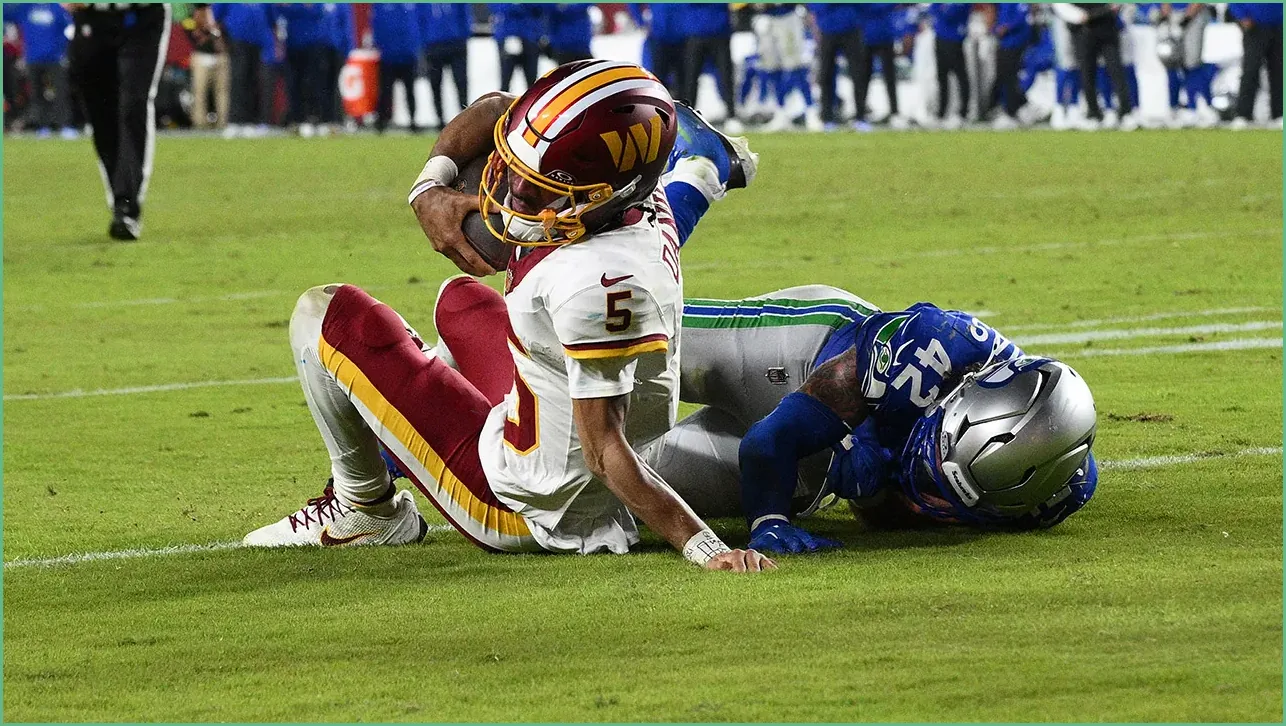
Jayden Daniels exited the Washington Commanders’ 38-14 loss to the Seattle Seahawks in the fourth quarter after suffering a severe arm injury that looked alarming on the field. Medical staff rushed in, and Daniels was helped off as teammates and fans watched in stunned silence. The team has not yet released a full medical update, leaving the franchise and supporters waiting for clarity on his condition and what comes next.
The injury happened late in the game and immediately shifted attention away from the scoreboard to Daniels’ wellbeing. Television replays and sideline photos showed him receiving focused attention from trainers, and the body language around him suggested real concern. For a young quarterback trying to establish himself, any serious arm injury is especially fraught because the arm is central to every throw and every development in the offense.
The Commanders now face short-term and long-term questions about their offense and roster construction. If Daniels needs an extended recovery, Washington will have to lean on the backup quarterback and coaching adjustments while evaluating depth on the roster. Those decisions can affect play-calling, timing with receivers, and the broader plan for the season, especially when a franchise is building around a promising signal-caller.
From a medical perspective, teams typically start with on-field evaluation and then move to imaging to determine the extent of damage. X-rays, CT scans, and MRIs are standard follow-ups to assess fractures, ligament damage, or soft-tissue injuries. The timeline to recovery depends entirely on what the imaging shows, and that uncertainty can be one of the most difficult parts for players and fans alike.
Coach and staff responses in these moments are measured because they have to balance transparency with protecting the player and the team. While the immediate focus is always the athlete’s health, coaching staffs also begin to prepare contingency plans as soon as a starter leaves the field. Those plans become the practical roadmap for practices, game preparation, and potential roster moves over the coming weeks.
For teammates, seeing a leader leave the field in pain can be a galvanizing moment or a demoralizing one, depending on how the group responds. Teams that handle adversity well tend to rally around each other and simplify playbooks to protect whoever is taking over. How the Commanders respond in practice and meetings this week will offer a clearer picture of their short-term resilience.
Fans and the media will push for details, but responsible outlets and team communications typically wait for confirmed medical findings before declaring timelines. Social media speculation often runs ahead of the facts, so the best course is patience until official test results and medical updates are released. That said, the emotional reaction from the stands and the locker room is an unavoidable part of the story right now.
The broader football world watches injuries because they can change franchise trajectories in an instant. A promising season can wobble under the weight of an unexpected absence, while backups can seize rare opportunities to show they belong. For Washington, the immediate priority is certainty about Daniels’ condition so the team can move forward with a clear plan.
Sunday’s scoreline will already be dissected for its on-field failures, but the more pressing issue is the health of the quarterback who left the game. The medical process will determine whether this is a setback measured in days, weeks, or months, and each outcome carries different implications for strategy and roster choices. Until the team provides a full update, speculation will fill the silence, but the only facts confirmed so far are that Daniels left the game with a serious-looking arm injury and that the Commanders now face an uncertain next chapter.
