
The House China panel is turning up the heat on aerospace deals that connect Western companies to Beijing’s military ecosystem. A new congressional report argues those partnerships helped move advanced know-how into China’s hands, and lawmakers want defense dollars cut off from firms that keep feeding that system.
At the center of the report is a blunt warning: civilian business ties can quickly become military gain in China. The 65-page study, put together by the House Select Committee on the Chinese Communist Party, says Western aerospace partnerships helped transfer technology, manufacturing expertise, and other sensitive capabilities to companies tied to the Chinese state and its defense machine.
The committee, led by Chairman John Moolenaar, R-Mich., and Ranking Member Ro Khanna, D-Calif., says the pattern is bigger than any one contract. It describes a steady pipeline in which Western firms chase commercial opportunities while Beijing’s military-civil fusion strategy makes it easy for the People’s Liberation Army to absorb the benefits.
Moolenaar did not soften the message. “American and European companies transferred technology to China that could be used against our brave men and women in uniform. With the CCP’s military-civil fusion there are no private companies in China,” he said in a statement shared with Fox News Digital.
The report singles out Airbus as one of the most striking examples, noting that the European aerospace giant still receives U.S. defense contracts while continuing manufacturing partnerships in China. Even after Airbus sold its stake in an AVIC affiliate in 2025, the committee says its business ties with the Chinese aerospace conglomerate did not end there.
The panel also examined at least six U.S.-China joint ventures tied to American defense suppliers GE Aerospace, Honeywell Aerospace and Collins Aerospace, a subsidiary of RTX. Investigators say the concern is not just where the work is done, but what kind of technology gets handed over along the way.
One of the report’s sharper claims centers on GE, which the committee says transferred foundational avionics technology to a joint venture with a subsidiary of AVIC, the state-owned Chinese conglomerate that develops military aircraft. The report says GE did not provide its original joint venture agreement despite repeated requests, which only deepened the committee’s suspicion about what was shared and how it was used.
That matters because AVIC sits at the heart of China’s aerospace buildup. The group is linked to military aircraft development, including the J-20 stealth fighter, and the report argues that technology meant for civilian use can still help build a stronger warfighting system on the other side of the world.
The companies involved pushed back and said their business was legal, licensed and limited to civilian aviation. Collins Aerospace said it appreciated the committee’s work and would keep following U.S. laws and regulations, while GE said it takes national security, compliance and intellectual property protection seriously.
GE also said its joint venture with AVIC involved older avionics technology sold only in China, not jet engines, and that safeguards were in place to protect sensitive information. Honeywell said its partnerships were fully licensed and approved by the U.S. government, adding that it had cooperated openly with investigators and remained compliant with export rules.
The report does not say those partnerships broke U.S. law, but it does point to earlier export-control settlements involving the companies as a reminder that compliance questions keep surfacing. That keeps the political pressure high, especially when the stakes involve aerospace, defense spending and China’s military rise.
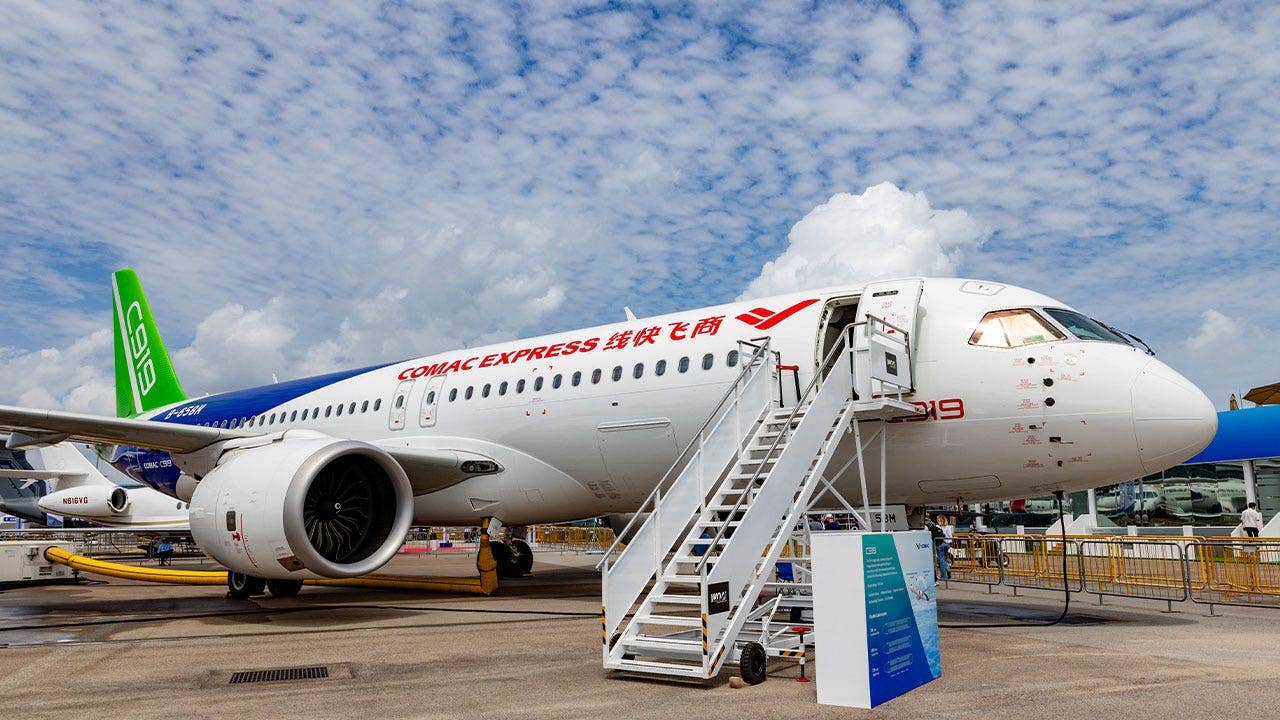
Another piece of the report focuses on the Federal Aviation Administration, which the committee wants to keep from certifying Chinese-manufactured aircraft. The panel cites state subsidies and Beijing’s refusal to release a final report on the 2022 China Eastern Airlines crash as reasons for caution, arguing that the U.S. should not casually bless aircraft built inside a system that shields information and blurs civilian and military lines.
The FAA response was direct: “The report’s only recommendation directed at the FAA is that they do not certify Chinese-made aircraft, which the agency has not done,” an FAA spokesperson told Fox News Digital.
For lawmakers on the panel, the bigger fight is about drawing a line before another wave of American technology gets pulled into China’s military orbit. The report presses the idea that U.S. contracts should not underwrite companies whose know-how can be repurposed for a rival power, and that aerospace firms cannot have it both ways when the business ends up touching Beijing’s defense network.
