
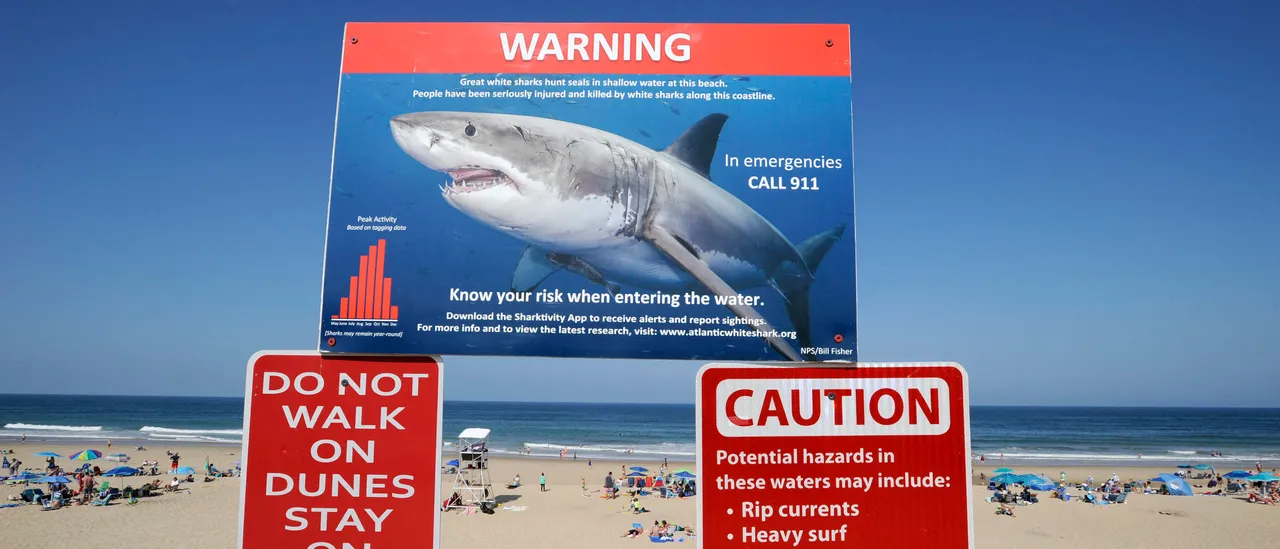
Four tagged great white sharks have pinged off Florida’s Gulf Coast as spring break travel ramps up, underlining the Gulf of Mexico’s role as an important wintering habitat. Researchers and ocean trackers are following their seasonal routes to learn where these animals go, how far they travel, and what the patterns mean for conservation and coastal communities.
The recent signals came from four individuals known to science as Ripple, Bella, Penny and Ernst, each with its own tracking history. These pings show the animals moving into warmer Gulf waters after spending months farther north, a routine migration that lines up with seasonal changes in prey and temperature.
A peer-reviewed study in Wildlife Research and long-term telemetry work both point to the Gulf as a predictable overwintering area for great whites, not just a transit corridor. That seasonal use is important: knowing where sharks concentrate in colder months helps scientists identify key habitats and informs management decisions aimed at a species that is still recovering in some regions.
OCEARCH, the non-profit that conducts many of these tagging operations, fits sharks with satellite transmitters to record surface time and location fixes. Those tags let researchers follow large-scale movements in near real time and build multi-year records of migration, residency and long-distance travel between feeding and breeding zones.
Ernst is a subadult female listed at about 12 feet and 1,009 pounds, and she pinged roughly 23 miles south of Cape San Blas on Feb. 20. In early March she emitted a Z-ping, which occurs when a transmitter briefly breaks the surface and sends a weaker signal that yields a less precise satellite location.
Since being tagged last October, Ernst has logged an impressive itinerary that includes a move from the Gulf of Maine to the Gulf of Mexico and, in only 139 days, about 3,633 miles of swimming. That kind of distance highlights how mobile great whites can be and why broad-scale monitoring matters for understanding population recovery and risks the animals may face.
Bella, a juvenile female roughly 10 feet long and 729 pounds, was detected near the Straits of Florida and later pinged northwest of Key West on Mar. 4. “Her story is a testament to the power of collaboration—from world-class scientists and fishermen to everyday ocean lovers,” reads the OCEARCH profile of Bella, and her movements underscore how partnered efforts create those long-term tracking records.
Penny, another juvenile, weighs in at about 522 pounds and measures near 10 feet; she was recorded off Key West at the end of February. Tagged in April 2023 near Ocracoke, North Carolina, Penny has now been tracked for more than 1,000 days and has covered over 12,000 miles, repeatedly returning to the Gulf before heading back toward the northwestern Atlantic in warmer months.
Ripple, a subadult male about 11 feet and 778 pounds, pinged around the Florida Panhandle on Mar. 3 after a long journey that included movements down the eastern seaboard and past Florida toward the Gulf. Each shark’s pattern differs in timing and distance, but collectively they paint a picture of seasonal migration between northern feeding grounds and warmer winter habitats.
All four animals remain visible on public trackers maintained by researchers and organizations that promote transparency and education about marine life movements. For coastal communities and beachgoers, those data offer context: seasonal presence is driven by natural needs for food and suitable water conditions, and the signals help managers balance public safety with conservation goals.
