
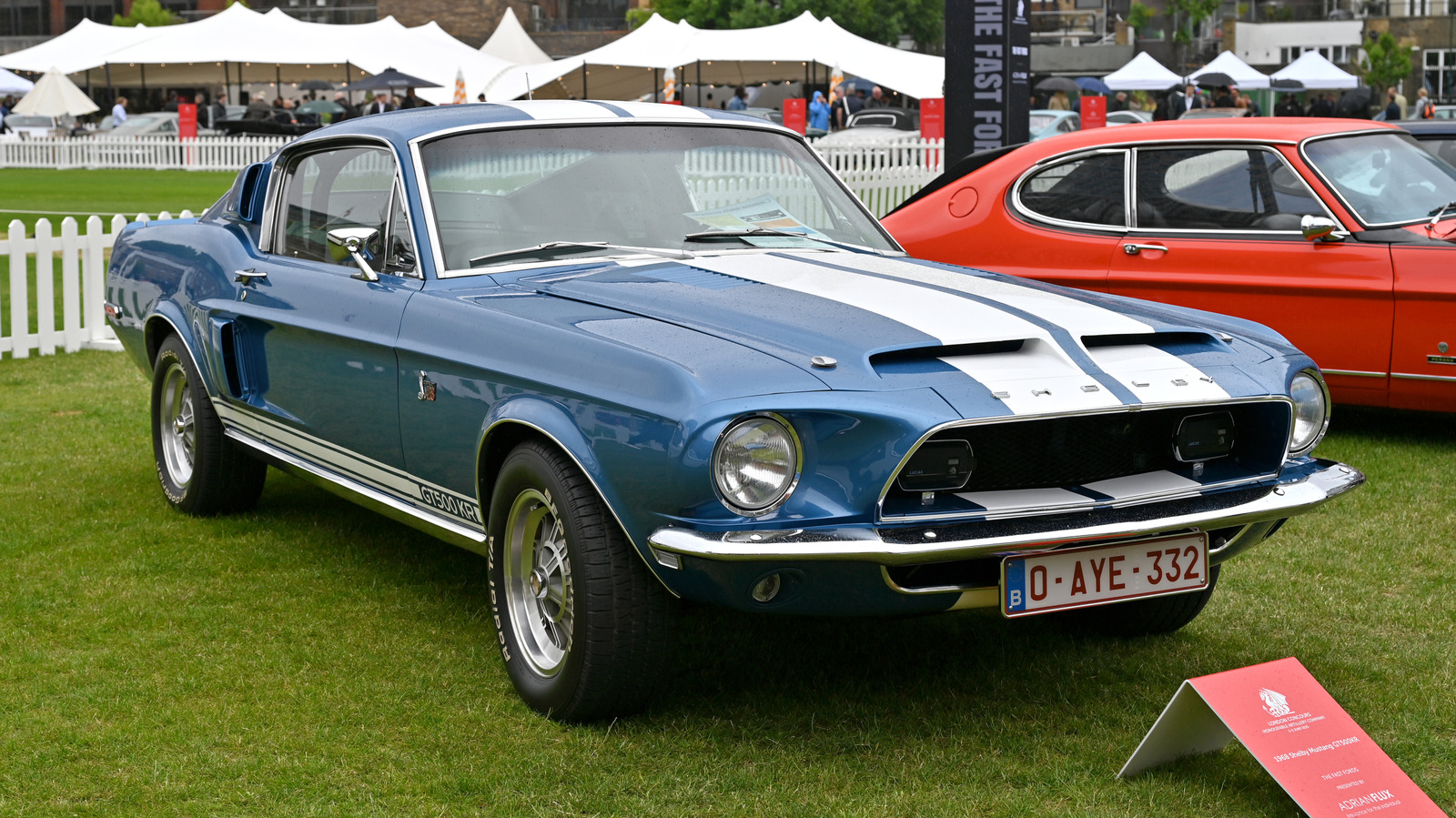
The Mustang badge has worn the “King of the Road” label only on a few special Shelby editions, and that nickname carries serious muscle behind it. The original 1968 GT500KR set the tone with rare production numbers, big-block power, and styling that still turns heads decades later. Later KR revivals leaned on the same attitude, but with modern upgrades and even more punch.
The first GT500KR was Shelby’s answer to a fresh performance moment in 1968. The name itself stood for “King of the Road,” and it landed on a GT500 fitted with Ford’s 428 cubic-inch Cobra Jet V8, tucked under a hood built to look as mean as the car drove.
That engine gave the KR its legend. Ford rated it at 355 horsepower, but the real output was widely understood to be well north of that, with torque arriving hard and early enough to make the car feel like it wanted to shove the pavement backward.
Production stayed limited, which only made the badge hotter over time. Just 1,571 examples were built in 1968, split between 1,053 fastbacks and 518 convertibles, and that kind of scarcity helped cement the KR as one of the most desirable Mustangs of its era.
Looks mattered too, and the KR wore them well. The fiberglass hood, grille-mounted rectangular driving lights, rear spoiler, sequential taillights, and those scooped lines gave it a swagger that matched the name without trying too hard.
The “King of the Road” title did not appear by accident. Carroll Shelby and Lee Iacocca were part of the conversation that led to the name, after word spread that Chevrolet might try to use it on a Corvette, and Shelby moved quickly to claim it for the Mustang instead.
That little bit of branding foresight turned into lasting identity. The KR badge became more than a trim level or a marketing flourish, because it carried a clear promise: this was the Shelby Mustang that stood at the top of the food chain for its moment.
Performance testing later showed why the car earned respect beyond the showroom floor. In a Car and Driver comparison, a 1968 GT500KR with some period upgrades posted a 0 to 60 mph time of 5.4 seconds with the automatic and covered the quarter mile in 13.9 seconds at 103 mph.
It was not perfect, and that only makes it more interesting. The same test showed weak cornering grip by modern standards, but few people were buying a GT500KR for delicacy, and the car’s reputation has always been built on brute force and presence.
That old-school appeal has become part of the money story too. Original GT500KRs have kept their value remarkably well, with recent sales on the collector market reaching deep into six figures, proof that rarity and history still carry a heavy premium.
The KR name returned in 2008 and again in a 2020 to 2022 run, and each version kept the spirit alive while changing the formula. Those later cars started as regular GT500s before Shelby added carbon fiber hoods, forged wheels, suspension tweaks, and extra power that pushed the newer version beyond 900 horsepower.
Those revivals mattered because they showed the KR badge was not just a museum piece. It still worked as a signal for more power, sharper hardware, and a little extra drama, which is exactly what a Mustang wearing “King of the Road” ought to deliver.
