
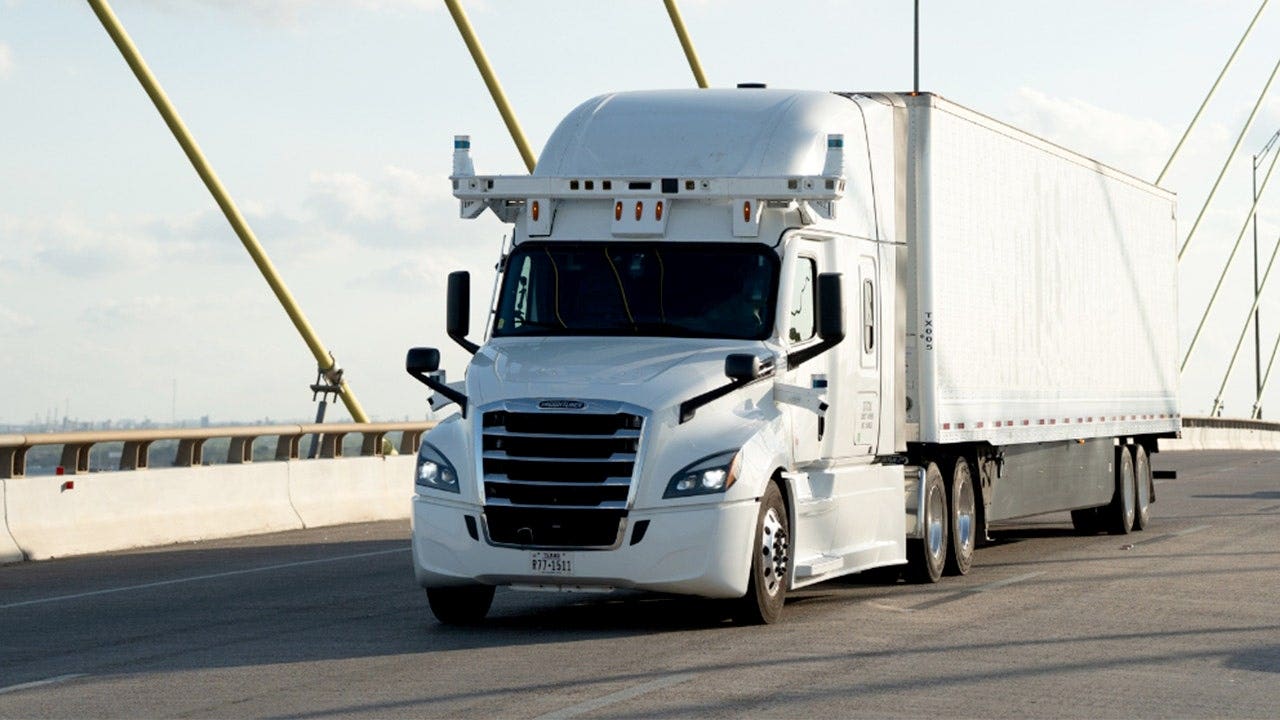
Bot Auto ran a commercial overnight haul from Houston to the Dallas area with no one in the cab, claiming a fully humanless 230-mile delivery on public roads. The company says the load was booked and priced like any other freight job, the safety systems handled the driving, and the economics came in under typical human-driven costs.
The truck left a truck parking lot in northeast Houston late at night and reached its dock south of Dallas the next morning without a driver, remote operator, or back-seat monitor. “Our autonomous truck departed Riggy’s Truck Parking in northeast Houston, headed to Hutchins, Texas, just south of Dallas. Departure was late at night as the shipper requested overnight service for this route.”
“The truck ran 230 miles northbound on I-45, one of the busiest freight corridors in the country, navigated stop lights, side streets and frontage roads. There was no safety driver or observer, nor a remote operator. It was booked through our customer Ryan Transportation, true to our operating model, which is compatible with how freight actually moves in America today.”
The headline-grabbing detail is that this was not a staged demo but routed through an actual brokerage and customer process. “Real freight, real customer, real timeline, delivered safe and on time. We are not disclosing the shipper or commodity, but this was not a load we manufactured to check a box.”
“It moved through Ryan Transportation, a top-20 freight brokerage. Booked, priced, and executed the same way as any truckload moves in America. We made money on it. This is a commercial business, not a research project.”
Bot Auto draws a bright line between systems that still rely on human fallback and what it calls true humanless operation. “The industry often blurs the line between driverless and human-supervised,” Hou explained. “For Bot Auto, fully humanless means no safety driver, no back-seat monitor, and no low-latency remote human fallback.”
“More specifically, our safety design does not require any human to notice, decide, or react within one minute to keep the truck safe. We may have operational visibility, just like an airport tower can monitor the plane, but it does not fly the plane. That is our standard: humans can support the mission, but the truck must own the driving safety case.”
The company says the vehicle is built to respond conservatively when it faces unexpected conditions. “The truck would not wait for a human to save it,” he said. “If it reached a condition outside its approved operating boundary, it would enter a mitigated risk condition: slow down, create space, and bring itself to a controlled safe state.”
“The principle is simple: when the truck encounters extreme or unexpected situations, it does not gamble. It acts conservatively. Sometimes that means stopping; sometimes it means continuing briefly to reach a safer place to stop. Human support can help after the vehicle is already safe, but the vehicle has to own the first minute.”
Before removing drivers, Bot Auto says it ran millions of simulated miles and extensive real-world testing to prove performance parity with trained professionals. “We operated on our own internal validation framework, rigorous and data-driven,” the company said. “Millions of miles of simulation, extensive real-world testing with safety drivers, scenario-specific disengagement analysis, and a documented operational design domain defining precisely the conditions under which the system is authorized to run.”
“We did not remove the driver until the system demonstrated, across a comprehensive set of tests, that it performs at or above the level of a professional human driver on this route. Safety isn’t one number; it is a system-level property.”
Beyond safety, Bot Auto argues the numbers make sense today. “With that complete accounting, the economics still work decisively in our favor,” he said. “This run came in below $2 per mile.” That figure undercuts many human-driven totals and points to broader operational savings beyond just labor.
“I want to be precise here, because the industry has a habit of cherry-picking the easy savings and hiding the real costs… autonomous trucking’s cost impact isn’t a simple trade-off between driver wages and vehicle cost, it runs deep into operations.” As the network grows and fixed validation costs are spread over more miles, per-mile technology costs should fall.
Regulation played a role in making the run possible, with Texas offering a formal program for commercial autonomous vehicle operations. “Texas passed Senate Bill 2807 in 2025, creating a formal authorization program for commercial autonomous vehicle operations, administered by the Texas Department of Motor Vehicles,” Hou said. “Bot Auto applied and was approved under that program… We met every requirement.”
The company says this Houston-to-Dallas lane is deliberately repeatable and is already being scaled across the dense Texas freight triangle. “The Houston-to-Dallas lane is repeatable now, and it isn’t a one-time event,” the company said. “We selected it deliberately: high freight volume, strong hub infrastructure at both ends, a supportive regulatory environment. Expansion is already underway.”
Skeptics have long doubted driverless freight, but Bot Auto frames this as proof that execution has arrived and commercialization is next. “A truck left Houston with no one in it, ran 230 miles on public roads, and delivered freight to a customer on time. That happened. The skeptics had a reasonable argument for a decade because this industry has been long on promises and short on execution. I understand and respect that. The question is no longer whether it can be done. It is who can do it at scale, safely, and economically. That is the competition we intend to win.”
If autonomous freight expands, shipping could become more predictable, overnight windows tighter, and costs lower over time, while the industry grapples with workforce changes and the need for long-term operational data. The empty cab grabs attention, but the real test will be whether this model can be repeated safely and reliably across many lanes and conditions.
