
Portland Agitator Lays a Trap for Himself, What Happened Next Was Chef’s Kiss
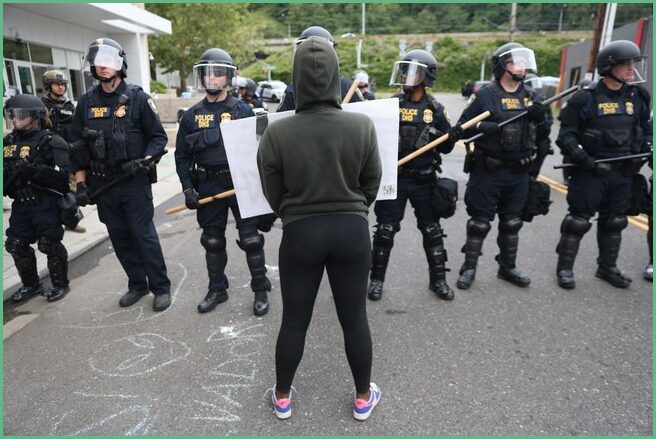
Portland has been a hotspot for chaos, and recent federal moves to secure the ICE building turned up the heat. Protesters and extremists have been pushing boundaries, and federal agencies responded with a visible mix of ground forces, helicopters, and drones. One alleged agitator tried a stunt that backfired badly.
Reports say someone aimed lasers at Customs and Border Protection helicopters hovering near the ICE site, a reckless act that risks blinding pilots and putting lives at stake. Federal officials identified a suspect and, in the process, discovered the person was living in the country illegally. That discovery shifted this from a protest incident into a broader immigration enforcement issue.
As authorities moved in, they found three others at the same residence, and all four people connected to the incident were taken into custody. Local law enforcement and federal agents coordinated to secure the area and collect evidence, including the device allegedly used to target aircraft. What started as a provocative tactic ended with handcuffs and federal processing.
Federal announcements clarified the suspect’s immigration status, which complicates the political picture for local officials who have long resisted federal intervention. The arrests raised immediate questions about how sanctuary policies and local leadership intersect with public safety when federal agents step in. For those who argue the city has lost control, this episode is more proof that federal tools were necessary.
All four individuals arrested are now being held as the feds sort out charges and possible removal proceedings. When federal law enforcement detains someone who is undocumented and accused of endangering aircraft, deportation moves from a mere talking point to an active outcome. The case underlines the link between unlawful behavior and immigration enforcement in real time.
According to media accounts, federal sources said the detainees are being processed for deportation as part of this response. That adds a layer of consequence that many local political leaders would rather ignore. When actions escalate from civil disobedience to potential felonies, federal penalties follow.
The laser that officials say was directed at the helicopters was reportedly operated from the residence where the four were taken into custody. A single pointed beam at a cockpit can be blinding, disorienting, and dangerous during flight operations. That is exactly why the federal government treats these incidents so seriously.
Video footage of helicopters circling the federal facility has circulated widely, showing the scale of the federal response and the kinds of platforms protesters allegedly interfered with. Whether or not the specific helicopter in those clips was the one targeted, the optics are undeniable: federal assets took action to protect missions and personnel. Citizens watching at home saw a clear demonstration of how far federal intervention can reach.
Lasers on the ground are not a trivial prank; they are weapons in practice because they can injure and incapacitate. Federal agencies have documented injuries from previous incidents where activists directed high-powered lasers at officers’ faces and at aircraft. That history explains the zero-tolerance approach from law enforcement when these events recur.
The Department of Homeland Security recorded hundreds of eye injuries to federal officers in past Portland clashes, underscoring the real harm lasers can cause. Medical and aviation experts warn that even temporary blindness is enough to create a catastrophic accident when aircraft crews are involved. This is not hypothetical; it is rooted in documented medical and aviation risk.
The deputy director of the Department of Homeland Security says federal officers in Portland suffered 113 eye injuries while guarding a courthouse from activists armed with powerful lasers.
The usually green beams produce uncomfortable heat, unlike common small red pointers, Ken Cuccinelli said Tuesday at a Senate subcommittee hearing on the clashes in Oregon.
Pointing lasers at aircraft carries federal felony exposure, as prosecutors and federal agents have repeatedly emphasized. Officials cite cases where people faced charges for intentionally targeting police helicopters, and those cases show courts take these threats seriously. The legal consequences are meant to deter behavior that endangers public safety and federal missions.
“Pointing lasers at an aircraft is extremely dangerous,” said U.S. Attorney Ryan K. Buchanan. “A laser aimed at an aircraft blinds the pilot and makes it difficult if not impossible for the persons in the cockpit to read their instruments. Persons who are found pointing lasers at aircraft will be prosecuted.”
“When aimed at an aircraft, a beam of light from a handheld laser can illuminate a cockpit, disorienting and temporarily blinding the pilot or pilots of the craft, and in this case, preventing police from completing important public safety work,” said Keri Farley, Special Agent in Charge of FBI Atlanta. “It’s not a game. It’s a federal felony that the FBI and our law enforcement partners take very seriously.”
Local reports say the Oregon National Guard was put on standby and that additional federal forces could arrive to bolster security and help restore order. For residents worn down by weeks of unrest, a stronger presence means a chance for normal life to return. Law-abiding citizens deserve a city where businesses can open and people can walk safely without fear of being caught in a chaotic scene.
City and state leaders who posture against federal help are learning that ignoring the realities on the ground has consequences, especially when dangerous acts risk lives. Voters watching this saga will remember which officials prioritized ideology over public safety when the stakes were high. This episode is likely to influence debates about law and order, immigration, and who is responsible for keeping communities safe.
