
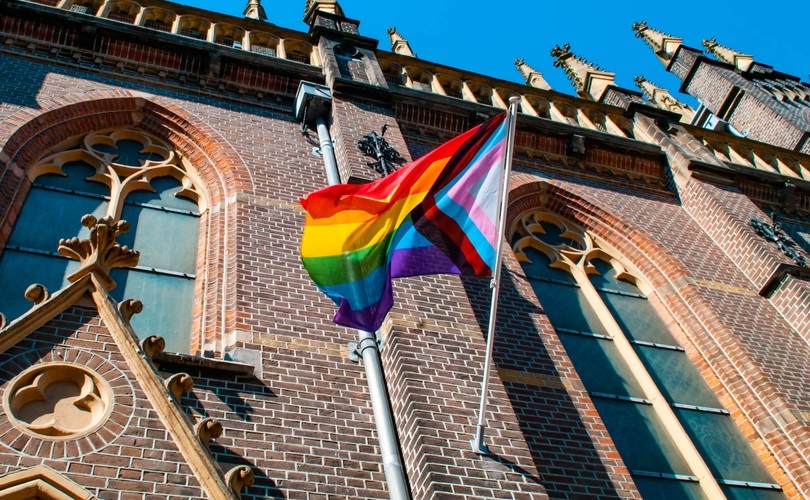
Father Alexander Santora, pastor of Our Lady of Grace Church in Hoboken, New Jersey, held a Mass that drew attention for messages at odds with established Catholic teaching on homosexuality while urging the Church to embrace “pride.” The service and its aftermath sparked conversation about pastoral approach, doctrine, and how congregations and leaders respond when a priest adopts a different tone. This article lays out what happened, the local context, and the tensions such moments create within a parish and diocese.
The event at Our Lady of Grace became notable because the priest publicly encouraged a stance toward “pride” that many saw as departing from official Catholic doctrine on sexual morality. Parishioners and observers described a pastoral tone that emphasized inclusion and affirmation over reiterating Church norms. Whether framed as pastoral accompaniment or a break with teaching, the service highlighted divisions in how clergy interpret their role when ministering to LGBT people.
Father Santora’s approach raised immediate questions about how a pastor balances personal convictions, pastoral sensitivity, and fidelity to Church teaching. In parishes across the country, clergy often wrestle with these competing demands, and this Mass became a focal point for that struggle. For some members of the community, the tone offered welcome affirmation; for others it sparked concern over doctrinal clarity and leadership responsibilities.
The local setting in Hoboken, New Jersey, added another dimension to the conversation because parishes in urban areas frequently encounter diverse viewpoints and active local movements. Our Lady of Grace has a history of community engagement and outreach, and this service fit into a pattern of visible public ministry. At the same time, diocesan structures and the bishop’s office play a role in interpreting whether a particular sermon or liturgy is consistent with diocesan expectations.
Reactions inside the parish were mixed, reflecting broader debates within the Catholic community. Some congregants expressed gratitude that the priest acknowledged and welcomed LGBT people at the altar and in parish life. Others felt uncomfortable and sought clarification about teaching and practice, worried that a public liturgical endorsement could be confused with official Church positions.
Clergy facing similar moments often point to a pastoral principle: meet people where they are and accompany them in faith. That approach emphasizes relationship and care, especially for those who feel marginalized. Critics, however, argue that pastoral sensitivity should not obscure or contradict established doctrine, and that priests have a duty to teach and uphold what the Church has long professed.
From a diocesan perspective, such incidents typically prompt a review of liturgical norms and guidelines for public ministry. Bishops and chancery staff may review homilies, liturgies, and public statements to determine whether they align with diocesan policies. These reviews aim to preserve unity in teaching while allowing pastors enough freedom to respond pastorally to local needs.
The parish itself often becomes the arena for ongoing conversation, where parishioners and leaders must navigate trust, transparency, and pastoral care. Open forums, prayer services, and meetings with diocesan representatives are common ways communities attempt to heal divisions and articulate a clear path forward. How those conversations are handled can shape parish life for months or years afterward.
For Catholic institutions and lay faithful watching from outside Hoboken, the episode served as a reminder of the tension between pastoral outreach and doctrinal consistency. It underscored how one Mass, and one priest’s public posture, can ignite wider debates about identity, inclusion, and authority within the Church. These debates are not new, but they continue to play out in parishes large and small.
Ultimately, incidents like the one at Our Lady of Grace force a question that churches repeatedly face: how to minister compassionately while maintaining clarity about teaching. The answers vary with leadership, local culture, and the willingness of diocesan structures to engage constructively. What happens next in Hoboken will likely mirror similar processes elsewhere as communities try to reconcile pastoral care with institutional faithfulness.

2 Comments
I’d guess that he is probably gay himself.
Father Alexander Santora, pastor of Our Lady of Grace Church in Hoboken, New Jersey, held a Mass that drew attention for messages at odds with established Catholic teaching on homosexuality while urging the Church to embrace “pride.”
“The priest publicly encouraged a stance toward “pride” that many saw as departing from official Catholic doctrine on sexual morality.”
And I tell you its no coincidence the rainbow is the symbol that these very rebellious and at times dangerous people use for their banner to the world! Just like Satan himself so full of pride and rebelliousness against God Almighty fell from heaven because of his arrogant blatant Pride after having been the most magnificent beautiful angel in heaven Lucifer. And Lucifer was the Light Bearer, embodying ‘illumination and wisdom’ before his fall. In Ezekiel 28:12-17, we see the emphasizing of his original glory, beauty, and the moment of his ‘pride-driven’ fall from heaven.
And This Scriptural verse signifies God’s promise and covenant not to destroy the earth with a flood again.
Genesis 9:12-13 And God said, “This is the sign of the covenant I am making between Me and you and every living creature with you, a covenant for all generations to come: 13 I have set My rainbow in the clouds, and it will be a sign of the covenant between Me and the earth.”
Of course Satan is now using all of this to cause such blasphemy and rebellion by the children of God! Like spitting in eye with such ego and pride to say, “I am great!” I’ll do what I please! It’s all Hate! Now this priest promotes this sacrilege! He isn’t serving God Almighty!
This is no Catholic Priest! He is Blaspheming God Almighty and is obviously serving the Darkness and Satanic Influence that is manifesting throughout this fallen world Everywhere! As if to state that nothing is sacred!
This is just more clear-cut evidence of what I was referencing in another article on this site yesterday which I will include here as it’s exactly what I was talking about!
“Bishop Joseph Andrew Williams is obviously fine with “Watering-Down” the oldest and truest form of the Mass, which to me is indicative of the “Bergoglian Globalist Agenda” and it’s radical alteration of the Proper Rite as history or tradition illustrates and Jesus Christ Himself initiated as “Fully Proper!”
This watering-down has been and is the improper promotion of “secular crooked ways of the world” falling into alignment with the “Globalist New World Order Agenda;” which can only cause further damage to the Church which is all part and parcel of the darkest and most wicked ulterior purposes that only want to destroy what is good and from God Almighty! Therefore it’s not the appropriate work of the Shepherds in leading the flock as God Himself said they must do!
This principle echoes Paul’s later counsel to Timothy: “Pay close attention to your life and your teaching; persevere in these things, for in doing this you will save both yourself and your hearers” (1 Timothy 4:16).
Titus 1:7-9 “7 Since an overseer manages God’s household, he must be blameless—not overbearing, not quick-tempered, not given to drunkenness, not violent, not pursuing dishonest gain. 8 Rather, he must be hospitable, one who loves what is good, who is self-controlled, upright, holy and disciplined. 9 He must hold firmly to the trustworthy message as it has been taught, so that he can encourage others by sound doctrine and refute those who oppose it.”
Paul commands In Acts 20, “Therefore be alert, remembering that night and day for three years I never stopped warning each one of you with tears.” The command to be alert calls for wakeful readiness.
Again Paul’s earlier imperative statement in Acts verses 28–31 makes the need for this vigilance clear: “Savage wolves will come in among you, not sparing the flock. Men will rise up even from your own number and distort the truth to lure the disciples into following them.” We see this happening in the current state of the Church!
Acts 20:28-31 “28Keep watch over yourselves and all the flock of which the Holy Spirit has made you overseers. Be shepherds of the church of God,[a] which he bought with his own blood.[b] 29 I know that after I leave, savage wolves will come in among you and will not spare the flock. 30 Even from your own number men will arise and distort the truth in order to draw away disciples after them. 31 So be on your guard! Remember that for three years I never stopped warning each of you night and day with tears.”
The Reformation was a huge breakaway from that Church which has splintered into 45,000 different so called Christian denominations globally and some 200 alone in the United States of America! Jim Jones of the “People’s Temple” which he initiated and founded in California and ended up bringing to “Jonestown” in Guyana, where in 1978 he totally duped over 900 followers into a mass suicide! Anyone who thinks they know best and overrides the True Catholic Church are on a collision course with destiny that won’t do much better than Jimmy Boy did! Radical departure even began with Martin Luther and others way back in Ancient times fully illustrating that the Devil has been working overtime to destroy God’s True Church on earth and His children right from the get-goes!
Peace!
Those facts along with the reality that abortion of human babies has become a modern day human sacrifice where in a totally disposable materialistic society of greed, pleasure seeking and all these rising forms of immorality! Now we see things like the transgender madness infecting young minds along with Marxism the Atheistic Totalitarian Political Ideology sweeping the globe which is called here in America Progressivism or Socialism!
Folks if you aren’t awake yet to what is happening before our very eyes then you either don’t give a rats ass or you are willfully stupid! Whatever the case may be there is one certainty coming upon this very twisted and increasingly chaotic human race at lightening speed; and that is Final Judgment!
God bless you in Jesus’ name.
Amen.