
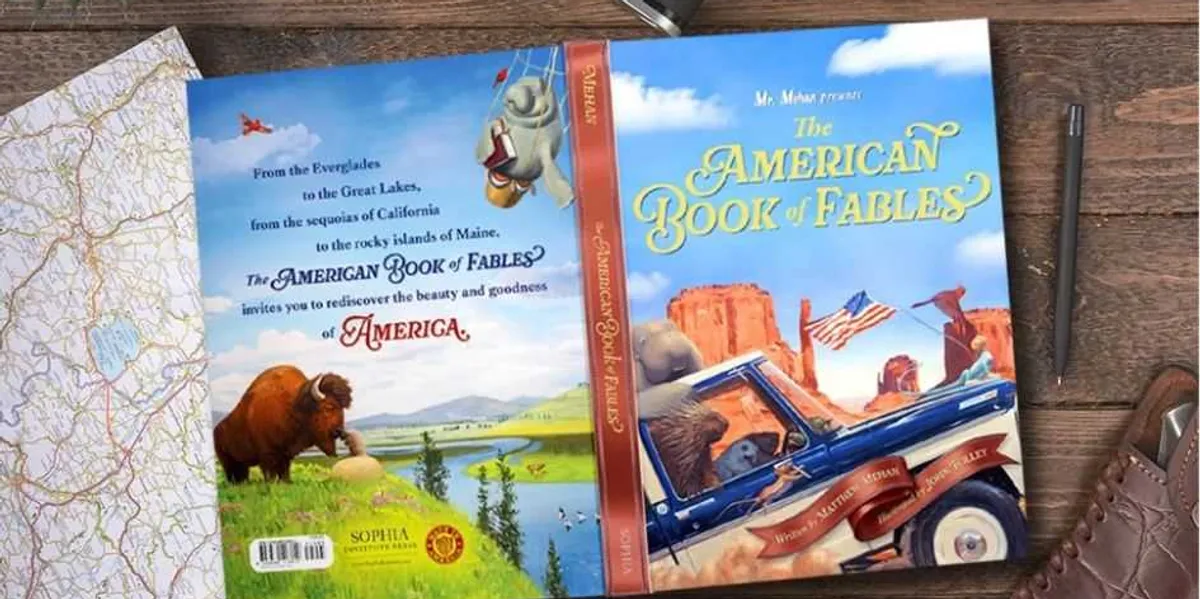
I’ll sketch how C.S. Lewis’ idea of creative identity connects to a new American collection of tales, explain how that collection is organized, show why it works for families and teachers, and touch on how fables and imagination shaped the founders and still matter today.
In “Sometimes Fairy Stories May Say Best What’s to Be Said,” C.S. Lewis separates the creative impulse into two roles: the Author who imagines and the Man who makes meaning. That split helps explain why some books feel delightful and also instructive. Matthew Mehan’s new work puts that theory into practice by pairing imaginative writing with reflective, educative substance.
The book, titled “The American Book of Fables,” arrives as a truly new volume rather than a reissue of something stale. Mehan organizes it into thirteen parts, each introduced by a line from the Declaration of Independence and centered on a different American landscape. Inside, you’ll find poems, rhymes, traditional fables, and true narratives aimed at different ages, with sections labeled “littles,” “middles,” and “bigs.”
That structure makes the book genuinely useful for families and classrooms. As a homeschool mom explained, it’s been a practical tool for preparing kids for the semiquincentennial while avoiding empty patriotic theater. Parades and fireworks are fun, but Mehan aims for a deeper appreciation rooted in story, place, and history.
On the child-facing side, the “littles” offer short rhymes and vivid images that hook a preschooler, while the “middles” layer in longer fables and gentle moral lessons for early readers. The “bigs” gather essays and richer material that adolescents and adults can work through together. That layered approach keeps everyone engaged and gives parents or teachers a clear path for growing curiosity into real learning.
My own conversation with Dr. Mehan highlighted how dense the scholarship behind the book is; he’s encyclopedic about literature and the ideas that formed early America. That experience left a simple lesson: it’s good to be a bit in over your head. Wrestling with big books and unfamiliar thinkers is the very engine that develops imagination and judgment.
Mehan also pushes back against much of today’s children’s publishing, which often flattens curiosity with bland art and simplistic messages. He argues that fables and classical stories used to be part of a broader civic education, teaching temperance, prudence, and self-government—lessons that are harder to find in mass-market picture books. Where some modern titles feel like empty calories, Mehan’s selections aim for nourishing material that sparks discussion.
Fables in particular play a starring role because they compress human habits into memorable tales. Animals stand in for traits—gluttony, greed, vanity—so readers can see vice and virtue in a clear, lively mirror. Those short narratives were once quoted by founding figures in letters and speeches, and Mehan suggests those stories helped shape civic judgment as much as formal political theory did.
Reading the book with kids invites questions and follow-ups that turn a single page into a whole trip of discovery. Children ask, “What’s a lynx? What was the Navajo Nation? What does “candor” mean?” and those questions become reasons to pull maps, photos, and primary tales into a conversation. Adults don’t just hand answers down; they learn alongside the young, and that shared exploration is the point.
An image in the middle of the book’s presentation captures that spirit of work and research, linking text to place and to visual curiosity.
