
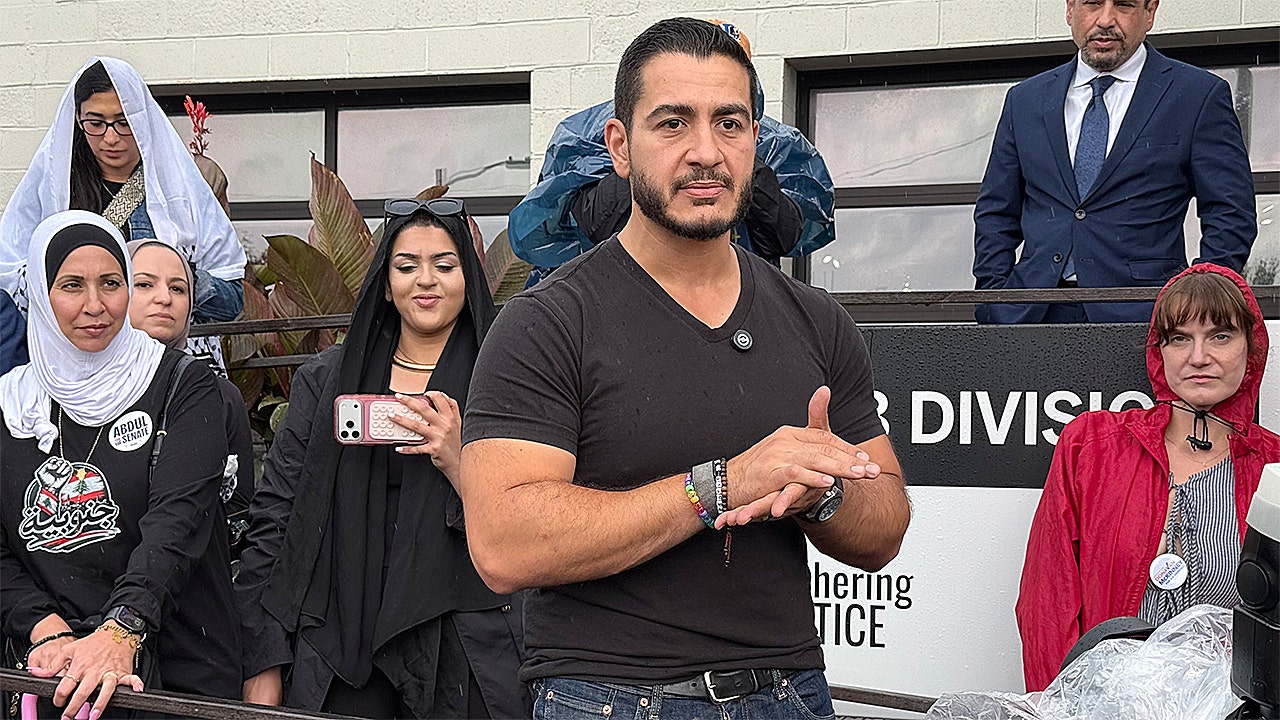
• Michigan’s Senate primary exposes a widening split inside the Democratic Party
• Abdul El-Sayed’s win gives the left a bigger stage and Republicans fresh attacks
• Bernie Sanders, AOC, and other progressives helped power the result
• The race highlights arguments over ideology, money, Israel, and Medicare-for-all
• Other Michigan primaries show the same tug-of-war between establishment and insurgents
Abdul El-Sayed’s win in Michigan did more than settle a primary. It jolted a party already wrestling with its direction, handing the left a loud victory while giving Republicans a new opening in one of the country’s most important Senate races.
The former Wayne County health official beat Rep. Haley Stevens in a contest that had been framed as a fight between the Democratic center and its harder-edged progressive flank. El-Sayed’s support from Bernie Sanders, Alexandria Ocasio-Cortez, and other left-wing figures made the result feel bigger than one state, because it landed right in the middle of a national argument over what Democrats want to be.
For Republicans, the outcome was almost tailor-made. Mike Rogers, the GOP nominee, quickly made the case that El-Sayed is too far out of step with Michigan voters, trying to turn the primary into a general-election warning label. That line of attack is simple, sharp, and built for a battleground state where margins are often razor thin.
El-Sayed’s profile gives that fight extra heat. He is an epidemiologist, a former gubernatorial candidate, and a longtime activist voice who has pushed Medicare-for-all, called for ending ICE, and taken a hard line on Israel’s war in Gaza. If he wins in November, he would also make history as the first Muslim U.S. senator, a milestone that would carry national attention even beyond the campaign itself.
The race also tapped into a broader Democratic frustration that has been building for years. Many voters on the left are furious with the party’s old guard, suspicious of big donors, and eager to back candidates who sound less polished and more confrontational.
That helps explain why the primary drew so much money and so much attention. More than $80 million poured into the fight, with outside groups flooding the airwaves in a contest that became one of the costliest Senate primaries ever. The spending did not just reflect interest in Michigan, it exposed how central the state has become in the national battle over donor influence and party identity.
Some Democrats say the result should not be overstated. Matt Bennett of Third Way argued that the primary may say more about this moment than about a permanent leftward shift, pointing to the intensity of anti-Trump sentiment and the fact that Stevens was viewed by many as the establishment choice. In that reading, candidate quality and political mood mattered as much as ideology.
Others see a deeper problem for the party’s moderate wing. Matt Grossmann of Michigan State University described the race as a recruitment miss, noting that Stevens was never the obvious favorite and that bigger names like Gretchen Whitmer or Pete Buttigieg never entered. When the first choice never shows up, the field can tilt fast.
That same pattern showed up elsewhere in Michigan. In the 7th Congressional District, William Lawrence, backed by Sanders and El-Sayed, edged out more moderate Democrats and set up a general-election fight with Republican Rep. Tom Barrett. In the 13th District, state Rep. Donovan McKinney knocked off Rep. Shri Thanedar with help from the progressive lane, giving the left another point on the board.
Still, Michigan has also shown that the story is not as simple as “left beats center” every time. Democrats like Elissa Slotkin, Jocelyn Benson, and Dana Nessel have done well with a more mainstream message, which keeps the debate alive instead of settling it. That tension is exactly why the El-Sayed victory has Democrats talking in circles and Republicans smelling blood.

1 Comment
Why is this country attracted to socialist doctrine? And another thing, Why has the Muslim Brotherhood been dismissed for 66years? Are the citizens of this nation just ignorant of the tru facts or are they wanting to be totally controlled by the demon democ-rats liberal socialist dogma?