
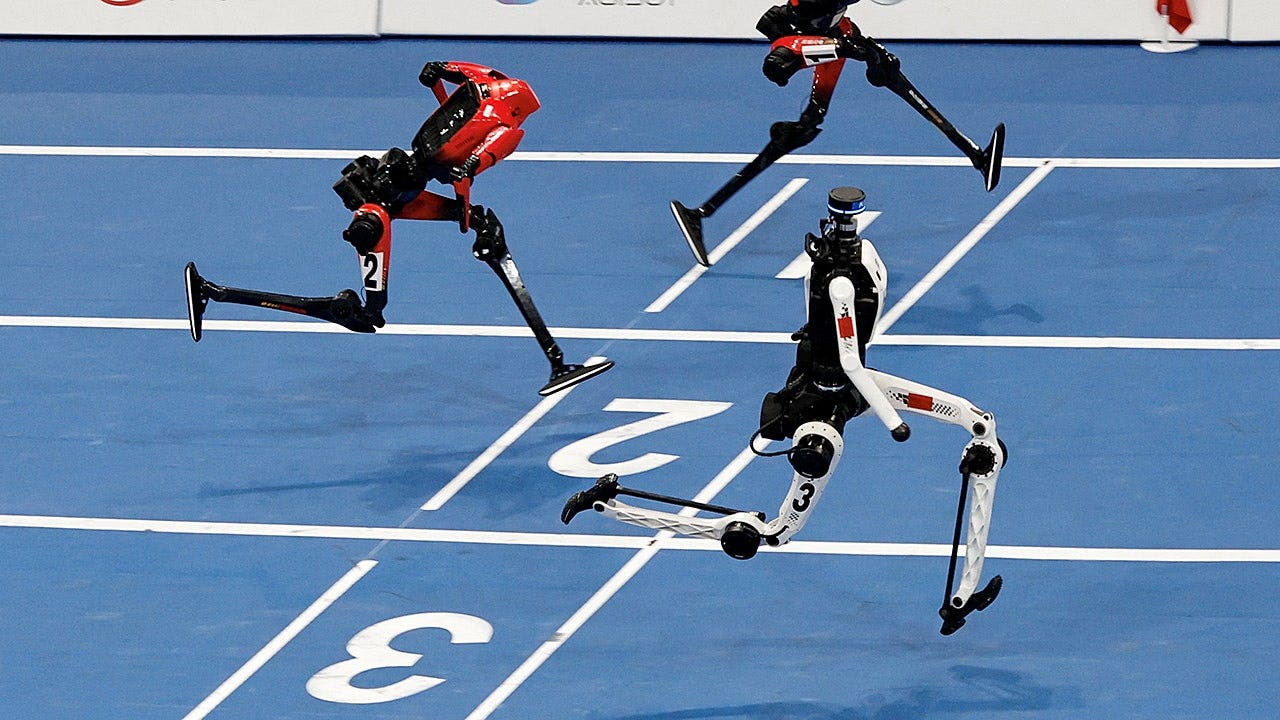
China’s latest humanoid robot milestone is turning heads for more than just speed. A machine from X-Humanoid has sprinted faster than Usain Bolt’s famed 100-meter record in a separate robot competition, and the bigger takeaway is the pace of progress behind it. The event in Beijing also showed how far humanoid systems have come in balance, coordination, and real-world movement, while raising louder questions about where this technology goes next.
If a robot still brings to mind stiff limbs and clunky steps, that picture is starting to look outdated. At the World Humanoid Robot Games in Beijing, a humanoid completed the 100-meter dash in 9.39 seconds, then X-Humanoid said TianGong Ultra later improved that time to 9.32 seconds. That is quicker than Bolt’s 9.58-second official human record, though the comparison is still apples and oranges because the robot competes under different conditions and rules.
Even with that caveat, the numbers are hard to ignore. The same event saw multiple robot teams trade fast times in a short span, which says a lot about how quickly engineers are refining motors, sensors, software, and balance systems. Just keeping a humanoid upright at that pace takes serious control, and every small gain suggests the machines are becoming more stable as they get faster.
The jump from last year makes the change feel even more dramatic. At the inaugural World Humanoid Robot Games in 2025, the winning robot 100-meter time was 21.50 seconds, more than twice as slow as this year’s top runs. That kind of leap in such a short window is the sort of thing that gets investors, engineers, and defense watchers leaning forward.
Speed was not the only attention grabber in Beijing. One humanoid reached 2.88 meters, or about 9 feet 5 inches, in a standing high jump, showing off explosive force and body control that would have looked absurd on a robot not long ago. It does not rewrite human track-and-field history, but it does reveal how quickly humanoid machines are learning to move with power instead of just wobbling through demonstrations.
The event itself was built to pressure-test those abilities. Organizers packed in a wide range of competitions, from running and soccer to boxing-style challenges and tasks that resemble physical labor. That mix matters because it forces robots to show more than one trick, and it exposes the weak spots that polished promo videos usually hide.
What makes this story bigger than a race result is the direction some developers are already talking about. Robotics engineer Yang Kun of AG BOT said humanoid robot soldiers could be only five to 10 years away, a prediction that is not a government deadline but still says plenty about where the conversation is heading. Once military use enters the picture, the stakes rise fast.
That future is not as simple as faster legs and stronger joints. A battlefield or disaster zone would demand machines that can move through broken ground, handle unpredictable obstacles, and keep making sound decisions when communication drops or sensors get confused. A robot can sprint in a straight line with a clear finish line, but real environments are messy, noisy, and full of surprises.
China is also pushing these machines toward practical work, not just spectacle. The Games included autonomous events and scenario-based tests set in factory, hotel, home, and emergency-response settings, which points to a much broader goal than sports fame. A robot that can run fast is flashy, but a robot that can function for hours without constant human help is the one that could actually change industries.
That is where the U.S.-China technology race starts to feel more physical. Artificial intelligence has already been the big story, but humanoid robotics adds arms, legs, and mobility to the competition. If a country can pair strong AI with reliable robot bodies and build them at scale, it gains a serious advantage in manufacturing, logistics, and potentially security.
Washington is clearly paying attention. The Federal Communications Commission added foreign-produced advanced robotic devices to its Covered List, including certain humanoid and mobile robotic systems, which means some of those devices generally cannot get the equipment authorization needed for import or sale in the United States without special approval. That kind of move shows robots are being treated less like gadgets and more like strategic hardware.
The body is only part of the story now. As humanoid platforms get faster and more capable, the AI inside them becomes the real pressure point, because motion without judgment only goes so far. The next leap may not be about making a robot move better, but about making it understand what it sees and decide what to do without human hand-holding.
That is what keeps this whole field so charged. The same balance systems that help a humanoid race could one day help it move through rubble after an earthquake or carry gear in a dangerous facility, but the same capabilities also raise harder questions about autonomy, responsibility, and military use. The machines are getting impressive, and the conversation around them is getting heavier right along with them.

1 Comment
Time to revise the Olympic Games and add Robotic Games to mix.