
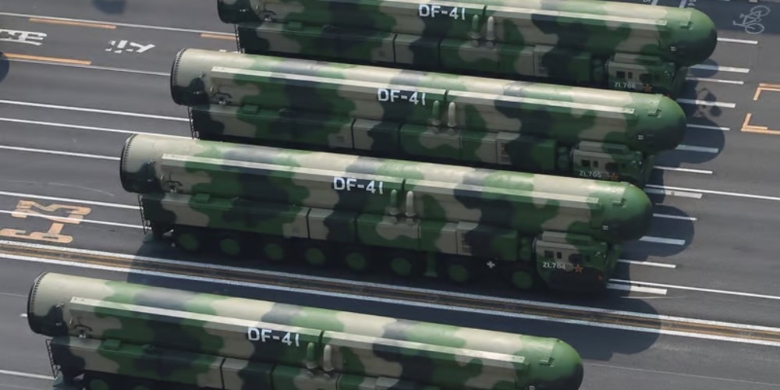
A chilling new Department of Defense (DoD) report has raised alarms over China’s unprecedented military expansion, with one expert comparing it to the rapid militarization of Nazi Germany in the 1930s. This revelation has sparked serious debate about the potential threat posed by China’s growing military capabilities and their implications for global security.
Chuck DeVore, a former Army lieutenant colonel and chief national initiatives officer at the Texas Public Policy Foundation, issued a stark warning in an article for The Federalist. DeVore likened China’s current military trajectory to Germany’s pre-World War II build-up, where unchecked growth in military strength and strategic positioning led to devastating consequences. The Pentagon’s annual report to Congress supports these concerns, detailing China’s aggressive investment in military power while much of the world’s attention has been diverted elsewhere.
China now boasts the world’s largest navy, currently comprising 370 ships and submarines. However, this is only the beginning. By 2030, China’s People’s Liberation Army Navy (PLAN) aims to increase its fleet to 435 vessels. This aggressive expansion is paired with advancements in cutting-edge military technology and strategic operational planning.
The DoD report highlights China’s focus on enhancing its global reach. The PLA is refining its power projection capabilities, creating a more mobile and modern force capable of challenging U.S. and allied interests, particularly in the Indo-Pacific region. China’s military investment goes beyond traditional warfare, with a significant emphasis on psychological operations.
A particularly troubling aspect of China’s strategy is its investment in “cognitive domain operations” (CDO), a sophisticated form of psychological warfare. These operations aim to achieve “mind dominance”—a state in which public opinion and opposition forces are manipulated or neutralized without firing a single shot.
According to the Pentagon report, the PLA employs CDO to create favorable conditions for China by influencing civilian and military decision-making. This strategy can deter adversaries, reduce resistance, and sway public perception, giving China a significant advantage in geopolitical conflicts without direct confrontation. The approach is described as an asymmetric capability that could destabilize opponents while enhancing China’s global image.
DeVore’s analysis criticizes U.S. military spending priorities, which he argues have left the nation vulnerable to the Chinese threat. Over the past two decades, the U.S. has allocated $5.4 trillion to counterterrorism efforts and nation-building, diverting attention and resources away from addressing the rise of China.
DeVore calls for a reallocation of Pentagon funding to counterbalance China’s military rise. He advocates for strengthening naval forces, nuclear deterrence, missile defense, and logistical capabilities—critical areas needed to maintain U.S. superiority in an era of great power competition. With the incoming Trump administration poised to reassess defense priorities, this pivot could prove vital.
China’s military expansion is not limited to traditional forces. The nation has also been implicated in extensive cyber operations aimed at undermining U.S. infrastructure. Recent reports reveal Chinese cyberattacks targeting U.S. telecommunications companies, highlighting another dimension of the growing threat. These activities underscore the comprehensive nature of China’s strategy to weaken adversaries and assert dominance across multiple domains.
China’s military build-up comes at a time of heightened tensions over Taiwan, territorial disputes in the South China Sea, and increasing friction with Western powers. The Pentagon’s report and DeVore’s analysis suggest that this expansion could destabilize the region and challenge the current global power structure.
The comparison to Nazi Germany serves as a sobering reminder of the dangers of unchecked military growth. While China’s intentions remain officially framed as defensive, the scale and nature of its expansion have raised legitimate concerns about potential aggression and the risk of miscalculation.
As China continues its rapid militarization, U.S. policymakers face a critical decision: how to respond effectively without escalating tensions into open conflict. DeVore and other experts argue for a balanced approach that prioritizes deterrence and readiness while maintaining open lines of communication with Beijing.
The stakes could not be higher. With China’s military expansion reaching unprecedented levels, the world is witnessing a shift in power dynamics that could define the 21st century. Whether the U.S. and its allies can adapt to this challenge remains to be seen, but the urgency for action is clear. As history has shown, ignoring such developments could lead to catastrophic consequences.
The post China’s Largest Military Expansion Since 1930s Nazi Germany Raises Global Concerns appeared first on Daily News Cycle.
